A tale of two farmers-food markets and what it means

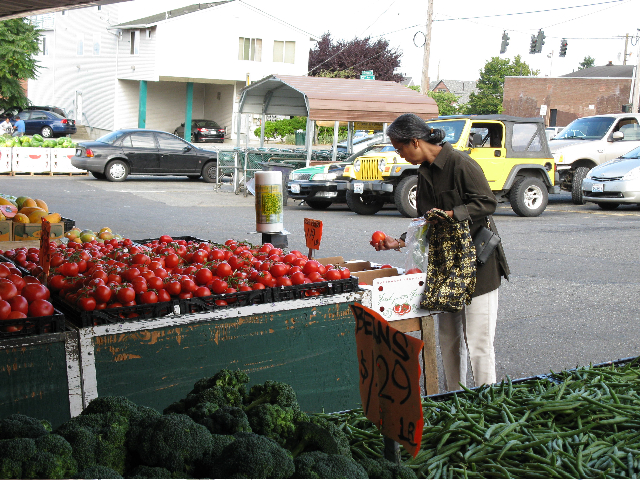
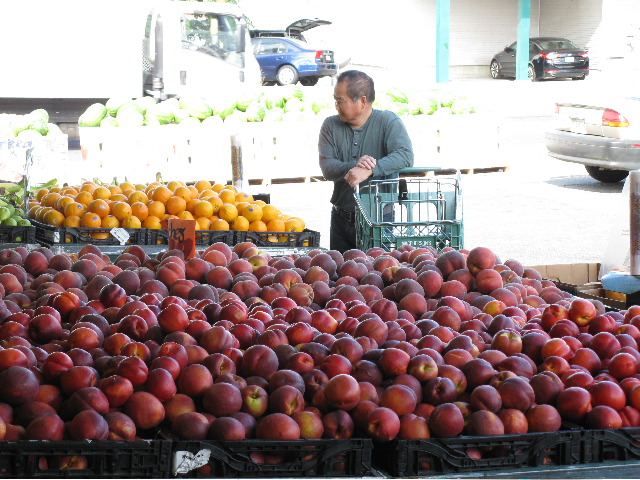
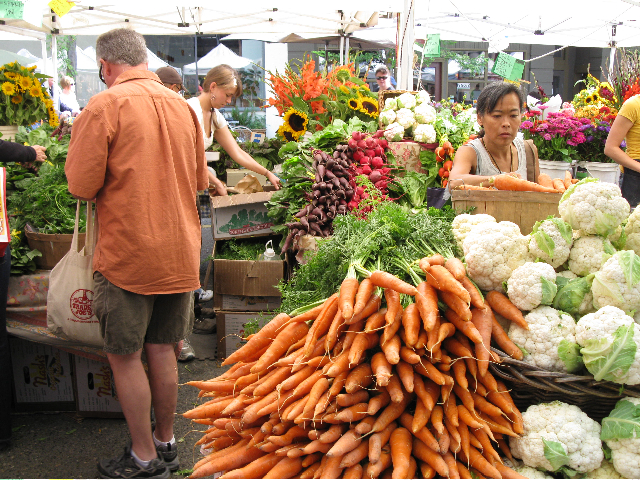
I love fresh food markets. I had a fruit, vegetable, and fish market near me growing up, the old Market in the Loop, in University City, Mo. To this day I remain a loyal supporter of local food and local businesses that sell fresh fruit and vegetables. Today, these markets are very much at the center of the national health discussion on nutrition, healthy food, obesity, and politics. So I decided to examine this issue using two examples in Seattle–one where I shop and the other where I mostly people watch and occasionally will buy some food. (Please go below for my photo essay of both venues.)

For  the last decade, the public health community increasingly has been focussing on how to increase fruit and vegetable consumption by Americans, improve Americans’ nutritional intake, and address the complex systems that are making this country the fattest on earth. Research has shown that Americans still do not consume the recommended amounts of fruits and vegetables, and government research is showing that lower-income consumers eat fewer fruits and vegetables than higher-income consumers do.

According to research by public health experts, communities that lack full-service grocery stores and neighborhood food markets have less access to fresh fruits and vegetables. Since 2009, the CDC, in its list of strategies to reduce obesity, has called for making healthier food choices available in “public service areas.” Specifically, the CDC says local governments can make healthier foods accessible through policy choices and offering vouchers that can be redeemed for healthy food choices. This is happening nationally at farmers markets, where technology to read food stamps, or EBT, cards (known today as Supplemental Nutrition Assistance Program, or SNAP), is being made available to merchants so they can serve lower-income consumers.

The Food Research Action Center (FRAC) has called for increasing participation in SNAP; improving those benefit levels so lower-income persons can afford adequate diets, including healthier foods; promoting fruit and vegetable purchases with SNAP benefits, which is taking place; and boosting the access to healthy and affordable foods in “underserved communities.” To that end, the CDC is making available more than $100 million (chump change, really, when you compare that to funding made available to corporate farms through the U.S. Farm Bill) to promote policy, systems, and environmental change through Community Transformation Grants (CTG).  This is designed to “to reduce chronic diseases such as heart disease, cancer, stroke, and diabetes” — all major health issues that are also bankrupting our health care system and treasury.

A 2010 White House report on childhood obesity notes that in the last three decades, prices for fruits and vegetables rose twice as fast as the price of carbonated drinks, and a bump in the cost of fruits and vegetables relative to less healthy foods can reduce consumers’ desire to buy fruits and veggies, leading to unhealthy Americans. Pricing is of course a key issue impacting purchasing decision of lower-income consumers, among other factors. U.S. Department of Agriculture (USDA) research found that a 10% discount in the price of fruits and vegetables would increase the amount purchased by 6-7%.

So, yes, price matters a lot, along with access. Where I live (Seattle), the Farmers Market Alliance claims “the vast majority” of the fruits, vegetables, herbs, and berries are the same price or less expensive at farmers markets, especially with organics, than at conventional grocery stores (QFC, Fred Meyer, Safeway, etc.). The organization further claims that the quality and variety of its produce exceeds the quality sold at the chain grocery stores. The farmers market movement is truly national in scope, and a network of nonprofits like the Philadelphia based Food Trust is partnering with local farmers to promote farmers markets in underserved areas.

The Atlantic in May 2011 published an article noting that farmers markets were less expensive than supermarkets and provided better food. The article challenges the criticism that farmers markets catered to mostly wealthy white snobs who drive Subarus and Prius’s, and it argues that no formal research supports “this widely accepted contention, and the few studies that have been conducted call its veracity into question.” Of course the movement to support “local food production” and farmers markets has both national and local critics, including conservative bloggers, who call it a trendy cause. Some have blasted the use of electronic EBT card readers as a wasteful expense ($1,200 to purchase, $50 to lease).

The closest market to my home, about one mile away, called the Ballard Farmers Market, most definitely is more expensive than grocery stores and independently owned produce and grocery stores where I also shop in Seattle. Its clientele, based on my many trips there, is decidedly and stereotypically upscale, white or Asian (I’d say 90% white, 5% Asian, 5% other), and professional. I haven’t conducted a poll to actually verify this, but this corner of Seattle is not that diverse, and it is close to a neighborhood where homes fetch $600,000 and where condominiums are sprouting on many major intersections. No, I can’t afford to buy anything there, with the exception of a good bargain, like beets today ($3 a bushel of three). I have bought a few apples and heads of lettuce and other veggies in the past, but not much else — not salmon, not herbs, nothing. For my part, I grow some of my own food, pick some (like berries or tree fruit that abounds in Seattle), and wish I caught salmon like I did in Alaska.

I don’t begrudge the vendors there for selling produce at a higher price point, which shuts out low-income persons like me. (I may have a few university degrees, but I am by all measures very low-income now.) As one food blogger and jam-making blogger from San Francisco notes: “People selling at the markets have priced their products according to a wide range of criteria. First, many of the farmers who sell at markets are smaller operations than those who sell to grocery stores. Maybe they have 10 acres of land compared to 60 or 100 or 200 acres and rely almost exclusively on markets for income.”

I try to support my favorite produce store in Seattle, called McPherson’s Fruit and Produce, in Seattle’s Beacon Hill neighborhood. First, their selection is usually excellent–fresh but not organic food in season. I find their produce is fresher than most grocery stores. Their vegetables and fruits are always cheaper than any grocery store I visit, including stores with hefty supply chain advantages like Costco. They cater to a full spectrum of clients, and that clientele is more low-income and more ethnically diverse than what is found in Ballard. (Beacon Hill is much more diverse ethnically.) I’m as likely to see Hispanic, African American, immigrant, and Asian-American shoppers as I am those who look like me (white). However, McPherson’s is located about seven miles by car from my home, while the Ballard Farmer’s Market is a mile away, making it impossible for me to bike to Beacon Hill, and there are some serious hill and traffic issues. So I drive there, but usually combining outings and errands with a stop. I have been shopping at McPherson’s for years, during my previous and current stays in Seattle. I do not know if their model can be replicated in other cities–unique private owners, a great location on well-travelled road, proximity to distributors, an ability to attract shoppers with and without cars.

Perhaps instead of throwing all of our support into the farmers market craze, more can be done to help smaller businesses and producers. This would require the proverbial “upstream intervention.” For instance, our government tells people to eat five servings of fruits and vegetables a day, but is not providing the supports through federal legislation to make that possible. The White House Task Force on Childhood Obesity notes that by 2020, the country needs to boost the availability of fruits and vegetables by 70%, or 450 pounds per person a year (that’s an enormous pile of food by the way). It is not doing that now because of our dated, bloated Farm Bill.

Such upstream actions, to grow the intake of healthy food consumption, in a policy sense, have the biggest bang for the buck, compared to downstream actions. Many wise and smart persons who follow food and nutrition issues have long said that the pork-laden, decades-old Farm Bill needs to be overhauled to create true change. New York Times food blogger Mark Bittman notes “agricultural subsidies have helped bring us high-fructose corn syrup, factory farming, fast food, a two-soda-a-day habit and its accompanying obesity, the near-demise of family farms, monoculture and a host of other ills.” The farm bill, up for renewal in 2012, offers an agriculture subsidy worth $30 billion, $5 billion of which is direct payments to farmers. Conservative groups like the Heritage Foundation even blast this.

Bittman suggests that a revised Farm Bill–which I believe no one involved in policy-making believes can occur in the current political climate–should support farmers who at the moment now grow unsubsidized fruits, vegetables, and beans, while giving incentives to “monoculture commodity farmers to convert some of their operations to these more desirable foods.” This is food that would make us healthier compared to factory raised meat fed on subsidized grain, which is what our current system promotes. Bittman also calls for incentives to help medium-sized farms, those big enough to supply local supermarkets but small enough to care what and how they grow, compete better with corporate agribusiness.

Personally, I would love to see both farmers markets and McPherson’s in most neighborhoods in most cities. Right now, I’m going to stick with shopping primarily at McPherson’s, despite the inconvenience. And I’ll keep growing a garden where ever I live, too.

A trip to Indian country and the Omak Stampede

So what is “Indian country”?

Drummers gather to perform at the Indian encampment at Omak’s Stampede, in August 2012.

A now-deceased doctor friend of mine who dedicated his life to serving the Native community in the Indian Health Service used the expression a lot describing where he worked in New Mexico and Alaska. It is a legal term, codified in treaty rights, federal regulations, and court decisions. Indian country can be a physical place, associated with customs and cultures of the continent’s first peoples. It is also a state of mind. You literally know you are in Indian country when you go there. There are place names and of course the people. I grew up in St. Louis, Mo., which sits on the mighty Mississippi River (Ojibwe for “great river”), and I felt connected to Indian country there because of the great muddy and the phenomenal Cahokia Mounds just east of the city in Illinois. I knew I was living on historic Indian land even as a kid.

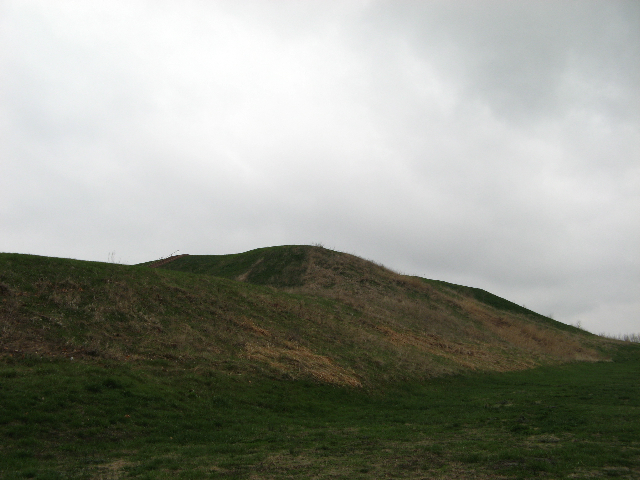
The largest Native mound in the United States is located at the historic Cahokia Mounds, just east of St. Louis.

I have lived the last 16 years of my life in what I definitely consider to be Indian Country, Alaska and Washington State. Alaska felt much more like Indian country to me. Anchorage, my home for six years, is very much a Native city in terms of population (about 16 percent). I rarely feel that connection in modern, congested, urban Seattle.  But I recently took a four-day trip to the hot, upper plateau of central Washington, from the Methow Valley to Omak, and indeed felt I had landed four-square in Indian country again.

According to a section of federal legislation pertaining to Native Americans, “Indian country” refers to three specific criteria:

-All land within the limits of any Indian reservation under the jurisdiction of the United States government, notwithstanding the issuance of any patent, and including rights-of-way running through the reservation;

-All dependent Indian communities within the borders of the United States whether within the original or subsequently acquired territory thereof, and whether within or without the limits of a State; and

-All Indian allotments, the Indian titles to which have not been extinguished, including rights-of-way running through the same.

Indian country also implies U.S. federal recognition of tribal bands as sovereign on their lands and capable of enjoying rights that are government to government. As one source notes, recognized tribes “possess absolute sovereignty [that] are completely independent of any other political power,” but also which is shared with other jurisdictions (local, state, and federal).

In Washington state, federal definitions of “Indian country” apply to state law, in addition to provisions acknowledging tribes non-taxable status in some commerce, such as the sale of tobacco products to tribal members on their reservation. In Seattle, there is still a band, the sparsely populated Duwamish, who have lost their sovereign status  and failed to win legal recognition in the city’s limits, on some of the choicest real-estate on the West Coast. Another nearby tribe, the Snoqualmie, regained their status in 1999 and promptly built a casino and became an economic and political player.

The decades-long fight over treaty-protected fishing and subsistence rights by the tribes culminated in the historic 1974 ruling in the landmark U.S. v. Washington case (the Boldt Decision) that unequivocally affirmed 19 federally-recognized tribes’ fishing rights to salmon and steelhead runs in western Washington. That decision gave the tribes rights to half of the salmon, steelhead, and shellfish harvests in the Puget Sound. It was a major game changer, and its impacts are still felt today–particularly legal squabbles if the decision should still be applied to land-use decisions impacting salmon habitat.

Yet, even as I gaze out on the beautiful Puget Sound, I am hard-pressed to think that I am on historic Indian lands, that I live in Indian country, where there are 29 federally-recognized tribes, in all corners of the state (see tribes and locations here).  But this is very much Indian country in a historic and cultural sense.

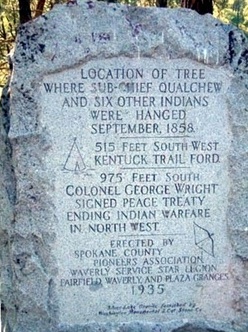
In fact, more than half of the state was outright taken by military force, illegal land seizures, and treaties (which also provided fishing and resource rights to tribal members) from the 1850s to the 1890s. Many stories of the exploitation of Native tribes come to mind, notably the hanging of Yakima warrrior Qualchan (also called Qualchew) by the reportedly violent Col. George Wright, in his campaign that defeated five tribes in Washington in the eastern half of what is now is the state. 

On Sept. 25, 1858, Qualchan had surrendered with a white flag and was hung within 15 minutes. That was followed with the hanging of six Palouse warriors the next day. Such incidents typified the period of conquest in my home state. Exploitation of tribal rights followed the signing of treaties. The Colville Tribes, for instance, had their lands stolen without their consent, setting off decades of legal battles that continued to the 1930s and ended in historic settlements returning hundreds of thousands of stolen acres of land.  Salmon and steelhead runs in the state were decimated by commercial fishing interests that harmed tribal groups in the upper and lower Columbia River basin. The runs were further extinguished by the dams built on the Columbia River. Only with the Boldt Decision in 1974 did the tide turn, but with numbers that no where near compared to the great runs of 100 years earlier.

Again, all of this is very academic and abstract to me and most Western Washington residents. Only when I traveled to the “World Famous Omak Stampede” rodeo and suicide race, with Native riders who charge down a 200 foot hill on horseback every second weekend of August, did I again realize I was truly in Indian country. Omak, in north central Washington, lies partially in the 1.4 million-acre Colville Reservation, in sparsely populated Okanogan and Ferry counties. The Confederated Tribes of the Colville Reservation number less than 10,000. I found the area to be amazingly beautiful. It’s hot in the summer, and bitterly cold in the winter. During my visit to Omak for the Stampede, the mercury hit 100 F.

Outside of agriculture (on non-tribal lands), there is little industry in this part of the state, but there is gold mining, forestry, and a limited personal use salmon fishery for tribal members.  Forestry is the mainstay for generating tribal revenues. Gaming is also a big moneymaker at the tribes’ three casinos. If you can believe it, the casinos are attracting acts like blues legend Buddy Guy and rock has-beens like Foreigner and Joe Walsh in the next few weeks. I think it’s a bit sad that even stalwart Canadians are driving south from British Columbia to spend their loonies at the tribal gaming tables, but come they do.

Despite the flow of revenues, health issues remain a problem, as they do throughout Indian country. A June 9, 2012, story republished in the New York Daily News about Tribal Councilman Andy Joseph, Jr., profiles his efforts to address Native health funding issues. The story notes his tribal members and others nationally “are dying of cancer, diabetes, suicide and alcoholism. They are dying of many diseases at higher rates than the rest of the population. And instead of those rates getting better, they’re getting worse.” Joseph is the tribes’ representative to the Northwest Portland Area Health Board, which serves 41 tribes in Washington, Oregon, and Idaho, and is that group’s delegate to the National Indian Health Board, which speaks for all 566 federally-recognized tribes in the country. The story notes that, nationally, tribal members die an average of five years earlier than the rest of the U.S. population and are six times more likely to die of tuberculosis or alcoholism, three times more likely to die of diabetes, and also twice as likely to be killed in an accident. What’s more, they are also twice as likely to die from homicide or suicide. Pretty grim data indeed.

According to Joseph, the major health issues associated with diet and nutrition have occurred as a result of conquest and cultural assimilation: “‘Joseph holds up a jar of canned salmon sitting on his desk. ‘Our people crave this,’ he said. ‘It was taken away from us when they put Grand Coulee Dam in.’ He reaches for a string of dried camas root. ‘It’s what our bodies were raised with for thousands of years. Now, we have Safeway and Albertsons and Walmart.'”

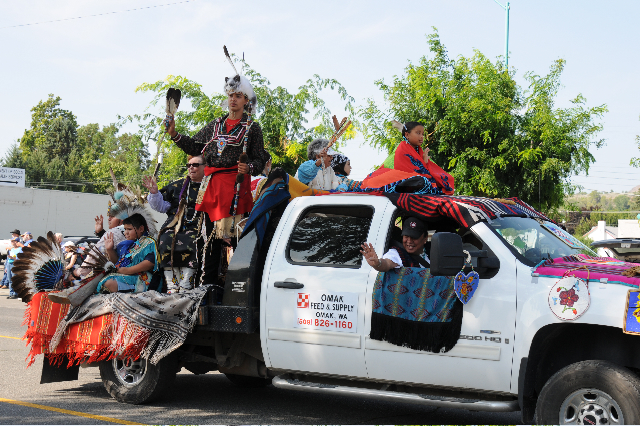
In Omak, I got a taste of Native pride during the Omak Stampede Parade, which mainly featured local businesses, rodeo princesses, groups like firefighters, Republican office holders or candidates, and less than half a dozen Indian floats. (I saw no Latino groups in the parade, despite their large presence picking fruit and in agriculture–they “officially” number about 15 percent of Omak’s residents.)

A Native float at the Omak Stampede parade.
Some of the many teepees at the Native encampment at the Stampede.

The Stampede features a tribal encampment with teepees and a performance area where tribal members perform traditional dances and song in gorgeous costumes.  It reminded me a lot of Alaska, particularly the many gatherings I saw there, including the largest conference called the Alaska Federation of Natives Annual Convention. Yup, I was definitely in Indian country.

My only real, true regret was that I missed the Suicide Race, which features some of the state’s finest Native horseman who charge down the steep hill and swim across the Okanogan River on their way to the finish inside the Omak Stampede stadium. You can watch it on YouTube, and note some times, yes, horses have died in this race.

A taste of the Philippines in Seattle during Seafair

Seattle’s annual Seafair, which culminates in noisy and popular Blue Angels fly overs and hydroplane races on Lake Washington the first week and weekend of August, is a month-long potpourri of community events, health fairs, ethnic festivals, parades big and small, and very slick corporate and U.S. military glad-handling. Just about any community event within 50 miles is somehow branded under Seafair’s giant umbrella. Overall, most Seattle area residents love it, particularly the Navy jets that break the sound barrier over the city, shutting down traffic on our floating bridges for several hours at a time over several days.

Seafair also features micro celebrations of the city’s diversity and neighborhoods. This has been the norm ever since I first moved to Seattle in 1987 (I have now lived here on four separate occasions). This is the part of Seafair I enjoy the most.  And I really like the diversity that is showcased, including by the Filipino community (see photos below).

Though Seattle is 70 percent white, the all-inclusive and equally non-descriptive “Asian American” racial category represents 14 percent of the city’s population (and that diversity is even greater in south King County). Filipinos fit into that mix, and they number well over 30,000 of the city’s residents.

Filipino immigrants have been arriving in Seattle in successive waves since the 1880s, and have a strong presence in the community, thought not entirely represented proportionally in political offices. However, I once worked with the first Filipino-American lawmaker elected to the Washington State Legislature, former Representative Velma Veloria, when I was employed by the House Democratic Caucus in Olympia, for two legislative sessions more than a dozen year ago.

The Filipino celebration that takes place during Seafair is called Pista Sa Nayon, and it was held the last weekend of July in Seattle’s Seward Park. I caught the Filipino Youth Activity Drill Team during a rehearsal on the shores of Lake Washington. They were one of many performing groups that entertained residents on July 29, 2012. I have seen this group many times before – and they are always entertaining and beautiful to watch in their colorful Filipino costumes. (I am a huge fan of the Philippines, having travelled there in 2003, and I hope to get back there one day soon.) So here are a few shots taken with my new digital Nikon camera that I converted to black and white. I really enjoyed watching these ladies practice. If you are in Seattle, be sure to visit their Facebook page and see them around town.

The Olympics: a grand tale of hope, scandals, Nazi propaganda, and corporatization

The massive corporate, sport, and media spectacle that is the Olympics is underway. The Games’ charter, in idealistic language, calls for “respect for universal fundamental ethical principles.” Who doesn’t want that.

Crowds cheer the start of the London Summer Olympics.

I’m a fan of the spirit of international cooperation and competition that are the “ideals” of the Games, but not the dark underbelly that is associated with them and has always been associated with them.

First, the positives. They bring out our best. They can lift you up. I simply loved watching Usain Bolt grab gold in the 100m and 200m sprints in Beijing in 2008, and also the fact that he became an instant positive icon to hundreds of millions of people around the world. (Since then he has become a self-styled global brand.) Or better, I continually marvel at the crop of Kenya’s world-class middle- and long-distance runners, such as Samuel Kamau Wanjiru, who won the marathon in Beijing with style with a blistering 2:06:32 time and then tragically died in mysterious circumstances in 2011.  Kenyans grabbed 14 medals in all in 2008, compared to Jamaica’s 11 – both amazing outcomes for countries that are relatively poor by all measures, and thus less capable of funding national sports programs. To me, these are the Games’ positives.

Kenya’s phenomenal male and female runners, who shine in the Games every four years, especially stand out for me, because most of them are running to escape poverty and build a better life for themselves and their families. A profile of them on the NPR pegged the success of the Kenyan athletes to their training regime at high altitudes in the Rift Valley, discipline, and also the country’s limited economic opportunities, with many of the best runners hoping to win big-money marathons like Chicago’s or Berlin’s.

Of course the dark side of the Olympics is the corporate control of every facet of the Games. As The Nation notes, the Olympics, under the leadership of Juan Antonio Samaranch, a certifiable Spanish fascist, “was transformed from Cold War spectacle into a neoliberal Trojan Horse: an invading corporate sledgehammer of privatization and payoffs.”  The Games have a recent history of corruption (at both the Sydney and Salt Lake City Games). According to the Daily Mail, taxpayers are subsidizing what many critics of the Games say is a giant corporate schmooze event. Taxpayers are underwriting the games by an 8-1 margin compared to private investors. A year before the games began, the Daily Mail noted that “corporate fat cats” got more than half of top games tickets for showpiece events, which are handed out to corporate sponsors, Olympic bigwigs, and their various VIP guests. Only 32,000 out of 80,000 seats in the Olympic stadium – about four in ten – were available to the public for the marquis events.

Transparency International has pointed out the multiple ways corrupt practices taint the Games, through ticket allocations, corporate hospitality, media contracts, match fixing (not proven), construction allocation, old-fashioned cronyism from corrupt states who bring large entourages, and corporate sponsorship itself.  According to Transparency International’s Robert Barrington, “of the 53 official corporate sponsors in London … several have also been subject to investigation under the U.S. Foreign Corrupt Practices Act (FCPA) or equivalent laws.”

The Olympics in my lifetime have always been mired in problems and issues of the day, and they have reflected conflicts boiling on the international stage and larger cultural and racial currents. Memorable controversies in my lifetime have been the massacre of hundreds of civilians by Mexican government forces just prior to the start of the Mexico City Games in 1968, the brutal killing of 11 Israeli athletes at the 1972 Munich Games by Palestinian gunmen who also were killed in a botched rescue,  the boycott by 62 nations of the 1980 Moscow games following the USSR’s invasion of Afghanistan and retaliatory boycott by 14 nations in response of the 1984 Los Angeles Games, and the terrorist bombing that killed two persons at the 1996 Atlanta Games by a right wing U.S. extremist, murderer, and abortion clinic bomber Eric Robert Rudolph. There are other scandals I could mention, but will not.

Sculptor Karl Abiker’s “Discus Throwers,” Nazi statues embodying the Third Reich’s racial ideology that was showcased at the 1936 summer Olympics, stand guard outside Berlin’s Olympic Stadium.

Perhaps the most abysmal moments in Olympics history were the summer and winter Olympics games in Nazi Germany in 1936. While many claim Nazi ideology of racial superiority was destroyed by Jesse Owens’ four gold medals on the track, the Games largely were a massively successful propaganda operation, according to the U.S. Holocaust Memorial Museum, by the Nazi state as it was marching toward implementing policies that later resulted in genocide against Jews and Gypsies and a war that claimed tens of millions of lives. It is worth watching the documentary of those games by Nazi propagandist Leni Riefenstahl. The opening ceremonies show national squads like France’s marching into Berlin’s Olympic Stadium with their arms raised with a “sieg heil” salute to future mass murderer and then-dictator Adolf Hitler (go to 4:47 of the clip on this video — it is truly chilling).

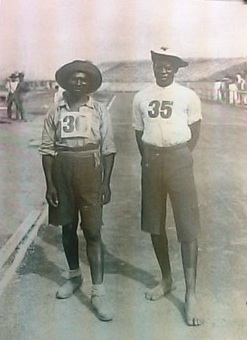
South African Tsuana tribesmen Len Tau (left) and Jan Mashiani (right) both ran the 1904 marathon barefooted.

In the city near where I grew up, St. Louis, the Olympics were hosted in conjunction with and likely in the same spirit as the World’s Fair in 1904 (I wrote my undergraduate thesis on the fair, and know it well). This was a time of imperial expansion, the prevalence of racial eugenics in scientific and political thinking, and entrenched racism and segregation in the United States. The fair was the single largest gathering  of human beings from other cultures ever put on display like a zoo. More than 5,000 persons from different cultures and countries were displayed, the largest group being Filipinos, whose country was taken over by the United States a few years earlier during the Spanish American War. Some of those humans on display, two tribesmen from South Africa, who were part of the “Boer Exhibit,” actually competed in the Olympics marathon and did surprisingly well, placing in ninth and 12th place. They were also the first Africans to compete in the notoriously racially segregated Games at the time.

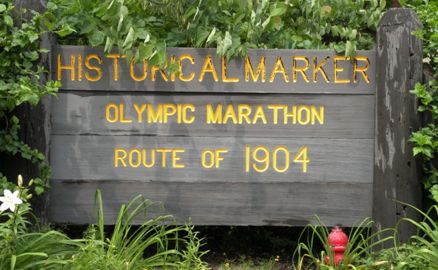
The 1904 Olympics marathon is notable for many reasons, including a famous scandal and my odd connection to it. I used to live in University City, Mo. (next to St. Louis), and run on a road that was part of the marathon route and see an official marathon mile marker every time I ran, about three times a week. It connected me to the Games in a personal way. That marathon had 32 racers; only 18 finished. The race began at 3 p.m., in 90 fahrenheit (in Midwest humidity!). The winner, Thomas Hicks, doped and nearly died (on strychnine). A false winner , John Lorz, cheated by being driven most of the race. Still another runner nearly died inhaling road dust kicked up by automobiles on dirt roads that were used for the race.

Mile Marker along the route of the 1904 Olympics marathon, a route I partially ran three times a week while in high school — my personal connection to the Games.

While the scandals and problems that were there nearly at the beginning of the Games remain to this day, I still would like to think of the Games as something to inspire. In many ways, I credit that Olympics’ mile marker sign for motivating many of my early morning runs in the dark in high school. I have not stopped running since.

Looking back at a North Carolina landfill, and who got dumped on

I have finally compiled my graduate thesis on environmental racism into a more easy to read PDF format. This document dates from July 1993, when I completed my MA in journalism at the University of North Carolina at Chapel Hill School of Journalism and Mass Communication. For my research project, I examined how a then-small, historically African American and poor community, Holly Springs, was chosen to become the site of Wake County’s new mega municipal landfill. Holly Springs, N.C., already had multiple open and closed landfills, and the rest of the county had not equitably assumed the same burden for waste generated in the most populous county in North Carolina, which is also home to the state capital, Raleigh.

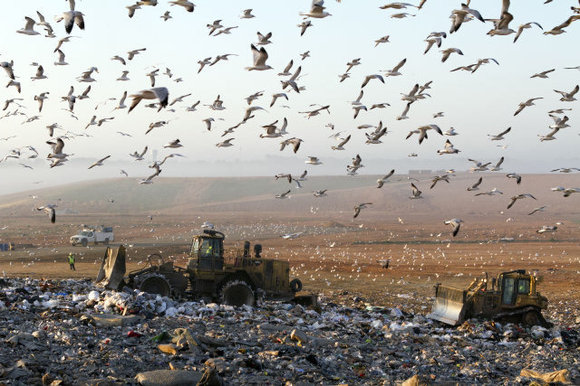
The Raleigh News & Observer published this photo of the South Wake County landfill, in Holly Springs, in March 2012, found here: http://www.newsobserver.com/2012/03/15/1931937/wake-county-plans-future-development.html.

My efforts to publish an investigative series for a regional alternative weekly serving Chapel Hill and Durham, N.C., were nixed by a number of forces, including pressure from senior Wake County officials who communicated with the weekly I had approached and successfully led that paper to disassociate itself from me and this project before it was published. (That is my version of events.) However, I did publish the thesis online in 1998. The articles were found by residents of Holly Springs in 1998, who contacted me, and my research became part of a major legal dispute that went to the North Carolina Supreme Court and federal courts, where litigants eventually lost and then finally settled with the county for remediation work to lessen the impact. Many of the legal issues raised in the case were cited first in my thesis. After years of legal wrangling, the Wake County Commissioners finally voted to approve a major municipal landfill in 2006.

I am proud of this work. It is factually sound, rigorously investigated, fair to all parties, and written in the spirit of good enterprise journalism on behalf of persons who had the least power and resources to advocate for themselves against much more powerful and organized interests (in this case Wake County’s government).

Here is the abstract to my original 1993 thesis titled: Environmental Racism in Our Own Backyard: Solid Waste Disposal in Holly Springs, N.C.

For more than two decades, the historically black and poor township of Holly Springs in Wake County, N.C., has been targeted for landfills.  The pattern continues with Wake County’s proposed 471-acre landfill, scheduled to open in Holly Springs by 1998.  Each facility was sited adjacent to existing black communities, whose residents never participated in the siting process.  The first story of this thesis’ three-article series examines the inequitable pattern for distributing these dumps countywide and how their placement fits a national pattern.  The second article and Appendix A discuss the new “environmental justice” movement, whose grassroots and minority activists are protesting unwanted pollution and alleged environmental discrimination.  The movement’s members have coined the term “environmental racism” to describe the unfair apportionment of environmentally noxious facilities.  Article three discusses whether municipal solid waste landfills can cause ground water contamination.  Federally mandated landfill technology to be installed at the planned landfill may not provide pollution protection for ground water, used by Holly Springs for its municipal water source.

(Find a map of the then-planned South Wake Landfill here.)