Can innovation thrive in the culture of U.S. public health systems

Amazon, despite its critics, has been an innovator in the private sector.

The business press and the communications teams in the private sector work hard to show that innovation mingles in the air like oxygen  at successful businesses. The theory goes, innovation breeds success, which creates profits, which spurs new products and services and wealth, which of course is good for the economy and thus all of us.

Forbes, for instance, showcases business innovators, like Starbucks and Amazon, by highlighting metrics that the magazine considers to be markers of innovation. According to the Forbes’ Sept. 2, 2013, piece on innovation, Amazon’s CEO Jeff Bezos says he looks for traits in innovators in his company and allows for innovation to occur three ways:

  • Rewarding innovators who are relentless in their on their vision but flexible on the details of how to get there.
  • Fostering a decentralized work culture for new products or services, so that the majority of employees feel like it is expected of them (Amazon’s now famous “two-pizza teams”). 
  • Third, teaching teams how to experiment their way to innovations.

But once we start talking about government, talk of innovation gets tossed out the door. In fact, the prevailing wisdom among many in the private sector, and likely in the public sector too, is that government is the ultimate death machine to innovation.

Not only does innovation die still-borne in public agencies, government regulations themselves kill innovation in the private sector, many writers and politicians claim ad infinitum.

Do any public agencies have capacity to innovate?

Government still funds innovation and research and development, particularly in defense and health care. But as a culture, government is not the incubator, goes prevailing wisdom. One global survey completed this year puts trust in government around the world below 50%, behind trust in business at about 58%, for its ability to demonstrate change and new leadership.

Public health, as a public endeavor in the United States, is by definition a public undertaking. Thus it remains government-funded, government-run, and thus, be default, the inheritor of government’s best and worst traits.

As someone who has now worked at the international, state, and local levels of government, including in public health, I can attest to government bureaucracies’ failure in many instances to embrace change, inability to stimulate ideas, and poor track record in adopting new ideas to improve how government does business.

One recent research paper by British researchers Geoff Mulgan and David Albury on the lack of innovation in the public sector noted: “Most service managers and professionals spend the overwhelming proportion of their time dealing with the day-to-day pressures of delivering services, running their organisations [sic] and reporting to senior managers, political leaders, agencies and inspectorates [sic]. They have very little space to think about doing things differently or delivering services in ways which would alleviate the pressures and burdens.” In short, government culture lacks innovation.

The pair argue that innovation should be a core activity of the public sector. They claim this helps public services improve performance and public value, respond better to the public’s needs, boost efficiency, and cut costs.

Geoff Mulgan and David Albury 's diagram how public bodies do no innovate.
Geoff Mulgan and David Albury ‘s diagram how public bodies do not innovate.

What are people saying about innovation in public health and health care

In Europe, in 2010, the Association of Schools for Public Health in the European Region’s Task Force on Innovation/Good Practice in Public Health Teaching developed a plan that called for seven action items, two of which focused on innovation:

  • Developing more coherence between policies in the fields of education, research and innovation.
  • Measures to develop an innovation culture in universities.

Back on this side of the pond, the Harvard Business School held a conference on innovation in the massive health care sector in October 2012, and then published a study in February 2013 on how innovation was seen as critical to health care and health education, which includes public health.

The report found that 59 of the CEOs of the world’s largest and most innovative health-sector organizations most frequently used the word “innovation.” According to the discussion of the attendees, innovation in its broadest sense was even seen as the “only way that change will happen and that creative solutions will be found for our current problems in health care.”
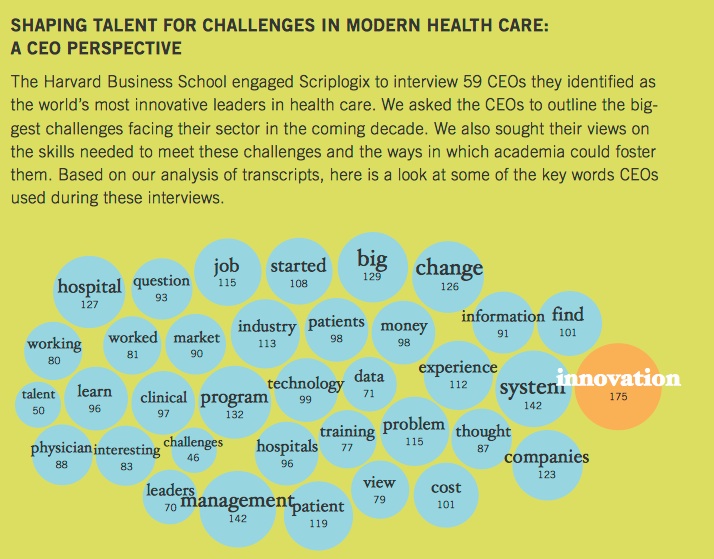
The most important characteristic for a company according to leading health care CEOs is innovation.

Recent evidence shows that innovation can lead to better outcomes. A 2013 study  published in the Journal of Multidisciplinary Healthcare, on technological innovation and its effect on public health in the United States, found a correlation regionally in parts of the country where it was perceived that technological innovation was occurring. The study reported that “relationships between the technological innovation indicators and public health indicators were quantified,” and it was found “that technological innovation and public health share a fairly strong relationship.”

Will innovation remain a dirty word in public health departments at all levels of government?

But does anyone working in a local health jurisdiction, hard-strapped for cash in the post-Great Recession era of downsizing, see innovation taking place in their work environments? As hierarchical bodies, modeled originally after the military since their original inception in the United States, public health bodies are seldom discussed in organizational behavior literature as “innovative.” They are organized hierarchically and often divided by departments with no interchange, and their managers may be unable to allow for information sharing and promote collaboration seen in many for-profit firms.

Yes public health jurisdictions, to win much-coveted accreditation by the national Public Health Accreditation Board, must prove they are committed to quality improvement and a competent workforce. But this by no means is the same as encouraging a culture of innovation to adapt to tremendous change, particularly financial downturns and the challenges posed by chronic disease and the increasing wealth disparity among the top wage earners and the majority at the bottom, which is leading to great health disparities.

One local health jurisdiction that is trying to innovate, the Spokane Regional Health District, developed a strategic plan that calls out as its top two strategic priorities: increasing awareness about the role of public health and securing more stable funding. I think these are spot on and demonstrate how this agency has moved its focus upstream and is adapting itself to succeed in that bruising political arena.
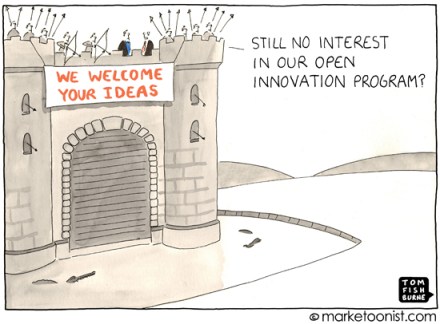
innovation not
More of Tom Fishburne’s artwork can be found on the web site: http://tomfishburne.com/.

But my own sense of public health jurisdictions, small and large in the Pacific Northwest at least, is that other jurisdictions may not wish to emulate Spokane because of agency rivalries and personal jealousies among upper management. I would love for one day to learn that some of the traits of private sector organizational behavior practices, such as rewarding innovators, promoting a culture of innovation, and teaching workers how to innovate take root. Right now, I’m not seeing that within the sector, and the talk is not matching the walk.

How the 10 essential public health services handicap a weakened profession

Public health, as a profession and system to improve population health, continues to fall short in the United States.

Since the start of the Great Recession, nearly a quarter of all employees working for local health jurisdictions have been downsized or laid off because of funding cuts to already meager budgets. The National Association of County and City Health Officials pegs the attrition at nearly 44,000 workers–a fact reported on this blog before.

Proportional changes in inflation adjusted spending for public health (CDC) versus health care spending in the United States.

Today, most Americans have little idea what public health does, why it matters, and why its funding is critical to improving health outcomes at the population level. For that matter, half of all Americans cannot even identify what the core elements of health insurance plans are. 

From its start as a profession in the United States in the early 1900s, public health was deemed to have a political-activist function. In fact, noted public health pioneer C.E.A. Winslow, Yale’s first chair of public health, promoted universal medical care in the 1920s as a principle of sound public health policy, backed later by other public health practitioners in the next two decades who unsuccessfully called for a form of universal health care.

Winslow’s often-quoted definition of public health called for the “development of the social machinery which will insure to every individual in the community a standard of living adequate for the maintenance of health.” Such efforts were overt and unashamed calls for political action and advocacy, the likes of which are mostly not heard today from the profession.

10 essential public health services: a recipe for political impotence?

Since 1994, the U.S. Centers of Disease Control has pushed the “10 essential public health services” model as the gold standard for defining public health’s realm of practice. As far back as 1999, the CDC claimed, “The overall goal for public health’s infrastructure is to have every health department fully prepared with capacity to fulfill the Ten Essential Public Health Services and every community better protected by an efficacious public health system.”

The 10 essential public health services is the U.S. model, not a global model, for defining the profession.
The 10 essential public health services is the U.S. model, not a global model, for defining the public health profession’s realm of practice.

This model has rippled outward to every public health agency, every school of public health, and all professionals in the field as the benchmark to measure quality and effectiveness. Logic models have been developed to see how well health departments were doing according to this standard.  Anyone who works in the field is told that these services define who we are and what we do.

All the while, public health budgets have been slashed nationally, and at the state and local level, workers have fled or were pushed out of the profession. Still the field of public health continues to push its competent but still toothless model for what is considered a best practice—the 10 essential services.

While evidence-based and certainly valid, this 10-step model is also a self-defeating set of quasi-religious commandments that fails to address the harsh political realities related to developing legislation and orchestrating fights over budget appropriations. It also fails to call for advocacy and political activity, which can and have pushed public health efforts far greater than these prescribed activities.

Politics, money, and real power

For-profit entities working in the health sector thrive because advocacy and political engagement are fundamental to their business models and bottom lines, unlike the model of inefficacy promoted for the public health profession.

For instance, pharmaceutical powerhouse Pfizer unabashedly states, “We believe that public policy engagement is an important and appropriate role for companies in open societies, when conducted in a legal and transparent manner. … The Pfizer Political Action Committee makes contributions to candidates for federal office, and fully discloses its contributions on a regular basis to the Federal Election Commission.”

Pfizer, multinational pharmaceutical firm, published its political spending activities in the United States for the first half of 2013.
Pfizer, the multinational pharmaceutical firm, published its political spending activities in the United States for the first half of 2013.

While for-profit health interests march forward, with ever more dollars and clout, public health continues to retreat. The President’s budget request in 2014 for the CDC, the agency charged with protecting America’s health, is a measly $6.6 billion (for its program level expenditures)—a drop of $270 million over 2012.

This dip likely reflects pushback by GOP lawmakers in the current Congress, who view CDC’s public health activities as synonymous with overt advocacy. Language in funding measures, in the current session of Congress, has attempted to limit federal dollars for grassroots efforts by public health practitioners to lobby on behalf of specific legislation, particularly on efforts to address chronic disease and obesity.

Generally, public health advocacy is not lobbying, which is prohibited when it involves federal or earmarked funds. Exceptions include study or research and discussions of broad social problems.

So it is not surprising that government-funded public health bodies have been generally shy, and in the case of firearms legislation, nearly totally muzzled, from discussing firearms deaths since congressional language banned funding of firearms research starting in 1996. (In my opinion there has been a failure of leadership in public health when such leadership was needed on the issue of firearms violence, which is a legitimate public health concern.)

But should bans on using public funds for lobbying mute the profession from pushing for advocacy approaches and political engagement?

Daniel Callahan and Bruce Jennings’ 2002 article in the American Journal of Public Health examined the ethics of public health advocacy. They noted, “Politics is a necessary component of public health, moreover, precisely in order to achieve public health policies and practices consistent with American traditions and values. Politics is the messy arena in which ultimate questions of the public good are worked out.”

Public health’s failures in the political mosh pit

A perfect example of what happens when public health was not fighting tooth and nail was President Obama’s Affordable Care Act of 2009, which ultimately squashed efforts for a single payer system—the long-held dream of public health advocates from the 20th century—and advanced a health insurance industry, market-based model for “health care” reform.

All told, advocacy groups in 2009 spent $3.47 billion for D.C.-based lobbyists to parse out issues, according to left-leaning Center for Responsive Politics. Not surprisingly, the lion’s share of that spending went to fight the health reform battle. Businesses and organizations that lobbied on “health reform” spent more than $1.2 billion on their overall advocacy efforts.

APHA lobbying 2013
Source: The Center for Responsive Politics

For its part, the American Public Health Association (APHA) spent less than $500,000 annually on lobbying at last count in 2013. (See spending chart for lobbying expenditures by APHA from 1998 to 2013.)

The good news is that this marked a jump of more than 300 percent from what APHA spent in 2012. It would appear that some in the field are waking up to the realities of fighting for public health where the most meaningful impacts can be achieved – through policy and legislation.

By comparison, just one big pharma company, Pfizer, spent more than $800,000 in the first six months of 2013, from local to congressional candidates and political parties nationwide (see chart above).

What is most discouraging is that future leaders entering the profession continue to be shortchanged by graduate programs that do not know how to prepare practitioners to win in the bruising political environment known as “upstream.” This is my general assessment of not just my graduate MPH program, but of the field that I still see through its obsessive and yet parochial obsession with the 10 essential public health services.

The CDC's 10 essential public health services.
The CDC’s 10 essential public health services.

A very smart resource guide developed by the California Endowment sharply noted: “… many public health faculty do not possess the skills or experience to teach advocacy effectively. Faculty surveys show, for example, that despite advocacy for health being recognized as an ethical responsibility and required competency of health educators, many health education faculty do not see themselves as competent for teaching advocacy and lack instructional materials to do so. Degree-granting programs in public health need to provide systematic training in social advocacy. In the absence of formal training in social change, public health graduates must learn this information and develop these skills on a catch-as-catch-can basis. Working in this way means that some will be less effective than they otherwise could be in advancing the health of the public.”

More than 20,000 views and still counting after 20 months

Thanks to everyone who has taken time to visit my blog focussing, mostly, on public health and health. I continue examining issues with the additional perspectives of history, culture, personal experience, and enterprise journalism. This month I crossed the 20,000-views threshold. See the screen snapshot below, taken today.

Wordpress's outstanding analytics tools provide a snapshot how many visitors and views have been recorded, in November, and since I launched this blog in late March 2012.
WordPress’s outstanding analytics tools provide a snapshot how many visitors and views have been recorded, in November 2013, and since I launched this blog in late March 2012.

WordPress’s analytics also report the following categories and tags attracted the most eyeballs:

Tags & Commentaries:
Most popular topics you’ve written about

Topic & Views

  • Public Health 81
  • Health 77
  • Travel 57
  • Obesity, Sweden, Sweden, most beautiful women, Sweden has the world’s most beautiful women, infant mortality, life expectancy, Norway, Nordic Countries, public health systems, national public health investments, beauty stereotypes, national stereotypes, national obesity rankings, fat countries, obesity health threats 51
  • Photography 18
  • Native American 12
  • Africa 11
  • Human Rights 10
  • History 10

The most popular post on my blog looks at why Swedes have a reputation for being attractive, and whether that is related to the country’s strong public health system and universal health care. No doubt a fair number of visitors came looking for pictures of blonde Swedes in bikinis, but hopefully came away with some knowledge of how investing in health upstream can pay dividends that are linked to, yes, physical appearance and overall health.

The data are great validation for the idea that first launched this enterprise. It began during a spirited discussion at the University of Washington School of Public Health about the value and validity of training future public health leaders to specialize in publishing in peer-reviewed journals as opposed to open-source communications like WordPress-enabled blogs or social media or non-scientific publications. This is a topic that is being debated by many seeking to improve public health’s relevance for the year 2013 and beyond.

Having public relevancy in the face of funding cuts remains a critical issue in the field of public health, which has seen its workforce at the local level shrink by 44,000 jobs, or nearly a quarter of all workers, since the start of the Great Recession. Budgets in local health jurisdictions have been slashed to the bone according to a national survey of those organizations by the National Association of County & City Health Officials (NACCHO).

In fact, I would recommend to anyone contemplating a career in public health, outside of epidemiology or biostatistics, to consider advanced degrees in law, business, or applied health like nursing rather than this field, based on the national employment data. Or future public health leaders can learn through other means how to integrate new tools of communications to engage the public with research, to build support for funding health.

In fact, those who now manage the nation’s graduate public health programs need to use the tools of program evaluation, which they teach in the nation’s finest universities, and engage in a serious discussion if their education model is still working and achieving longer-term goals and ultimately leading to a better public health system and healthier country.

How many MPH graduates in 2013 found jobs within six months? Is that number acceptable? Why train a workforce for many jobs that may not be in high demand or nonexistent, with skills that are not reaching a wide audience, thus preventing the public from knowing what public health is and why it matters?

This will remain a fundamental issue at the heart of the crisis facing the field today and for years to come. Meanwhile, I think there will continue to be a bottoms-up response to how the profession adapts to change in the new era of diminished resources. I hope that this blog will continue to be involved in that larger discussion, and the numbers show that at least some online readers are hungry for information in easier-to-access ways.

Roger Gollub, a model for leadership in public health

Dr. Roger Gollub and his beloved golden retriever, Sophie, at the famous Balto  statue in downtown Anchorage.
Dr. Roger Gollub and his beloved golden retriever, Sophie, at the famous Balto statue in downtown Anchorage.

Five years ago today, on a cold Alaska night, I was awoken by a strange phone call left on my answering machine saying something had happened to my Anchorage friend, Dr. Roger Gollub. Confused, I called the emergency room at the Maniilaq Health Center in Kotzebue, a remote bush city in the Northwest Arctic Borough, 26 miles north of the Arctic Circle on the Chukchi Sea. Roger had flown there a day earlier on assignment—I was with him the night before. I could not believe what I heard. The medical personnel told me, with great difficulty, that one of county’s finest pediatricians and public health caregivers had died from injuries sustained on a trail just outside of town that night.

Dr. Roger Gollub, a career pediatrician with the U.S.  Public Health Service’s Indian Health Service, never returned home from his short visit to care for patients in this mostly Native community. He, along with a coworker, were mushing on a shared-use trail in subzero weather, under Alaska’s majestic starry skies, when they were run over by a snowmachine. The driver had a criminal background and was under the influence of drugs and booze. It was about a senseless a crime as I could have ever imagined, and more brutal because of the injuries Roger and his coworker sustained. (Note, Roger’s colleague survived, but only after heroic procedures and months of recovery, all costing more than any non-wealthy person can afford.)

After a bitter scream of disbelief upon hearing the news, I caught myself and thought, what would Roger do. I then spring into action for the next 24 turbulent hours, and the years beyond. In fact, my response to Roger’s tragic passing continues to this day. I would never have gone back to graduate school and earned my MPH in 2012 had I not been inspired by Roger’s amazing life’s work. He remains the finest man I have ever known.

Roger Gollub's good friend and champion in so many uncountable ways, Gunnar Knapp, stands by spot where Roger was taken. Thanks, Gunnar, for sharing this with all of us who cared about Roger.
Roger Gollub’s good friend and champion in so many uncountable ways, Gunnar Knapp, stands by the spot where Roger was taken on Nov. 19, 2008. Thanks, Gunnar, for sharing this with all of us who cared about Roger.

Roger had just retired from a distinguished career, which included an epidemiological residence with the U.S. Centers for Disease Control and path-breaking work with Native American and Alaskan Native communities (details here). He was still working under contract serving his many patients, and thinking about an active life ahead, including research, time with his wife and two daughters, projects with the Anchorage Amateur Radio Club, and travels he long delayed. Roger’s death forever changed my life, but also in a good way. From that time on I vowed to work even harder at showing the type of leadership that Roger demonstrated throughout his life.

Though he was only 5’6”, Roger towered above his peers as a professional, and particularly as an exemplary caregiver who understood his young Native American and Alaskan Native patients and their families. He was named physician of the year by the national health agency he dedicated his life too. He had legions of fans across the U.S. Public Health Service who held him in the highest of regards.

At Roger Gollub's "Celebration of Life," hundreds of well-wishers offered condolences and happy memories of one of Alaska's finest doctors ever (December 2008).
At Roger Gollub’s “Celebration of Life,” hundreds of well-wishers offered condolences and happy memories of one of Alaska’s finest doctors ever (December 2008).

I saw hardened, even stoic and cantankerous men who knew him through his ham radio activities openly weep when trying to make sense of his death. (Roger was an advanced ham, who knew Morse code, and who brought amazing life into the local club.) I saw more than 500 mostly Alaskan Natives give him the highest honors normally bestowed only to revered elders. I heard dozens of stories describing how Roger helped and even saved their very sick children, all while preventing costly medical waste within a sometimes-inefficient bureaucratic health delivery system. That alone is amazing, and Roger never expressed cynicism about that system that often thwarted him and his seasoned colleagues.

This letter, published in the Anchorage Daily News shortly after his death, captured a sentiment that lit up the blog coverage of his passing, with comments pouring in nationwide: “I am sure I’m not the only one who feels a great loss with the recent passing of Dr. Roger Gollub. He was truly a man with a servant’s heart and had a tremendous impact on my family. As a pediatrician at the Alaska Native Medical Center, he has shown pure dedication to the Native community and loved each and every patient. He had a place in my heart and my children’s. Once, my daughter had to see another doctor while he was on vacation, and cried for her doctor to come back. The world will never see another with the same compassion, dedication, intellect, integrity and valor as he. I was privileged to know this man for six years and he will never be forgotten in my children’s heart and mine. Linda Tomaganuk Anchorage.”

On the darkest of days, Roger still managed to smile. He always took phone calls from worried parents–at home, in his car, on his walks, wherever. How many doctors take house calls, or personal calls, ever? That was Roger. That was the kind of leader he was. He breathed it. He lived it.

Roger demonstrated to me examples of the leadership that I admire most:

Emotional Intelligence: Roger demonstrated this trait that most researchers say is the best predictor of leadership. He never appeared flustered. His coworkers described his ability to bring chaotic situations under control, in hospital wards or during infectious disease outbreaks, with a calm, deliberative, thorough, and positive manner. It proved contagious, and he earned trust and credibility among his peers.

Understanding of and Respect from his Peers: Abraham Lincoln, America’s greatest politician, was infamous for his empathy and his ability to understand his friends and opponents, which helped him articulate decisions and policy choices that always seemed perfectly suited for the difficult challenges ahead. He knew where the audience was, and where he needed them to go. Roger was celebrated in the Indian Health Service for his true commitment to community based participatory research, for which he earned the deepest respect from his Native American medical professionals. Mention Roger to anyone who has worked in this community, and you will quickly learn of Roger’s deep and genuine appreciation for the community he served during his lifetime. I met a former career pediatrician in the Indian Health Service last spring and mentioned Roger’s name, and was greeted by the most contagious grin I had seen in months. One University of Washington School of Public Health faculty member, who specializes in the field of community based participatory research and who knew Roger in New Mexico, said unequivocally, “Roger was the real deal.”

Leading by Example: Dorris Kearns Goodwin’s portrayal of Lincoln’s wartime cabinet, his famous “team of rivals,” highlights Lincoln’s eventual winning over of Democrat Edward Stanton. Before the Civil War, the former Ohio attorney had ridiculed and mocked the then lesser-known Illinois lawyer as a “long-armed ape” during a legal case during which Stanton shunned Lincoln’s work. Lincoln did not hold a grudge, and he then sought out Stanton to run the War Department during the Civil War, because he had the right qualities to master a complex organization. Stanton later become Lincoln’s strongest ally. Lincoln’s ability to put aside personal grudges and genuinely collaborate even with his political rivals was not an act. It was genuine.

Roger treated everyone he interacted with, even those who did not return the courtesy, with respect. I never once heard him utter a bitter word or even cynical comments, even when I expected them. I have met few people who have demonstrated this trait. Roger had a work ethic paralleled by few. He put in 12-hour days and longer, never compromised his duties as a father or husband, and excelled at nearly anything he tried to do—medicine, engineering, ham radio communications, running, parenting, research, epidemiology, research. Roger adopted practices seeing patients that saved taxpayers tens of thousands of dollars, which his peers steadfastly noted at his funeral. He never sought glory, though during his life he was gaining a national reputation he could never even imagine.

That tiny little guy you see in the front row, in the middle, is team captain Roger Gollub (University City Senior High School Track Team, 1973).
The small guy in the front row, in the middle, is team captain Roger Gollub (University City Senior High School Track Team, 1973).

Roger  particularly demonstrated this talent at University City High School, where he ran track and cross country. I attended the same high school, though ten years after Roger. Roger was the smallest man on an interracial track team, which was comprised of very large young men who towered over Roger. Racial tensions were real here, but so were the strong bonds. I know this school, and I can assure you this is a serious alpha dog environment and not for the faint of heart, particularly among young, competitive men. Roger’s peers voted him captain of the track team, because he pushed the bar farther and competed harder and ran faster than all of them. In short, he inspired them to do better. He never asked for that title. He earned it. He made his team a genuine competitor at the state level. Roger carried that excellence to Yale where he competed for the Yale track team as well. (Roger’s own running hero was Olympian Edwin Moses.)

Moral Vision and Visionary: Roger’s values were nurtured in his Jewish, middle-class upbringing in a diverse community, University City, Mo., which we both called home. (I lived next door to Roger, but only briefly overlapped when I was younger, as he was 10 years older.) It was an often-hard place to learn about racial differences, but also a great place to dream big about pursing a path that made a difference. Roger knew exactly who he was and what he wanted. He graduated class valedictorian in 1973, and never forgot his roots. His vision was, as his friends said, a mix of Mighty Mouse heroism mixed with the Star Trek prime directive to do no harm–and yes, these describe his actions and values as a doctor working cross-culturally.

At Roger Gollub's celebration of life, his family assembled assorted "tools of the trade" he used to care for sick kids, and of course the famous lobster hat.
At Roger Gollub’s celebration of life, his family assembled assorted “tools of the trade” he used to care for sick kids, and of course the famous lobster hat.

I never once saw Roger lose faith in others or in the inherent goodness of people. His service to patients, the core mission of the U.S. Public Health Service, and purposes far bigger than himself can be seen in every personal and professional choice he ever made. He demonstrated and articulated a clear, humane vision for health care, community, family, race relations, and society that he blazed intensely everyday, inspiring dozens if not hundreds by his example.

Don’t be fooled by that doctor you see in this picture with a goofy grin, and a lobster hat and Elmo toys. That was a master professional’s slight of hand to get nervous kids comfortable and the most conniving of change agent’s subversive and effective strategy to reform a health care system that has long forgotten how to put compassion ahead of egos and profits.

I have yet to meet anyone in the field of public health and public service who embodied all of the leadership traits Roger seemed to have in spades. Sometimes we just get dealt the right hand and can say, damn, I was lucky I had a chance to work with or know such a gifted, natural leader. Thanks, Roger!

Public health’s evolving role promoting U.S. military interests

The seal of the U.S. Department of Defense, representing seven branches of the U.S. military.

The U.S. Department of Defense (DoD) remains one of the most sophisticated media production machines on the planet. Its ubiquitous advertising filters into every aspect of our lives, from public schools to product placement in the lucrative gaming industry to traditional online ads.

In 2007 alone, according to a Rand Corp. study, the total recruiting budget for the Army, Navy, Air Force, and Marine Corps exceeded $3.2 billion. Rand Corp. analysts also deemed those investments as successful as measured by recruitment, even during two ongoing wars in Afghanistan and Iraq.

Events with military personnel always feature sophisticated press and social media coverage. One of the more nuanced and I think effective messages I have seen from the DoD is how the military is not just about defense, but about a more deeply and morally resonant “good.” The U.S. Navy’s very slick videos call the branch a “a global force for good,” and show Navy SEALs in action carrying that message.

This clip from a U.S. Navy recruiting video shows a successful branding effort by the U.S. Department of Defense to promote its global activities as a moral good, including special ops efforts by U.S. special forces
This clip from a U.S. Navy recruiting video shows a successful branding effort by the U.S. Department of Defense to promote its global activities as a moral good, including special ops efforts by U.S. special forces.

Helping to prop up that messaging is the country’s long-standing integration of public health services into the DoD and overall military readiness. The military is successfully integrating public health activities, and it is branding these as part of its global efforts, including on the new battlefield in Africa.

Through contracting opportunities that support these efforts, many U.S. based firms who specialize in development and traditional public health activities are actively supporting these initiatives, in order to monetize their own business models.

Chasing contracts serving two masters: public health and defense

I recently stumbled on a job posted on the American Public Health Association (APHA) LinkedIn page by a company called the QED Group, LLC. The position was similar to ones I see posted on their job site now, for work on a “monitoring and evaluation” project in Africa.

This is one of many government-contracting agencies that chase hundreds of millions of contracts with U.S. government agencies and the major public health funders like the Bill and Melinda Gates Foundation.

In this case, the company was specifically targeting those in the public health community, who are entering the field or currently have positions with backgrounds in public health, economics, science, and health. The 15-year-old company itself actually began as a so-called 8(a) contractor, which means it could win no-bid and lucrative government contracts that are now the center of an ongoing and intense controversy over government waste. (These companies were created by the late Alaska Sen. Ted Stevens, who created the provision to steer billions in government contracting to Alaska Native owned firms that partner with companies like Halliburton and the Blackwater overseas and in the United States.)

QED Project in NorthAfrica
The company QED Group showcases its recent work evaluating anti-terrorism-related efforts in North Africa.

Today, QED Group, LLC claims “it is full-service international consulting firm committed to solving complex global challenges through innovative solutions” by providing clients “with best-value services so they increase their efficiency, learning capacity, and accountability to the public in an ever more complex and interconnected world.” It lists standard international development and public health contract areas of health, economic growth, and democracy and governance.

QED Group is not the only multi-purpose public health and development agency chasing military and global health contracts in Africa.  Another health contracting company called PPD boasts of its “long history of supporting the National Institutes of Health, the nation’s foremost medical research agency,” and that it was “awarded a large contract by the U.S. Army.” It claims its is also a “preferred provider to a consortium of 14 global health Product Development Partners (PDPs), funded in part by the Bill & Melinda Gates Foundation.”

As a public health professional, QED Group looks like a great company to join. However, if one scratches deeper, one learns that this company also uses its public health competencies with the U.S. military, which is spearheaded in Africa by U.S. Africa Command, or AFRICOM.  This raises larger questions of the conflicting ethics of both promoting human health and public health and also serving the U.S. Department of Defense, whose primary mission is to “deter war and to protect the security of our country.”

AFRICOM’s emerging role flexing U.S. power in Africa

AFRICOM’s demonstration of “hard power” is well-documented through its use of lethal firepower in Africa. AFRICOM is reportedly building a drone base in Niger and is expanding an already busy airfield at a Horn of Africa base in the tiny coastal nation of Djibouti. On Oct. 29, 2013, a U.S. drone strike took out an explosives expert with the al-Qaida-linked al-Shabaab terrorist group in Somalia, which had led a deadly assault at a Kenyan shopping center earlier that month.

One blog critical of the United States’ foreign policy, Law in Action, reports that the AFRICOM is involved in the A to Z of Africa.  “They’re involved in Algeria and Angola, Benin and Botswana, Burkina Faso and Burundi, Cameroon and the Cape Verde Islands. And that’s just the ABCs of the situation. Skip to the end of the alphabet and the story remains the same: Senegal and the Seychelles, Togo and Tunisia, Uganda and Zambia. From north to south, east to west, the Horn of Africa to the Sahel, the heart of the continent to the islands off its coasts, the U.S. military is at work.”

U.S. efforts in Africa require health, public health, and development experts. As it turns out the company, QED Group,  won a USAID contract examining U.S. efforts promoting “counter-extremism” programs in the Sahel. That study evaluated work using AFRICOM-commissioned surveys, all designed to promote U.S. national security interests in the unstable area.

The area is deeply divided between Christians and Moslems. It is also home to one of the largest al-Qaida based insurgencies known as al-Qaida in the Islamic Maghreb, which has similar violent aspirations as the ultra-violent Boko Haram Islamic militant movement of violence-wracked northern Nigeria. Al-Qaida in the Islamic Maghreb military seized control of Northern Mali in 2012, which ended when U.S.-supported French military forces invaded the country and routed the Islamic extremists in January 2013.

Public health’s historic role with U.S. defense and national security

“Hard power” and “soft power” are tightly intertwined in U.S. overseas efforts, where health and public health personnel support U.S. interests. This is true in Afghanistan and is certainly true in North Africa. This particular QED-led program used the traditional public health method of a program evaluation of an antiterrorism program to see if a USAID program was changing views in Mali, Niger and Chad—all extremely poor countries that are at the heart of a larger struggle between Islamists and the West.

That research methods used in public health–and which I have used to focus on health equity issues in Seattle–can be used equally well by U.S. development agencies to advance a national security agenda is not itself surprising.

However, faculty certainly did not make that case where I studied public health (the University of Washington School of Public Health). I think courses should be offered on public health’s role in national defense and international security activities, because it is nearly inevitable public health work will overlap with some form of security interests for many public health professionals, whether they want to accept this or not.

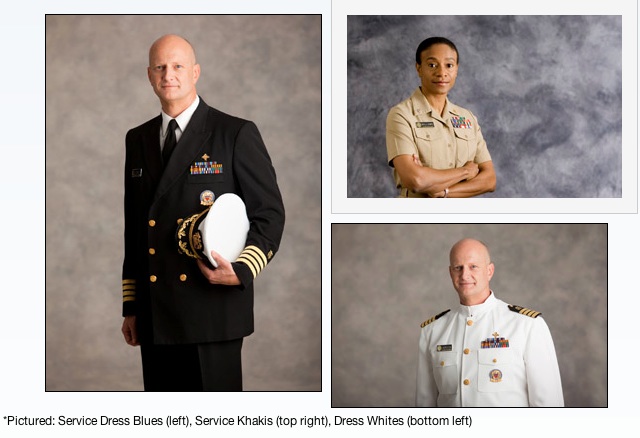
U.S. Public Health Service Corps members proudly serve their country and wear its uniforms.
U.S. Public Health Service Commissioned Corps members proudly serve their country and wear its uniforms. This photo published on the corps’ web site demonstrates that pride.

Public health in the United States began as a part of the U.S. armed services, as far back as the late 1700s. It was formalized with the military title of U.S. Surgeon General in 1870. To this day those who enter the U.S. Public Health Service Commissioned Corps wear military uniforms and hold military ranks.

A good friend of mine who spent two decades in the Indian Health Service, one of seven branches in the corps, retired a colonel, or “full bird.” He always experienced bemusement when much larger and far tougher service personnel had to salute him when he showed his ID as he entered Alaska’s Joint Base Elmendorf Fort Richardson looking often like a fashion-challenged bum in his minivan (he frequently had to see patients on base, and was doing his job well).

The U.S. Public Health Corps' web site shows the different uniforms worn by their members.
The U.S. Public Health Service Commission Corps’ web site shows the different uniforms worn by its members.

The U.S. Army’s Public Health Command was launched in WWII, and it remains active today. One of its largest centers is Madigan Army Medical Center at Joint Base Lewis McChord, in Pierce County, Washington. Public Health activities are central to the success of the U.S. Armed Services, who promote population-based measures and recommendations outlined by HealthyPeople 2020 to have a healthy fighting force.

AFRICOM charts likely path for the future integration of public health and defense

Africom photo
This screen snapshot of an AFRICOM media file highlights the public health and health related efforts AFRICOM personnel undertake in the region, where military efforts are also underway to suppress and disrupt Islamic extremist groups.

Today, the U.S. military continues to use the “soft power” of international public health to advance its geopolitical interests in North Africa.  In April 2013, for example, AFRICOM hosted an international malaria partnership conference in Accra, Ghana, with malaria experts and senior medical personnel from eight West African nations to share best practices to address the major public health posed by malaria.

At last count, the disease took an estimated 660,000 lives annually,  mostly among African children.

At the event, Navy Capt. (Dr.) David K. Weiss, command surgeon for AFRICOM, said: “We are excited about partnering with the eight African nations who are participating. We’ll share best practices about how to treat malaria, which adversely impacts all of our forces in West Africa. This is a great opportunity for all of us, and I truly believe that we are stronger together as partners.”

I have reported on this blog before how AFRICOM and the United States will increasingly use global health as a bridge to advance the U.S. agenda in Africa. And global health and public health professionals will remain front and center in those activities, outside of the far messier and controversial use of drone strikes.

It is likely this soft and hard power mission will continue for years to come. Subcontractors like QED Group will likely continue chasing contracts with USAID related to terror threats. Global health experts will meet in another African capital to discuss major diseases afflicting African nations at AFRICOM-hosted events. And drones will continue flying lethal missions over lawless areas like Somalia and the Sahel, launching missiles at suspected terrorist targets.

Oregon’s smallpox legacy in a state celebrated for vaccination deniers

Smallpox remains the only human disease that has been successfully eradicated. Its scourge has been global, impacting nearly every great civilization from the time of the Pharaohs onward.

Smallpox helped the Spanish invaders conquer the Aztecs in the 1500s; nearly 3 million persons were killed.

In Europe, it reportedly claimed 60 million lives in the 1700s. In the 1500s, up to 3 million Aztecs died after being infected by the conquering Spanish, bringing about the collapse of their culture and civilization more effectively than the violent conquistadores could have ever dreamed. The last reported case occurred in the 1970s. Since that time, the virus has existed only in two highly guarded labs.

Smallpox is also tragically rooted in the meeting of European and Native American cultures, and its horrific impact on the continent’s first peoples underlies the nation’s historic narrative as much as political and economic developments from colonial expansion to industrialization to slavery.

The pilgrims, like the Spanish, brought the dreaded scourge, which immediately took a toll on Native tribes on the Eastern seaboard. The first outbreak claimed 20 of the white settlers’ lives. Founding Father Ben Franklin lost a son to smallpox in 1736. But smallpox more than any army, particularly in the Pacific Northwest in the Oregon territory, made it possible for the young American nation to conquer Native areas, many totally wiped clean of their Native inhabitants. I will talk more about the impacts in Oregon shortly, but first some background on the killer virus.

Smallpox’s enormous role in North American and Native American history

There are two smallpox variants, Variola major, the more severe form, and the less severe Variola minor. Its symptoms include fever and lethargy about two weeks after exposure, followed by a sore throat and vomiting. For those afflicted, a rash would then appear on the face and body, and sores in the mouth, throat, and nose. Infectious pustules would emerge and expand. By the third week, scabs formed and separated from the skin. The virus is spread by respiratory droplets, and also by contaminated bedding and clothes. This was how many historians suspect the disease may have been transmitted to Native Americans in North America.

French Jesuits in Canada in 1625, according to an account by Ian and Jennifer Glynn in The Life and Death of Smallpox, received great hostility from Natives because of the link made between the disease and contact with Europeans. The missionaries reported the local people “observed with some sort of reason that since our arrival in these lands those who had been the nearest to us had happened to be the most ruined by [smallpox], and that whole village of those who had receive us now appeared utterly exterminated.”

The first recorded use of smallpox as a weapon was during the siege of Fort Pitt in 1763, when Native tribes during Pontiac’s uprising during the French and Indian war were reportedly given infected blankets by a British general, possibly with the goal of infection, even though scientific knowledge at the time did not fully understand germ theory or microbial infections. However, there was an understanding of how the disease might be spread based on experiences.  Reports also exist of the British attempting to infect colonial areas during the Revolutionary War–all early cases of germ warfare.

Smallpox was reportedly used against the 10,000-man contingent of the Continental Army that invaded British-held Quebec. Of that force, half were stricken by smallpox, and it was theorized the British commander may have intentionally spread it by sending infected persons to Continental Army camps. That army’s commander died, and the force retreated in 1776, keeping the Canadian territories intact and thus giving birth to Canada. Noted John Adams, “Our misfortunes in Canada are enough to melt the heart of stone. The smallpox is 10 times more terrible than the British, Canadians and Indians together.”

Abraham Lincoln supposedly contracted it during the height of the Civil Ware in 1863—the outcome of which could have turned the course of U.S. and global history, had he died. (I for one am glad he survived this.)

The first vaccine, developed in 1770, was derived from cowpox by Edward Jenner. He had observed how a milk maid  was inoculated from the impacts of the more deadline Variola major and minor by a previous exposure to cowpox. It was not until 1947 when a frozen vaccine was introduced globally. After a costly global campaign, smallpox was declared eradicated in 1980.

The College of Physicians of Philadelphia has published an extremely useful illustration and timeline of the history of smallpox in the United states and globally.

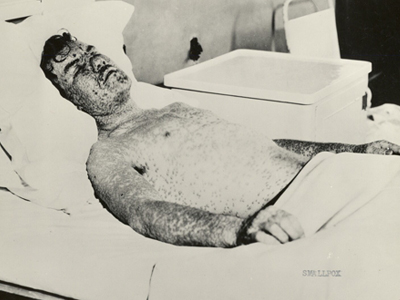
A man who caught smallpox in Milwaukee is shown in this 1925 photo.
It was less than 100 years ago smallpox wreaked havoc. A photo provided by Dr. Bennet Lorbar shows a man with pox marks on his body, among the victims of the 1925 Milwaukee outbreak that claimed 87 lives.

Today, many people in the United States, particularly those born after routine smallpox vaccinations were ended in 1972, have no memory of how awful such a disease can be. (The CDC has a plan to vaccinate the entire country should the virus ever break free from its labs.)

This may be a contributing factor to the rise of the anti-vaccination movement. It should noted opposition to smallpox vaccination in the United States dates to the 1920s, and opposition even as far back as the first vaccine of Jenners.

Ex-Playmate McCarthy and the vaccination deniers

The most famous case of modern day vaccination denialism is linked to controversies surrounding the measles, mumps, and rubella (MMR) vaccine, and its alleged link to autism and autism spectrum disorder. This bogus claim was completely based on a widely discredited study published by the British medical journal the Lancet in 2004, and then formally retracted in 2010. It was further debunked by extensive population based studies.

Facts, of course, have still not stopped former 1994 Playmate of the year Jenny McCarthy, and the “Green our Vaccines” campaign, from claiming toxins in vaccines cause autism.

Would anyone care what Jenny McCarthy has ever said if she did not have large breasts and have been a Playmate of the Year in 1994?
Would anyone care what Jenny McCarthy has ever said if she did not have large breasts and was not the Playmate of the Year in 1994?

Her campaign of disinformation just got a boost when she was given a national stage by Walt Disney Co.-owned ABC News, which hired the vaccination extremist to its show called The View in mid-July 2013. She begins her post in September.

As expected a chorus of worried public health advocates and policy wonks decried ABC’s crass capitalistic gesture. This made no impact whatsoever on the parent corporation, Disney—all of which might lead a rational person to ask when the Disney-owned ABC News might hire a blond, big-boobed Holocaust denier to co-host a lively, unscripted talk show, so long as she boosted ratings.

Smallpox wiped out Native Americans in state that now has the highest rates of vaccination exemptions

It seems particularly and painfully ironic that the state with the highest rate of parents opting out of childhood vaccinations is Oregon. This is a major public health concern, because when there are fewer people receiving vaccinations, herd immunity is reduced, making it easier for a disease to spread.

Oregon currently has the highest rate of unvaccinated children in the nation, well above the national average of 1.2%.

As of 2013, Oregon schools had the highest rate of non-medical–meaning religious–immunization exemptions for kindergarten age children. An all time high of 6.4% were exempt. That same year the state also recorded the highest rates for pertussis (whooping cough) cases in the United States, for the past 50 years, according to the Centers for Disease Control and Prevention (CDC).

According to the newsletter called the Lund Report: “In 2013, rates also showed that 17 counties have now surpassed the common 6 percent threshold whereby herd immunity may be compromised for some vaccine-preventable diseases such as pertussis and measles. In 2012, 13 counties were above 6 percent.”

Thanks to a new law signed in July 2013 by Gov. John Kitzhaber (D), himself a doctor, it will now be harder for Oregon parents to get exemptions from mandatory immunizations for children enrolling in schools.

Now, flash back more than two centuries, when the scourge of smallpox was first recorded in the Northwest due to trade with Europeans. A smallpox epidemic, starting in the upper Missouri River country, swept through current day Oregon to the Pacific Ocean in 1781–82 with horrific effects. Another scourge of “fever and ague,” likely malaria, ravaged Oregon in 1830–31. Other diseases as tuberculosis, measles, and venereal infections also took a huge toll. Epidemics in fact took an estimated nine of 10 lives of the lower Columbia Indian population between 1830 and 1834.

A rest stop on the Columbia River Gorge provide historic background on the dessimation of Native residents in Oregon due to disease in the 1800s.
A rest stop on the Columbia River Gorge provides historic background on the dessimation of Native residents in Oregon due to disease in the 1800s.

In 1834, Dr. John Townsend, in the area that would become the Oregon Territory, wrote of a mass extermination of Native residents, similar in scope to what one today only knows through zombie or science fiction films of recent years like World War Z and I am Legend.

Townsend wrote: “The Indians of the Columbia were once a numerous and powerful people; the shore of the river, for scores of miles, was lined with their villages; the council fire was frequently lighted, the pipe passed round, and the destinies of the nation deliberated upon . . . Now alas! where is he? –gone; —gathered to his fathers and to his happy hunting grounds; his place knows him no more. The spot where once stood the thickly peopled village, the smoke curling and wreathing above the closely packed lodges, the lively children playing in the front, and their indolent parents lounging on their mats, is now only indicated by a heap of undistinguishable ruins. The depopulation here has been truly fearful. A gentleman told me, that only four years ago, as he wandered near what had formerly been a thickly peopled village, he counted no less than sixteen dead, men and women, lying unburied and festering in the sun in front of their habitations. Within the houses all were sick; not one had escaped the contagion; upwards of a hundred individuals, men, women, and children, were writhing in agony on the floors of the houses, with no one to render them any assistance. Some were in the dying struggle, and clenching with the convulsive grasp of death their disease-worn companions, shrieked and howled in the last sharp agony.”

An image the young then-U.S. officer Ulysses S. Grant, during his tour of duty on the Pacific Coast, where he saw the devastation of smallpox firsthand.
An image shows the young then-U.S. officer Ulysses S. Grant, during his tour of duty on the Pacific Coast, where he saw the devastation of smallpox firsthand.

While stationed in Fort Vancouver on the banks of the Columbia River in 1852 and 1853, future Union General and President Ulysses S. Grant recorded similar devastation: “The Indians, along the lower Columbia as far as the Cascades and on the lower Willamette, died off very fast during the year I spent in that section; for besides acquiring the vices of the white people they had acquired also their diseases. The measles and the small-pox were both amazingly fatal. … During my year on the Columbia River, the smallpox exterminated one small remnant of a band of Indians entirely, and reduced others materially. I do not think there was a case of recovery among them, until the doctor with the Hudson Bay Company took the matter in hand and established a hospital. Nearly every case he treated recovered. I never, myself, saw the treatment described in the preceding paragraph, but have heard it described by persons who have witnessed it. The decimation among the Indians I knew of personally, and the hospital, established for their benefit, was a Hudson’s Bay building not a stone’s throw from my own quarters.”

(For those interested in this topic, they may wish to buy, download, or borrow a study of smallpox’s impact on Native North Americans called Rotting Face: Smallpox and the American Indian. One reviewer wrote that smallpox “claimed more lives from the Northern Plains tribes in one year than all the military expeditions ever sent against American Indians.”)

Where is the statue or monument pointing out this critical event in Oregon’s history?

Yet, I could find no record of any statue or memorial in Oregon today that notes this historic tragedy, which depopulated a region and left it wide open for white settlers to inhabit in the mid-1800s. Perhaps if such physical reminders were present, and educational programs to accompany them, there might be a more lively debate in Oregon. But as of now, it is state celebrated for its vaccination deniers and for denying the benefits of community water fluoridation for residents of its major urban center, Portland, for a fourth time since the 1950s.

Maybe a statue honoring ghost villages, dead tribes, and forgotten cultures on the banks of scenic Multnomah River in downtown Portland, could kick off with a special celebrity ceremony. The organizers could host a live broadcast of The View with Jenny McCarthy, in a revealing dress, describing why the state’s residents should keep their children from getting vaccinated from diseases such as pertussis.

I would be sure this event included representatives of the remaining tribal groups who managed to survive the wholesale disease-driven extermination of their brethren not many decades ago, many due to illnesses now controlled through childhood immunizations. Now that would be an attention-grabbing event that might just propel the discussion in a new direction.

The crowded, congested, contested road: unsafe at nearly every speed

Seattle traffic
Seattle traffic is among the worst in the nation, and it can be downright deadly, according to those who track road-related fatalities.

Every day that I drive to work, I am literally putting my life on the line. I commute roughly 80 miles daily, round trip, from Seattle to Tacoma, navigating one of the most harrowing urban traffic corridors in the Untied States, on Interstate 5 and two state highways. (My story why I am commuting this way will be for another day, but there are good reasons.)

Routinely, erratic drivers dangerously pass me, putting our lives at risk, in order to gain a few extra minutes by speeding. I have seen many accidents, some fatal, on this route over the years, and I am glad that I have my will and living will in proper order in case a truck jack-knifes near me in the rain—and yes I’ve seen that happen twice before on the freeway system around Seattle.

Seattle Road Kill 2001-2009
How deadly are roads in the Puget Sound–take a look at the roadkill on this data map showing types of mortality by form of transportation for 2001-2009.

Judging by this map, we get a fair share of road kill in the metro area I call home.

The Centers for Disease Control and Prevention (CDC) put the number of road deaths annually in my home state at nearly 500 (2009). Nationally, in 2012, the United States reported that 34,080 people died in motor vehicle traffic crashes in 2012, a 5.3% jump over 2011. This ranks as 10th leading cause of death in the United States, if one pulls this form of death from all accidental deaths, in which it is grouped by the CDC epidemiologists.

So by all counts, getting in one’s car (or on one’s bike or in a bus or other form of transportation) and hitting the road can be deadly business in my country, especially given the proliferation of mobile-device users and drunk drivers.

In 2011, cell phone use in the good ole’ U.S.A. was a contributing factor in more than 3,300 deaths and for the previous year, in 387,000 motor vehicle injuries. These are very sobering numbers, and I actually expected there would be more given that I have seen far too many texters during peak travel times in vehicles moving 70 mph. Normally I move over a lane or lay on my horn to snap them out of it.

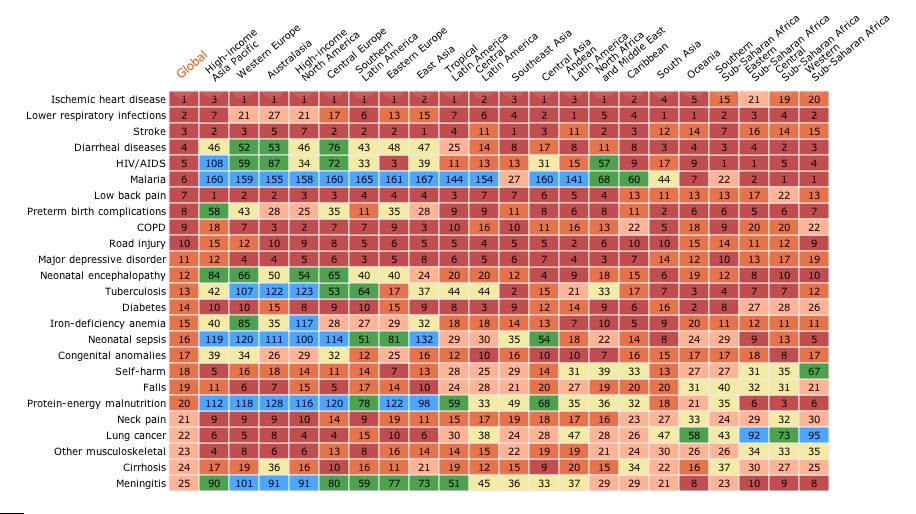
But this is nothing compared to the perils that passengers and drivers experience globally. According to the World Health Organization (WHO), road accidents claimed 1.2 million lives globally in 2011, ranking as the No. 10 cause of death, on a list that has some pretty nasty company, including respiratory infections (3.5 million), tuberculosis (1.3 million), and the big killer of children ages 0-5 years, diarrhea (2.5 million).

The Institute for Health Metrics produced this data table showing how road deaths globally compared to other causes of death (it's No. 10); go to: http://www.healthmetricsandevaluation.org/gbd/visualizations/gbd-heatmap
The Institute for Health Metrics produced this data table showing how road injury globally compares to other burdens of disease (it is No. 10); go to: http://www.healthmetricsandevaluation.org/gbd/visualizations/gbd-heatmap

A typical story that one sees with mind-numbing frequency overseas are bus collisions with motorcycles and motor scooters. This November 2012 story, 19-yr-olds crushed to death by bus, notes two aspiring young men were run over by an errant bus driver and dragged 40 feet in Chandigarh, India; the driver then fled the scene. Both of the men’s heads were crushed by the bus’s wheels.

I saw no less than three similar road maulings on the island of Java in 2009, when I visited Indonesia. That island, one of the most densely populated locations in the world, is overwhelmed with low-income and middle-income residents on  scooters competing for space with trucks and army of loosely and unregulated van taxis and buses.

Indonesians who use these highly efficient and inexpensive 100-125cc motor scooters are frequently killed on the island nation's infamously unsafe and crowded roads.
Indonesians who use these highly efficient and inexpensive 100-125cc motor scooters are frequently killed on the island nation’s infamously unsafe and crowded roads.

Road accidents alone in Indonesia account for more than 48,000 deaths annually, the 9th leading cause of death in the world’s largest Muslim nation.

The United States Department of State offers this stern warning to would-be American visitors to Indonesia–a country I really loved by the way: “Air, ferry, and road accidents resulting in fatalities, injuries, and significant damage are common. … While all forms of transportation are ostensibly regulated in Indonesia, oversight is spotty, equipment tends to be less well maintained than that operated in the United States, amenities do not typically meet Western standards, and rescue/emergency response is notably lacking.”

During my two-week visit in 2009 to the island nation, I rode about a dozen different buses and equally as many microbuses, not to mention the country’s crash-prone domestic air carriers once, their local train service (also unsafe at times), and the far less safe inter-island ferry services. I saw about a half dozen crashes from my bus window, most fatal and usually with motor cycle riders as victims, and from my hotel room I heard one multi-vehicle crash in the middle of the night that clearly claimed many lives. I learned the next day it was between a bus and truck. The bus was totaled.

Roads can really kill you overseas, and so can planes, boats, and trains too

Buses like these are cheap in Indonesia, but your life can be as some locals would say, insha-Allah, or at the mercy of God.

The writer Carl Hoffman, author of the book The Lunatic Express: Discovering the World… via Its Most Dangerous Buses, Boats, Trains, and Planes, documents the horrendous conditions of ferries, public transportation, trains, planes, and other forms of transport. The book’s online promotion notes that it offers a “harrowing and insightful look at the world as it is, a planet full of hundreds of millions of people, mostly poor, on the move and seeking their fortunes.”

Anyone who has travelled in developing or “middle-income” countries (like, say, Chile or Turkey) knows their life is literally in the hands of drivers who may have no proper training, in busses with no proper maintenance or even reliable brakes. Worse, the drivers of buses and microbuses in countries from Uganda to India to Mexico may trust their fate to Allah, Saint Christopher, the Virgin Mary, or Krishna. Those who have travelled in such places know this to be true, by the many religious deities dangling at the front of public transportation by the drivers’ seats.

Worse, the drivers will often play chicken with their competitors by speeding into oncoming traffic at high speeds while passing other vehicles or simply to “have fun.” I swear I thought I would die on many occasions in: Mexico, Guatemala, Nepal, Peru, Uganda, Indonesia, Egypt, Turkey, Chile, Argentina, India, and other places that I’d rather forget just now.

accident or more by Birn
When is an accident really an accident, or when it is linked to larger systems issues? This analysis is provided by Anne-Emmanuelle Birn in her description of the social determinants of health (SDOH).

Three separate times, after I lived through the near mishap, I swore I would never, ever take a bus again in a developing nation. Yet I threw caution to the wind, as I needed to get around, and I could not afford to get around any other way. Not seeing the country I was visiting was not an option.

Is it really  “just an accident” or something more?

Anne-Emmanuelle Birn, international health professor at the University of Toronto, and co-author of the widely used global health tome called Textbook of International Health, points out the deeper connections that road-related deaths have to poverty and social inequity in undeveloped and middle-income countries. Birn writes that road traffic accidents are the second-leading cause of death for children between 5 and 14 years of age globally, and that poor and working classes are disproportionately affected in most countries. In high- income countries, most of those killed are drivers and passengers, whereas in low- and middle-income countries pedestrians, cyclists, and public transport passengers make up nine out of every 10 road-related deaths.

In Haiti, for instance, the word for local transport is molue (“moving morgue”) and in southern Nigeria locals say danfo (“flying coffins”).

Duncan Green, an Oxfam policy adviser and development blogger, recently wrote an article asking when road traffic injuries would finally be recognized as a priority by the international development community.

In fact a major report released in June 2013 by the Overseas Development Institute, the United Kingdom’s leading development think tank, notes that transportation is not recognized as a human right like access to water, yet it still is a fundamental factor for many to achieve basic human rights. Well-run transportation systems, for people and for goods and services, promote benefits, while unsafe and weak transportation systems harm the most vulnerable citizens.

Given the debate emerging now for future sustainable development post-2015, the deadline set for the Millennium Development Goals, road safety may finally find a way into the broader public health, development, and environment agenda, as a way to tackle this clearly documented major global killer. Perhaps the threat may finally be treated as the international epidemic that is is, globally or closer to home in the United Sates. For me, this includes the roads in the Puget Sound where I spend more than two hours daily to and from my public health job.

Project Homeless Connect provides ‘disaster relief’ close to home

On May 17, 2013, I participated with other employees in my public health department working at Project Homeless Connect.  This is, at present, a quarterly endeavor to provide a range of medical and social services to the estimated 2,000 homeless individuals of Pierce County, Washington.

However, the people who line up as early as 7 a.m. for a range of needed services are not entirely the homeless. Many have jobs, but lack health and dental insurance. They basically are coming for primary or even emergency care that they cannot access elsewhere.

The Washington State Department of Social and Health Services is one of many organizations participating in Project Homeless Connect.
The Washington State Department of Social and Health Services was one of many organizations participating in Project Homeless Connect, held on May 17, 2013 at Calvary Community Church, in Sumner, Wash.

Project Homeless Connect, in its communications for its volunteer-run event, said it offered the following:

  • Medical and urgent care
  • Urgent dental care
  • Mental health services
  • Social service referrals
  • Vision/glasses
  • Haircuts
  • Child/adult immunizations
  • Veterinary care
  • Legal and financial advice
  • Housing, shelter, employment and education information
  • Tobacco cessation
  • Homeless assistance
  • Veterans services
  • Chemical dependence and assessment

This was no small effort. Months of planning went into pulling off this disaster-relief style engagement that is more associated with hurricanes and tornadoes than with meeting the basic needs of Pierce County, the second most populous (pop. 812,000) in Washington State.

Large, converted vans/trucks lined up providing veterinary services, dental care, and other interventions. Yet, oddly, there was no media present to put the story on the 5 p.m. news or in the daily newspaper the following day. (I checked but found nothing doing Google searches.) Why? Everyone who was homeless in Pierce and most social service and medical service providers likely was aware the event was taking place, for months in advance.

I did see not any elected officials (they may have come, and they may even have volunteered). All of this took place in a county whose hospitals are making profits of $1,000 per patient visit more than the state average and in a county where nonprofit hospitals are earning up to and more than $500 million in profits.

I saw all kinds of people—young, old, white, black, Asian, Latino, Pacific Islander, disabled, able-bodied, veterans, you name it. Volunteers came in all stripes as well. There were military personnel, dental assistant students from Pierce County community colleges (Bates and Pierce ), trained medical providers, church volunteers, hair stylists, and more. The list goes on. What struck me the most was how polite and appreciative the attendees were. Many drove or were driven from remote parts of the county to this somewhat semi-rural area in Pierce, southeast of Tacoma.

One of the providers, Medical Teams International, had one of its full-service converted mobile home vans providing dental care.

Medican Teams International brought one its converted mobile home vans to Project Homeless Connect on May 17, 2013, in Sumner, Wash.
Medical Teams International brought one its converted mobile home vans to Project Homeless Connect on May 17, 2013, in Sumner, Wash.

That program boasts a fleet of 11 mobile dental clinics in Oregon, Washington, and Minnesota that use 38-foot converted motor homes. Each clinic contains has two full medical stations and all necessary equipment, instruments, and supplies. The organization claims it has helped more than 200,000 adults and children with its mobile medical program since 1989.

Medical Teams International defines itself as a christian global health organization “demonstrating the love of Christ to people affected by disaster, conflict, and poverty.” The group works globally, including in Africa, South America, Asia, and North America.

Yet, it was in Pierce, addressing what clearly that organization perceived as akin to disaster and conflict.

In Washington State, 14 percent of all residents are without health insurance, according to the Kaiser Family Foundation. In Pierce County, the percentage is roughly the same.

All of this I find remarkable. Less than five miles from this revolving quarterly circus of human need there was a major shopping center, South Hill Mall, with about every major electronic gadget and consumer good on the market. Truck and car lots were also close by, with products selling from $25,000 and up. The disconnect to me was palpable, particularly the same week the Republican-led U.S. House of Representatives passed its 37th legislative measure to repeal or defund the market-driven health care reform known to its detractors as “Obamacare.”

I recall what one of my University of Washington School of Public Health colleagues—the one I respected more than nearly all others—told me when we talked about our peers who had worked or would work in public health in Africa or in developing nations. My friend asked somewhat ironically, why don’t they work at home. We have plenty of problems here. Given what I saw at Project Homeless Connect in Pierce County in mid-May 2013, I could not agree more.

Why Joan of Arc matters to beleaguered public health

Milla as Joan
Milla Jovovich in her role as Joan of Arc in the film The Messenger: the Story of Joan of Arc.

Recently, I watched a movie about the life of Joan of Arc (Jeanne d’Arc) called The Messenger, the Story of Joan of Arc by French director Luc Besson and starring Milla Jovovich. Though the movie got tepid reviews, I was mesmerized by it.

The period epic faithfully re-tells many key moments in the short life of the world-renown young French leader, including her actual words that were recorded in detailed written accounts. I found the movie intoxicating because of Jovivich’s exuberance as Joan, inspiring her countrymen to arms to free their nation, ensuring the crowning of the Dauphin Prince in the Reims Cathedral as King, and following in her view the will of God.

Few other single individuals had such an impact on world history as this illiterate peasant girl, who rose to prominence in a violent male world and became one of history’s greatest and most inspirational figures—and a saint for Catholic believers. In fact, at the mess hall at West Point, a mural depicting history’s greatest military leaders includes a rendition of Joan, with her holding a sword and in full body armor.

In fact no single historic figure from Europe during the 100 Years War between France and England remains as famous today as Joan. By the age of 17, she unswervingly acted on voices in her head telling her to drive the English from France and crown Charles VII as King of France. This came at France’s weakest moment in its history, with the English and Burgundians in control of half the country.

Yet, this virtual unknown girl never waivered. She gained access to the French court in the spring of 1429 in Chinon, France. She withstood questions from learned and suspicious church officials and a virginity test. She arrived in the besieged city of Orleans in April that year, bearing a standard and ready for action.

In defiance of cautious male commanders, she singlehandedly helped lead the French to defeat the attacking English, suffering several nearly fatal injuries. Her foes called her a witch and remained fearful of her talismanic powers. She brought together violent, power hungry men, like the Count of Dunois and the Duke of Alencon, around a common cause to the point they even would stop swearing and offered blind loyalty to her. Most importantly, she restored confidence of the French people around a common goal. Soon, all of Europe was talking about the Maid of Orleans and her battlefield exploits.

Joan Burning Picture
Joan of Arc being burned at the stake after being tried by the English and church leaders in 1431. She was only 19 years old.

By July that year, Charles VII was crowned king. Yet within a year, the young peasant who worked miracles was captured and ransomed to the English, tried as a heretic, and burned at the stake in Rouen on May 27, 1431, for having worn men’s clothes, no less.

Five centuries after her murder, she was pronounced a saint by the Catholic Church for the miracles that are linked to her remarkable accomplishments. While she did promote violence, she always offered her opponents opportunities for peaceful alternatives, and she reportedly showed great kindness to those captured.

So why should anyone in public health care about Joan of Arc?

As a student of history, I found many elements of her remarkable story relevant for my reality. Instead of beleaguered 15th century France, I find myself in the reality of the beleaguered U.S. public health system.

Religion you say? That has nothing to do with healthcare and public health, right? Well, that ignores the fact that religion has everything to do with healthcare and public health. For example:

Well, an illiterate peasant girl can teach nothing of value to doctors, PhDs, and other well-educated professionals who run our nation’s public health system, right?

I recently read an article highlighting leadership and public health. Some of the attributes associated with leadership include: serving, complex thinking, being a change agent, self-empowerment to empower others, risking failure, creating a future one envisions, and being confident in one’s beliefs and then living the change one wants. I am actually hard-pressed to find examples of such traits in leaders in my field who are resonating widely with the American public. Joan of Arc consistently showed all of these leadership traits, from risking her life on the field, to being a catalyst, to having supreme confidence in her vision.

Former U.S. Surgeon General and "Public Health Hero" Dr. David Satcher.
Former U.S. Surgeon General and “Public Health Hero” Dr. David Satcher.

In the United States, there are always “unsung hero” awards for people who no one outside of the particular field giving the award have heard of, or even care about, it seems. While these may help sustain the field of providers, they likely do little to inspire the public.

The University of California Berkeley in February held its annual event for “public health heroes,” awarding its 2013 prize to former U.S. Surgeon General Dr. David Satcher. However, I doubt few Americans know who Dr. Satcher is, what he accomplished, and why such facts matter to the nation’s crisis of promoting public health in the 21st century.

This is not to belittle Dr. Satcher’s many accomplishments, such as his calling attention to the oral health epidemic in the United States. (Oral health experts have been talking about his report for more than a decade because he and it were spot on.)

Public health, teetering like France before the arrival of Joan of Arc?

Of course medieval France has nothing in common with the reality of modern America and its healthcare system, right? But if you take the view of that history can teach open-minded students of the present many valuable lessons, regardless of their field, one might find parallels.

France at Joan’s time was on the verge of collapse, lacking strong leadership and a vision to restore hope and unity. Joan arrived completely confident in her vision and religious mission, and she never wasted a day. She famously said, “Better today than tomorrow, better tomorrow than the day after.” She also is remembered by her words, “go forth boldly.” Such words and such inspiration are lacking in the U.S. public health system, to me at least.

For those working in the field of public health, one is constantly exposed to the reality of budget cuts that continue to hack away at programs that do everything to promote chronic disease interventions to immunizations. Between 2008 and 2010 alone, in the aftermath of the Great Recession, more than half of all local public health departments had cut core funding and shed 23,000 jobs, as well as cut programs, mainly due to falling tax revenues that hammered local and state funding.

Things continue to spiral downward as the recession’s effects linger, and mandatory across the board federal budget cuts known as the sequester will soon impact every local public health department in the country and national agencies who help fund local efforts.  The Public Health Institute warned that sequester related cuts will be “devastating to the public’s health.” Such cuts, the institute says, “will cost jobs and resources in the short run, and the long-term costs—in money and lives—will be borne by families and communities for years to come.”

Crises also prevent departments from looking to innovation as they focus on life support and triage. Morale suffers, which impacts service and core functions. Leadership, perhaps what little that may exist in this beleaguered environment, is lacking. Public health managers struggle to connect with the public about what public health is and why it matters.

They fail to show that the U.S. health system’s treatment, not prevention, focus is largely unsustainable for the population’s health and the economy. In 2009, U.S. public health spending (at all governmental levels) amounted to $76.2 billion – only 3% of the nation’s overall healthcare outlays of $2.5 trillion. Yet, chronic diseases, which public health efforts can address, make up three quarters of all health care costs.

Public health spending versus all other healthcare spending in the United States.
Public health spending, as measured as billions of dollars, versus all other healthcare spending in the United States and spending on chronic diseases and all other healthcare costs.

Reform does happen, and it can be bold when breakthroughs capture the public’s and globe’s attention.

HIV/AIDS assistance, which is now at the heart of a larger global public health agenda, was launched in the late 1990s when activists outside of the medical and public health establishment demanded that antiretroviral drugs, or ARVs, be made available to many of the world’s poorest and most afflicted nations, most in Africa, to reduce the spread of the virus inside the bodies of infected people and make it possible for them to live long lives.

It was not reformers inside “the system,” it was radicals outside “the system,” who offered a clear vision and the groundswell for change that the establishment eventually fully embraced.

As someone who works inside “the bureaucracy,” however, I am ever mindful of how the great Joan of Arc was ultimately marginalized, tortured, and burned alive at the stake for her completely unorthodox ways that challenged nearly all in authority in her day. The English did not trigger her downfall, it was palace politics and sexism, and likely fear of her power.

Joan statue
One of many Joan of Arc statues in France honoring one of the French nation’s greatest heroes.

The lessons are telling today. You can work miracles, but the machinations of any bureaucratic system can be deadlier than slings and arrows of a battlefield of your sworn enemies. You could transpose the palace intrigues of 15th century French and English courts to any bureaucracy today and it would be a near perfect fit, really. Would any bureaucratic leader trust an uneducated, poor, unconnected interloper to provide a vision for change for the failing health and public health system, such as the one facing the United States in 2013?

Sure, such a thought is laughable, but it happened, and can happen again. It may even be needed if things continue on the present course.

In the end, no one remembers the bishops who tried and convicted Joan or the weak king she helped to bring to power, or in fact any of the kings of her day. Likewise, no one remembers or cares about bureaucrats in the end. Why? Quite simply they are not visionaries.

It is Joan who has statues in her honor, countless biographies recounting her legend, and many movies and documentaries exploring her incredible exploits.

America’s cultural zeitgeist and the emerging Don Corleone of public health

This has been one of the wildest weeks exposing the extremes of America’s cultural zeitgeist I can remember. What could be more American than gay marriage moving to the mainstream of American life and semi-automatic weapons readily available at a Walmart  near you, right?

Need a weapon of war to feel safe? Just drive to the nearest Walmart near you and select from their popular product lines.

On one hand, you have the U.S. Supreme Court hearing two landmarks cases, one on the legality of a voter approved ban on same sex marriage and another on the constitutionality of the federal Defense of Marriage Act, which aligns hundreds of federal benefits to promote that only a man can legally marry a woman.

Meanwhile, a full-court press was taking place in Congress to advance legislation that would require criminal background checks on all gun purchases and that would close the so-called gun-show loophole, which allows for up to 40% of all firearms sales to evade any scrutiny at all. However, efforts to include Sen. Dianne Feinstein’s amendment to restrict the sale of semiautomatic, military style assault rifles —the kind used to slaughter 26 civilians at Newtown—were dashed when Sen. Majority Leader Harry Reid (D-Nev.), on March 20, pulled it from the current gun legislation in the U.S. Senate. GOP members of Congress are already promising to filibuster the bill.

Will Ferrell, actor, comedian, and cultural clairvoyant, seemed to sum up the obvious best.

Will Ferrell’s now much repeated tweet seemed to put the pulse of the nation best: “I feel so blessed that the government protects my wife and me from the dangers of gay marriage so we can safely go buy some assault weapons.”

And, as we have so often seen in our country, sometimes tasteless, but also very popular, comedians can best summarize the seemingly craziness of political reality, where serious-minded commentators fall flat. Perhaps only through comedy can we see the absolutely surreality of our current reality.

Bloomberg takes on the NRA: no quarter asked, and none given

This week also saw the launch of Mayor Michael Bloomberg’s $12 million campaign in 10 states to promote federal gun legislation, through his national coalition of big city mayors called Mayors Against Illegal Guns. “I don’t think there’s ever been an issue where the public has spoken so clearly, where Congress hasn’t eventually understood and done the right thing,” said the multi-billionaire leader of a national political movement to restrict the proliferation of weapons that claim more than 31,000 lives annually.

Bloomberg’s newly created super PAC, Independence USA PAC, infused millions in the last federal election cycle, helping elect four of seven candidates who promoted legislation to reduce gun violence in the United States, a major public health threat that only now is getting the attention of public health  officials nationally after years of self-imposed silence.

Wayne LaPierre went head to head with Michael Bloomberg on the talk shows.

Likely fearing the emergence of a national political movement, the National Rifle association (NRA) launched a counter-strike against Bloomberg’s media campaign. NRA head Wayne LaPierre sparred with Bloomberg on Meet the Press on March 24, framing Bloomberg as a plutocratic, public health-minded uber-nanny who threatened America’s freedoms, including the alleged right to own guns and the right to eat unhealthy food:

“And he can’t spend enough of his $27 billion to try to impose his will on the American public,” said LaPierre, the national face for the most powerful gun industry lobby.”They don’t want him in their restaurants, they don’t want him in their homes. They don’t want him telling them what food to eat; they sure don’t want him telling them what self-defense firearms to own. And he can’t buy America.”

Which multi-billionaire do you want to champion public health, Gates or Bloomberg?

Bloomberg’s efforts to limit the size of sugary drinks in New York City was recently struck down by the courts. But Bloomberg remains determined to preserve his emerging national status as the Don Corleone of public health.

From pushing upstream interventions to tackle obesity to funding multiple efforts to reframe the national dialogue on guns and America, Bloomberg appears to be everywhere at once these days. In many ways, the bolder, tougher, more confrontational face for public health and the national voice for legislative action on clear public health threats is the 71-year-old Boston native.

By force of will and deep pockets, Bloomberg is emerging as a rival brand for plutocratic public health warrior to reigning champion Bill Gates, whose Microsoft-based wealth helped fund the biggest non-governmental player in public health, the Bill and Melinda Gates Foundation. With $34 billion in assets it is the largest openly run private foundation on the planet.

Which Don Corleone do you want to promote public health, Bill Gates or Michael Bloomberg?

Multi-billionaire Gates carefully has chosen non-confrontational public health initiatives that many limited-government and conservative minded leaders can champion, such as poverty reduction programs, education programs, and promoting technological efforts such as genetically modified crops.  Bloomberg’s approach is a much more in-your-face, New York style. He has proven very effective on the bully pulpit by staking out public positions and articulating views that few in the field of public health or even elected office have championed since the assault weapons ban was passed in 1994 as part of a major cops bill under the Clinton White House.

One thing is clear. Leadership, in the wake of repeated gun-fueled tragedies, like the Sandyhook Elementary School mass murders, is making a difference. And for a change, it appears that the NRA’s seeming unshakable momentum to promote the ever-expanding sales of firearms and legislation that allows for the deadly use of force has been called into check.

This also has rippled down to the public health departments, which are now showing greater resolve and passing measures calling firearms-related deaths a threat to public health and totally preventable. Maybe Bloomberg’s moxie is rubbing off. Such symbolic efforts by public health departments clearly are not a true fix, but they are a long-awaited and long-overdue baby step forward.