Australia, what I saw, and so much more to see

I watched the 2008 old-fashion movie epic Australia last night, a film surprisingly about historic racism Down Under. The film evoked part of my imagination that Australia always filled ever since I read Bruce Chatwin’s travelogue called Songlines. That book profiled the aboriginal concept of Dreamtime. To the subsistence based first Australians, the landscape has special meaning, revealed in songs, transmitted over generations, creating a powerful bond between the people and their land. While living six years in Alaska, I encountered a similar perspective learning about Native Alaskans’ subsistence culture, in which they conceived of their harsh land through cycles of hunting and fishing, a cyclical view and distinctly non-linear.

I only saw a sliver of Australia, from Sydney to Brisbane. It would the equivalent of driving from Los Angeles to San Francisco. There is so much more to see. One day I hope to see more.

Memories of Kalaallit Nunaat (Greenland)

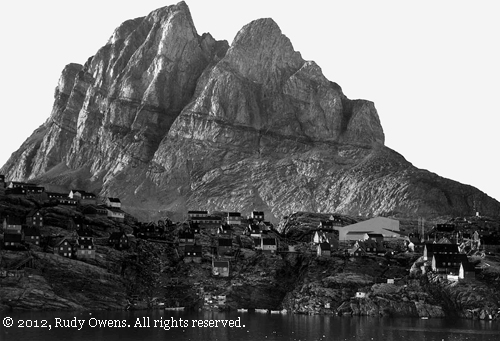
Come next month, it will be 14 years since I first traveled to Greenland, perhaps my favorite destination I have ever been lucky to enjoy. (A summary of my first two visits can be found on my web site here.) I actually visited Greenland on three occasions, last during the late spring/early summer of 2000. That was an incredible trip. I visited with my Greenlandic friends in several communities, including one of the world’s most remote and northernmost cities, Uummannaq (see the rocky island photo below).

This small sample of my images also include young residents of Sisimiut, the second largest Greenlandic city, and on Ericsfjord, in the small community of Qassiarsuk, across the fjord from the small hub city of Narsasuaq, where visitors can land and explore the country’s rich Inuit and Norse cultural traditions. There’s nothing quite like the light, cleanliness, and wide-openness of Greenland, nor the friendliness of its residents.

Arriving at night by ferry at Uummannaq, west coast of Greenland
Young men at fishing camp, near Sisimiut, Greenland
Ericsfjord from Qassiarsuk, Greenland

Alaska: snow, DUIs, and memories of spring

I lived in Anchorage, Alaska, for six years. It was an amazing experience, with the highest of highs and the lowest of lows. I still follow the news from the state, and this week had two stories that brought back a flood of intense memories, good and bad.

– The Municipality of Anchorage recorded the most snow, ever, in a single season this week. For those of you who have not had snow on your lawn until May, you really will never understand what this story means. Let’s just say it was a big deal. As of April 7, there has been 133.6 inches this winter.

– Sadly, another drunk driver (driving a three-quarter ton pickup no less) murdered two more innocent persons and critically injured two others near Fairbanks (no date  given, but I believe it was this Easter weekend). In Alaska, DUI is not a felony. This story just tears at the heart, because such deaths are completely avoidable. In my two years studying public health at the University of Washington, not once did I study the issue of DUI, or come across the topic in any class-related project. I have urged faculty there consider the topic in health services courses offered.

So, with spring in the air, I dug up a few of my Alaska spring shots. I took these while running, climbing, and biking in the Turnagain Arm area, just south of Anchorage. Spring is a time of renewal up north. It was always welcomed when it arrived, even very late on most folks’ calendars.

Turnagain Arm, from the top of Bird Ridge, near Anchorage
Scene near Girdwood, Alaska
Spring hike in the Chugach, near Anchorage

Why it’s good to appreciate simple things, like split pea soup

This week, I ate a lot of split green pea soup for dinner. Pea soup on rice, mainly. It’s good food. Simple to cook, likely free from most nasty materials that can be used in processed or industrialized food, and very good for human nutrition. Peas are high in fiber, high in vitamin B, high in protein, and high in key micronutrients. Pea soup also tastes good. And it is cheap.

In general, I like simple things. I am reminded of one of my Facebook posts from last year. I did it after watching the excellent TV series called The Pacific. In that series, I saw an interview with Dr. Sidney Phillips, a veteran of the U.S. Marine Corps from WWII, who was inspired to his profession by his combat experiences. He is a really wise man. I like what he said about how he saw and savored simple things in light of what happened to him in WWII. “You appreciate a glass of water. You appreciate good food. You appreciate clean sheets.”

I like drinking glasses of clean water. It is a pleasure, always. And I like pea soup on rice too.

Split pea soup, organic brown rice, and redleaf lettuce and red cabbage salad -- very yum-yum.

A few reasons why I loved Italy, its culture, and its history

I travelled to Italy for 10 days in October and November 2006. I loved every minute of my time there, from simple pleasures like drinking cappuccino every morning (and I am not a coffee drinker), to soaking up the country’s warm, lush light in the morning and at sunsets. It does make one think that Rome once ruled from Iraq to the Atlas Mountains of North Africa to northern England to the Black Forest of Germany and to the upper Nile of Egypt. And then, it collapsed. I hope to go back to Italy again.

Four images of the Holy Lands and empty, contemplative places

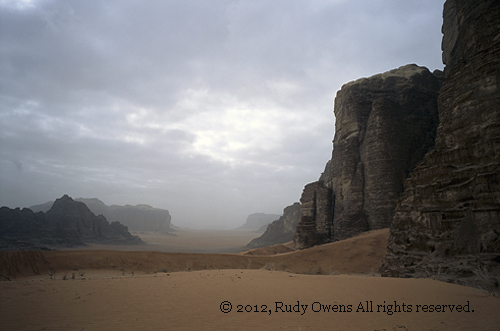
I took these four images on two separate trips, to Israel and Jordan, and later to Egypt, all in 2004. They all are special, quiet, and mostly out of the way places that speak to a deep, spiritual place inside.

Avdat ruins, Israel
The Wadi Rum, Hashemite Kingdom of Jordan
Mary's Tomb, Jerusalem
Bishoi Monastery, Egypt

Another reason why we love dogs — they are wonderful athletes

As much as I love kennel club shows, I think I love dog frisbee-catching contests more. They bring out the best in the crowd, and usually the Aussie shepherds or border collies clean house, at least at shows I have attended. Here is a shot from the show that is held every year in the spring in the Parkstrip in downtown Anchorage, Alaska (shot from 2008). Love this dog’s intensity. What is not to like about a dog catching a frisbee? Beats anything I have seen on TV.

A howl is definitely more than we “clever” humans think

On my Facebook page earlier this winter, I shared two video clips that were remarkable to me and remarkably similar. One showed a malamute howling lovingly next to a crying infant, and it stopped both its fussing and crying. Another showed a Siberian husky doing the same thing to a crying baby. I just saw a “Discovery News” YouTube piece attempting to explain away the significance of the inter-species activity and give less value to the meaning of the howl.

I have experienced howling up close in Alaska, by both sled dog mutts in the hundreds and wolves that I came feet from touching. I know the howl very well. There is an intensity to the howl that I cannot fully explain. It’s a very soul-satisfying sound that speaks to something primal inside of me at least. Even though I was close to the wolf, I never felt threatened. The wolf was speaking to its pack (the wolf was actually trying to kill the two dogs I was with, not to harm me and my three running friends). Anyway, I think that dogs and humans have spent thousands of years together now, particularly in a very co-dependent evolutionary way in the Arctic, from Greenland to North America to Siberia to the Lapland/Sweden/Norway. There is a reason why the two species collaborated to survive this brutal climate together. It was mutually advantageous. One could not survive well without the other. That is very clear.

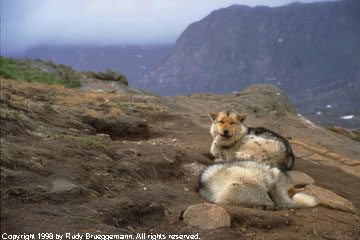
I believe there is something very deep taking place when these dogs howl in these two videos. It’s the howl of a dog taking care of the pack, and the most vulnerable member of the pack. I would also like to see evidence offering something that meaningfully rebuts that theory. And here’s one of my photos from Greenland of a sledge dog (what they call dogs there). I took it in 1998. I love Greenlandic dogs. Very wolflike critters, indeed.

Why we love pets, and why it is healthy for us

One of the benefits of paying tuition to a research university (in my case the University of Washington) is that you get access to otherwise off-limits articles. I am not allowed to share a full copy of this 1997 article by John Archer on why humans love pets, but I’ll include the abstract and some key findings:

-Compared to nonowners, pet owners are found to show significantly reduced physiological risk factors for cardiovascular disease, such as plasma cholesterol and triglyceride levels, and systolic blood pressure (Anderson 1992; Anderson et al. 1992). These differences could not be attributable to confounding variables such as socioeconomic status, body weight, or smoking habits (Anderson 1992).

-Among patients who had been treated for myocardial infarction or angina pectoris, pet ownership was significantly associated with lower mortality 1 year later (Friedman et al. 1980); this association remained even when dog owners were removed, to control for their additional exercise. Pet owners also show less intense reactions to stress (Bergler 1992), fewer psychosomatic symptoms (Bergler 1992), and fewer visits to medical practitioners than nonowners (Siegel 1992), a finding that was attributed to the stress-buffering effect of pet ownership.

-Other studies show the direct effects of interacting with a pet (e.g., stroking it) on physiological measures indicative of relaxation, such as heart rate and blood pressure (Lysons 1992).

-A sample of children in an experimental situation where they were asked to read aloud showed comparable lowered blood pressure and heart rates when a friendly dog was present (Friedmann et al. 1983).

-A 10-month prospective study (Serpell 1991) examined changes in health and behavior following acquisition of a dog or cat and in a control group without pets. Pet owners showed a highly significant reduction in minor health problems and improved scores on a standardized questionnaire, the General Health Questionnaire (Goldberg and Williams 1978). These effects were more prolonged among dog than cat owners.

CITATION:
Why Do People Love Their Pets?
John Archer, Department of Psychology, University of Central Lancashire, Preston, United Kingdom
Evolution and Human Behavior 18:237-259 (1997)

Abstract: The evidence that people form strong attachments with their pets is briefly reviewed before identifying the characteristics of such relationships, which include pets being a source of security as well as the objects of caregiving. In evolutionary terms, pet ownership poses a problem, since attachment and devoting resources to another species are, in theory, fitness-reducing. Three attempts to account for pet keeping are discussed, as are the problems with these views. Pet keeping is placed into the context of other forms of interspecific associations. From this, an alternative Darwinian explanation is proposed: pets are viewed as manipulating human responses that had evolved to facilitate human relationships, primarily (but not exclusively) those between parent and child. The precise mechanisms that enable pets to elicit caregiving from humans are elaborated. They involve features that provide the initial attraction, such as neotenous characteristics, and those that enable the human owner to derive continuing satisfaction from interacting with the pet, such as the attribution of mental processes to human-like organisms. These mechanisms can, in some circumstances, cause pet owners to derive more satisfaction from their pet relationship than those with humans, because they supply a type of unconditional relationship that is usually absent from those with other human beings.

For those with access to such databases, you may wish to find the full article, or there is a chance Google Scholar may have it somewhere in the “gray literature” area online.

And this is one of many pieces of peer reviewed research that highlights the many health benefits of pets and the incredibly strong emotion attachments humans have with them. (Go to the Delta Society web site for other research published online).

A look back at an uncomfortable photo: Birkenau

In March, I licensed a photo to the University of Texas at Dallas that I took in July 2000 of Birkenau, the largest Nazi death camp that is known to most people as Auschwitz. The image will be used by the university’s Holocaust studies center, which is a good thing. I don’t enjoy looking at these photos, but I do think this is one of the better ones I took from my documentary project I did throughout Europe of Nazi camps and places linked to that regime’s terrible crimes.

I remember the day I took this photo well too. It was pouring rain, in late July. I awoke at 5 a.m. to catch the train from Krakow to Auschwitz. I was the first one at the gate that morning. I met a death camp survivor right by that entranceway. He was at one of the subcamps, Gurtz. He was an elderly Israeli man, but fit and vital. We exchanged some words. He was tough and he hated being there, but he was there all the same. I then toured the whole camp. During the tour, I met a survivor and his colleagues and heard personal stories. I took a lot of pictures that day and learned a great deal about things that still disturb me. I remember the survivor shaking my hand as I left saying he was glad I had come. As I look back, I am glad I came, but some days I am not.