Cheap energy poses a threat to Americans’ health

One of the most talked-about initiatives taking place in public health, with funding supports from the Centers for Disease Prevention and Control (CDC), is policy, system, and environmental change to address the rise of chronic disease in the United States, the country’s leading cause of death. According to the CDC, chronic diseases are responsible for seven out of 10 deaths of all Americans annually, and one half of all Americans have at least one chronic illness. Worse, three-quarter of the $2.5 trillion (yes trillion) dollars spent annually on health care in the United States goes to battling chronic diseases. The CDC’s grant funding is being disbursed to health departments to undertake a range of interventions. But none of these interventions is going after what some say is one of major sources for the rise of obesity and chronic disease—the cheap price of energy in the United States.
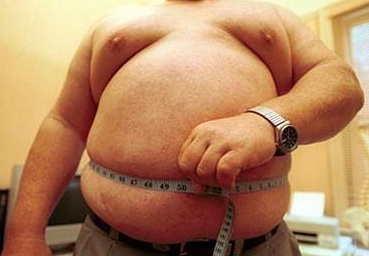
According to Ian Roberts of the London School of Hygiene and Tropical Medicine, the overall obesity rate is highest in the United States among all other nations because the price of gasoline is very low. “So where gasoline is really cheap, we over-consume it, it’s bad for the environment and actually because we should be using food energy for human movement – if we use gasoline for human movement, then we store the food energy and you know where we store it.” And there are other costs associated with being a fat nation, says Roberts. “So there’s obviously an increased demand on food supplies, but also there is an increased demand on everything. You know, bigger people need more energy to move them. Airplanes take more energy to get off the ground. It takes more of the shares that, you know, of the Earth’s resources to actually support all that extra weight.”

In the United States, the U.S. Energy Information Agency estimates we use 317 million BTUs per person a year. In this country, nearly half of all of our energy comes from petroleum and natural gas, and the country ranks seventh globally in terms of per capita energy use, trailing Canada and some smaller nations like Luxembourg and Trinidad and Tobago. However, the United States is  No. 2 (19% of global demand) in terms of global consumption of energy after China (20.3% of global demand), which just took the No. 1 slot.

Feeder pipelines gather crude oil produced at Prudhoe Bay, which is eventually shipped to the lower 48 for consumption on the West Coast.

A significant negative outcome can be seen in the widening waistlines of Americans. Charles Courtemanche of the Department of Economics at the University of North Carolina at Greensboro published a study in 2009  (A Silver Lining? The Connection Between Gasoline Prices and Obesity) that found increases in gas prices were associated with an uptick in walking or bicycling and public transportation use (and more people walking to bus and subway stops) and a drop in the how often people eat at restaurants, all impacting weight. Courtemanche estimates that:

– A $1 rise in the price of gasoline would reduce overweight and obesity by 7% and 10% in the U.S. The reduction in obesity would save approximately 11,000 lives and $11 billion per year, savings that would offset 10% of the increased expenditures on gasoline.

– An 8% of the recent rise in obesity from 1979 to 2004 can be attributed to the decline in real gasoline prices during the period.

According to Dr. Brian Schwartz, professor at the Johns Hopkins Bloomberg School of Public Health’s Department of Environmental Health Sciences and co-director of the School’s Program on Global Sustainability and Health, cheap energy also is responsible for creating our built environment, which is exacerbating our poor health trends. Schwartz argues that since World War II, the United States and other developed countries “have invested in large tracts of low density, non-compact, single use developments, which are highly reliant on the automobile and often lack public transit options.  This type of housing and transportation system is totally reliant on cheap and plentiful oil.”

The built environment of U.S. suburbs has been shaped by the relatively cheap price of petroleum paid by U.S. consumers at the pump.

Schwartz argues the average foodstuff in the United States requires about 10 units of fossil fuel-based energy input for each unit of food energy derived from the food, and that ratio jumps to 100 to 1 for many meats. Less energy would lead to declines in food calories too, as many kinds of food would become too expensive to produce and too expensive for consumers. What’s more, Schwartz suggest that this unsustainable suburban lifestyle would change dramatically after peak oil, that future and historic moment when global production of both oil and natural gas reaches its historic peak and begins to decline, setting off chain reactions impacting every facet of our life to what we eat, how we work, how goods and people move about, and how nations respond on a massive scale. (Go here for a summary of peak oil and its health impacts, as explained by Schwartz.)

Schwartz also notes that our entire health care delivery system, on top of our suburban-sprawl development pattern, food production systems, and supply chains, also is tied to unsustainably cheap energy in the form of cheap fossil fuel. “Large energy-inefficient health care facilities are staffed by health care workers living in distant suburbs who require large quantities of paper, plastic, and electronics to do their work. Systems for provision of care will need to be completely redesigned to adapt to the new reality of more expensive energy.”

Portland, Ore., that oh-so progressive Northwest city that has become a beacon of contemporary planning that tries to vaguely resemble what they do in Netherlands or Denmark, for instance, already has assembled a Peak Oil Task Force, back in 2006. The group prepared a report and drafted a resolution, passed by the City Council in 2007. That resolution sets out an ambitious goal to “reduce oil and natural gas use in Portland by 50 percent in 25 years and take related actions to implement recommendations of the Peak Oil Task Force.” It may be no surprise Portland was recently ranked the No. 1 biking community in the United States.

What continues to baffle me is how unengaged or willfully silent the United States’ professional public health system is to the connection between cheap energy and health, notably obesity. I just did a keyword search today (Sept. 3, 2012) on the word “obesity” for the upcoming American Public Health Association (APHA) Annual Meeting and Exposition to be held in San Francisco in October 2012. There were 797 hits for the word–many for papers being presented on the topic. When I typed in the word “oil” I yielded 33 hits, some on the Deep Horizon oil spill and its impacts and others on shale gas development, such as a paper being presented by Dr. Roxana Witter of the University of Colorado called “Comprehending health implications of natural gas development through public health research.” But I saw no papers on any linkage between the so-called “obesygenic environment” and energy prices tagged under the word “oil” in the searchable database of presentations and papers. I did a search for the word “energy” and got 82 hits, but most related to topics like high-energy drinks, not on oil, gas, or energy policy issues impacting human health.

Seattle like other cities is entirely dependent on relatively cheap petroleum, and as a consequence suffers from some of the worst traffic congestion of any metro area in the country, as well as a sprawl development in the city and throughout surrounding King County.

I dream of the day when public health professionals will organize their advocacy less around what kids eat at school and talk more about what our state and national lawmakers are doing to create meaningful tax policy that prices energy–making it more expensive while using revenues to promote renewable energy sources–to create larger downstream impacts. To completely cede this issue to supporters of cheap energy and the status quo and to deny that there are serious public health implications by doing so is to turn one’s back on best available evidence and the duties those in the field have to promote healthy outcomes for the U.S. population.  I did try to raise this issue in one of my classes at the University of Washington School of Public Health, and was met with unusual silence. I hope one day perhaps UW faculty in the economics department, school of business, and schools of public health and public affairs get together one day to pursue research examing negative health impacts of national energy policy.

A tale of two farmers-food markets and what it means

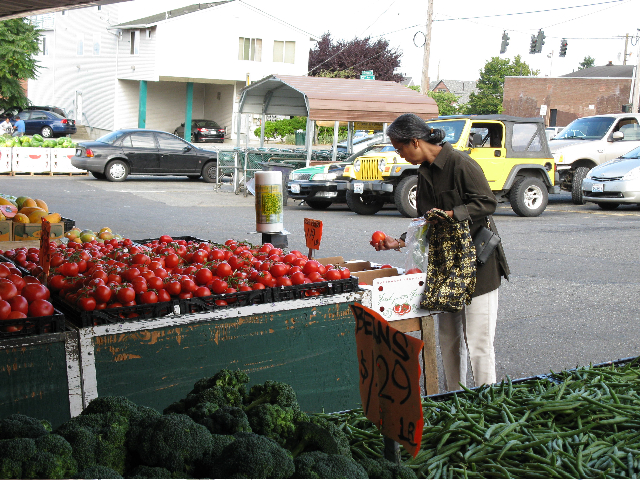
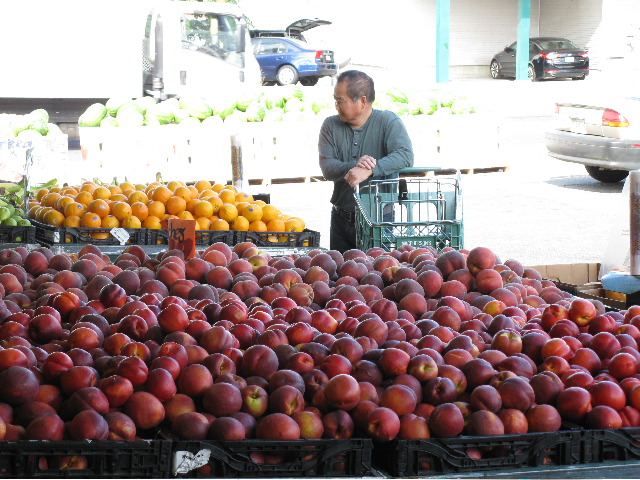
I love fresh food markets. I had a fruit, vegetable, and fish market near me growing up, the old Market in the Loop, in University City, Mo. To this day I remain a loyal supporter of local food and local businesses that sell fresh fruit and vegetables. Today, these markets are very much at the center of the national health discussion on nutrition, healthy food, obesity, and politics. So I decided to examine this issue using two examples in Seattle–one where I shop and the other where I mostly people watch and occasionally will buy some food. (Please go below for my photo essay of both venues.)

For  the last decade, the public health community increasingly has been focussing on how to increase fruit and vegetable consumption by Americans, improve Americans’ nutritional intake, and address the complex systems that are making this country the fattest on earth. Research has shown that Americans still do not consume the recommended amounts of fruits and vegetables, and government research is showing that lower-income consumers eat fewer fruits and vegetables than higher-income consumers do.

According to research by public health experts, communities that lack full-service grocery stores and neighborhood food markets have less access to fresh fruits and vegetables. Since 2009, the CDC, in its list of strategies to reduce obesity, has called for making healthier food choices available in “public service areas.” Specifically, the CDC says local governments can make healthier foods accessible through policy choices and offering vouchers that can be redeemed for healthy food choices. This is happening nationally at farmers markets, where technology to read food stamps, or EBT, cards (known today as Supplemental Nutrition Assistance Program, or SNAP), is being made available to merchants so they can serve lower-income consumers.

The Food Research Action Center (FRAC) has called for increasing participation in SNAP; improving those benefit levels so lower-income persons can afford adequate diets, including healthier foods; promoting fruit and vegetable purchases with SNAP benefits, which is taking place; and boosting the access to healthy and affordable foods in “underserved communities.” To that end, the CDC is making available more than $100 million (chump change, really, when you compare that to funding made available to corporate farms through the U.S. Farm Bill) to promote policy, systems, and environmental change through Community Transformation Grants (CTG).  This is designed to “to reduce chronic diseases such as heart disease, cancer, stroke, and diabetes” — all major health issues that are also bankrupting our health care system and treasury.

A 2010 White House report on childhood obesity notes that in the last three decades, prices for fruits and vegetables rose twice as fast as the price of carbonated drinks, and a bump in the cost of fruits and vegetables relative to less healthy foods can reduce consumers’ desire to buy fruits and veggies, leading to unhealthy Americans. Pricing is of course a key issue impacting purchasing decision of lower-income consumers, among other factors. U.S. Department of Agriculture (USDA) research found that a 10% discount in the price of fruits and vegetables would increase the amount purchased by 6-7%.

So, yes, price matters a lot, along with access. Where I live (Seattle), the Farmers Market Alliance claims “the vast majority” of the fruits, vegetables, herbs, and berries are the same price or less expensive at farmers markets, especially with organics, than at conventional grocery stores (QFC, Fred Meyer, Safeway, etc.). The organization further claims that the quality and variety of its produce exceeds the quality sold at the chain grocery stores. The farmers market movement is truly national in scope, and a network of nonprofits like the Philadelphia based Food Trust is partnering with local farmers to promote farmers markets in underserved areas.

The Atlantic in May 2011 published an article noting that farmers markets were less expensive than supermarkets and provided better food. The article challenges the criticism that farmers markets catered to mostly wealthy white snobs who drive Subarus and Prius’s, and it argues that no formal research supports “this widely accepted contention, and the few studies that have been conducted call its veracity into question.” Of course the movement to support “local food production” and farmers markets has both national and local critics, including conservative bloggers, who call it a trendy cause. Some have blasted the use of electronic EBT card readers as a wasteful expense ($1,200 to purchase, $50 to lease).

The closest market to my home, about one mile away, called the Ballard Farmers Market, most definitely is more expensive than grocery stores and independently owned produce and grocery stores where I also shop in Seattle. Its clientele, based on my many trips there, is decidedly and stereotypically upscale, white or Asian (I’d say 90% white, 5% Asian, 5% other), and professional. I haven’t conducted a poll to actually verify this, but this corner of Seattle is not that diverse, and it is close to a neighborhood where homes fetch $600,000 and where condominiums are sprouting on many major intersections. No, I can’t afford to buy anything there, with the exception of a good bargain, like beets today ($3 a bushel of three). I have bought a few apples and heads of lettuce and other veggies in the past, but not much else — not salmon, not herbs, nothing. For my part, I grow some of my own food, pick some (like berries or tree fruit that abounds in Seattle), and wish I caught salmon like I did in Alaska.

I don’t begrudge the vendors there for selling produce at a higher price point, which shuts out low-income persons like me. (I may have a few university degrees, but I am by all measures very low-income now.) As one food blogger and jam-making blogger from San Francisco notes: “People selling at the markets have priced their products according to a wide range of criteria. First, many of the farmers who sell at markets are smaller operations than those who sell to grocery stores. Maybe they have 10 acres of land compared to 60 or 100 or 200 acres and rely almost exclusively on markets for income.”

I try to support my favorite produce store in Seattle, called McPherson’s Fruit and Produce, in Seattle’s Beacon Hill neighborhood. First, their selection is usually excellent–fresh but not organic food in season. I find their produce is fresher than most grocery stores. Their vegetables and fruits are always cheaper than any grocery store I visit, including stores with hefty supply chain advantages like Costco. They cater to a full spectrum of clients, and that clientele is more low-income and more ethnically diverse than what is found in Ballard. (Beacon Hill is much more diverse ethnically.) I’m as likely to see Hispanic, African American, immigrant, and Asian-American shoppers as I am those who look like me (white). However, McPherson’s is located about seven miles by car from my home, while the Ballard Farmer’s Market is a mile away, making it impossible for me to bike to Beacon Hill, and there are some serious hill and traffic issues. So I drive there, but usually combining outings and errands with a stop. I have been shopping at McPherson’s for years, during my previous and current stays in Seattle. I do not know if their model can be replicated in other cities–unique private owners, a great location on well-travelled road, proximity to distributors, an ability to attract shoppers with and without cars.

Perhaps instead of throwing all of our support into the farmers market craze, more can be done to help smaller businesses and producers. This would require the proverbial “upstream intervention.” For instance, our government tells people to eat five servings of fruits and vegetables a day, but is not providing the supports through federal legislation to make that possible. The White House Task Force on Childhood Obesity notes that by 2020, the country needs to boost the availability of fruits and vegetables by 70%, or 450 pounds per person a year (that’s an enormous pile of food by the way). It is not doing that now because of our dated, bloated Farm Bill.

Such upstream actions, to grow the intake of healthy food consumption, in a policy sense, have the biggest bang for the buck, compared to downstream actions. Many wise and smart persons who follow food and nutrition issues have long said that the pork-laden, decades-old Farm Bill needs to be overhauled to create true change. New York Times food blogger Mark Bittman notes “agricultural subsidies have helped bring us high-fructose corn syrup, factory farming, fast food, a two-soda-a-day habit and its accompanying obesity, the near-demise of family farms, monoculture and a host of other ills.” The farm bill, up for renewal in 2012, offers an agriculture subsidy worth $30 billion, $5 billion of which is direct payments to farmers. Conservative groups like the Heritage Foundation even blast this.

Bittman suggests that a revised Farm Bill–which I believe no one involved in policy-making believes can occur in the current political climate–should support farmers who at the moment now grow unsubsidized fruits, vegetables, and beans, while giving incentives to “monoculture commodity farmers to convert some of their operations to these more desirable foods.” This is food that would make us healthier compared to factory raised meat fed on subsidized grain, which is what our current system promotes. Bittman also calls for incentives to help medium-sized farms, those big enough to supply local supermarkets but small enough to care what and how they grow, compete better with corporate agribusiness.

Personally, I would love to see both farmers markets and McPherson’s in most neighborhoods in most cities. Right now, I’m going to stick with shopping primarily at McPherson’s, despite the inconvenience. And I’ll keep growing a garden where ever I live, too.

A trip to Indian country and the Omak Stampede

So what is “Indian country”?

Drummers gather to perform at the Indian encampment at Omak’s Stampede, in August 2012.

A now-deceased doctor friend of mine who dedicated his life to serving the Native community in the Indian Health Service used the expression a lot describing where he worked in New Mexico and Alaska. It is a legal term, codified in treaty rights, federal regulations, and court decisions. Indian country can be a physical place, associated with customs and cultures of the continent’s first peoples. It is also a state of mind. You literally know you are in Indian country when you go there. There are place names and of course the people. I grew up in St. Louis, Mo., which sits on the mighty Mississippi River (Ojibwe for “great river”), and I felt connected to Indian country there because of the great muddy and the phenomenal Cahokia Mounds just east of the city in Illinois. I knew I was living on historic Indian land even as a kid.

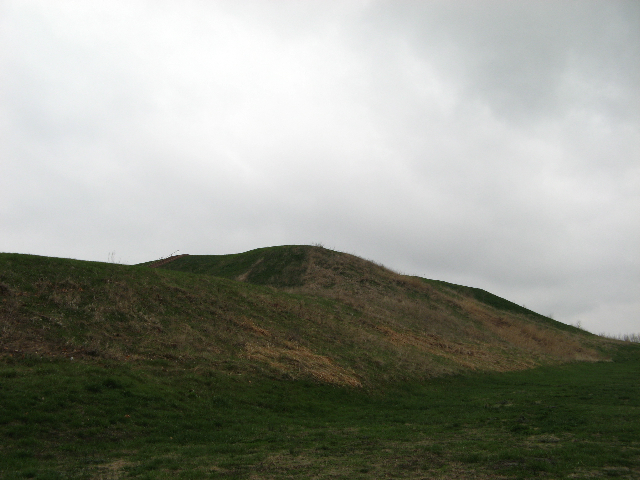
The largest Native mound in the United States is located at the historic Cahokia Mounds, just east of St. Louis.

I have lived the last 16 years of my life in what I definitely consider to be Indian Country, Alaska and Washington State. Alaska felt much more like Indian country to me. Anchorage, my home for six years, is very much a Native city in terms of population (about 16 percent). I rarely feel that connection in modern, congested, urban Seattle.  But I recently took a four-day trip to the hot, upper plateau of central Washington, from the Methow Valley to Omak, and indeed felt I had landed four-square in Indian country again.

According to a section of federal legislation pertaining to Native Americans, “Indian country” refers to three specific criteria:

-All land within the limits of any Indian reservation under the jurisdiction of the United States government, notwithstanding the issuance of any patent, and including rights-of-way running through the reservation;

-All dependent Indian communities within the borders of the United States whether within the original or subsequently acquired territory thereof, and whether within or without the limits of a State; and

-All Indian allotments, the Indian titles to which have not been extinguished, including rights-of-way running through the same.

Indian country also implies U.S. federal recognition of tribal bands as sovereign on their lands and capable of enjoying rights that are government to government. As one source notes, recognized tribes “possess absolute sovereignty [that] are completely independent of any other political power,” but also which is shared with other jurisdictions (local, state, and federal).

In Washington state, federal definitions of “Indian country” apply to state law, in addition to provisions acknowledging tribes non-taxable status in some commerce, such as the sale of tobacco products to tribal members on their reservation. In Seattle, there is still a band, the sparsely populated Duwamish, who have lost their sovereign status  and failed to win legal recognition in the city’s limits, on some of the choicest real-estate on the West Coast. Another nearby tribe, the Snoqualmie, regained their status in 1999 and promptly built a casino and became an economic and political player.

The decades-long fight over treaty-protected fishing and subsistence rights by the tribes culminated in the historic 1974 ruling in the landmark U.S. v. Washington case (the Boldt Decision) that unequivocally affirmed 19 federally-recognized tribes’ fishing rights to salmon and steelhead runs in western Washington. That decision gave the tribes rights to half of the salmon, steelhead, and shellfish harvests in the Puget Sound. It was a major game changer, and its impacts are still felt today–particularly legal squabbles if the decision should still be applied to land-use decisions impacting salmon habitat.

Yet, even as I gaze out on the beautiful Puget Sound, I am hard-pressed to think that I am on historic Indian lands, that I live in Indian country, where there are 29 federally-recognized tribes, in all corners of the state (see tribes and locations here).  But this is very much Indian country in a historic and cultural sense.

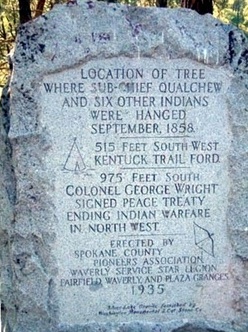
In fact, more than half of the state was outright taken by military force, illegal land seizures, and treaties (which also provided fishing and resource rights to tribal members) from the 1850s to the 1890s. Many stories of the exploitation of Native tribes come to mind, notably the hanging of Yakima warrrior Qualchan (also called Qualchew) by the reportedly violent Col. George Wright, in his campaign that defeated five tribes in Washington in the eastern half of what is now is the state. 

On Sept. 25, 1858, Qualchan had surrendered with a white flag and was hung within 15 minutes. That was followed with the hanging of six Palouse warriors the next day. Such incidents typified the period of conquest in my home state. Exploitation of tribal rights followed the signing of treaties. The Colville Tribes, for instance, had their lands stolen without their consent, setting off decades of legal battles that continued to the 1930s and ended in historic settlements returning hundreds of thousands of stolen acres of land.  Salmon and steelhead runs in the state were decimated by commercial fishing interests that harmed tribal groups in the upper and lower Columbia River basin. The runs were further extinguished by the dams built on the Columbia River. Only with the Boldt Decision in 1974 did the tide turn, but with numbers that no where near compared to the great runs of 100 years earlier.

Again, all of this is very academic and abstract to me and most Western Washington residents. Only when I traveled to the “World Famous Omak Stampede” rodeo and suicide race, with Native riders who charge down a 200 foot hill on horseback every second weekend of August, did I again realize I was truly in Indian country. Omak, in north central Washington, lies partially in the 1.4 million-acre Colville Reservation, in sparsely populated Okanogan and Ferry counties. The Confederated Tribes of the Colville Reservation number less than 10,000. I found the area to be amazingly beautiful. It’s hot in the summer, and bitterly cold in the winter. During my visit to Omak for the Stampede, the mercury hit 100 F.

Outside of agriculture (on non-tribal lands), there is little industry in this part of the state, but there is gold mining, forestry, and a limited personal use salmon fishery for tribal members.  Forestry is the mainstay for generating tribal revenues. Gaming is also a big moneymaker at the tribes’ three casinos. If you can believe it, the casinos are attracting acts like blues legend Buddy Guy and rock has-beens like Foreigner and Joe Walsh in the next few weeks. I think it’s a bit sad that even stalwart Canadians are driving south from British Columbia to spend their loonies at the tribal gaming tables, but come they do.

Despite the flow of revenues, health issues remain a problem, as they do throughout Indian country. A June 9, 2012, story republished in the New York Daily News about Tribal Councilman Andy Joseph, Jr., profiles his efforts to address Native health funding issues. The story notes his tribal members and others nationally “are dying of cancer, diabetes, suicide and alcoholism. They are dying of many diseases at higher rates than the rest of the population. And instead of those rates getting better, they’re getting worse.” Joseph is the tribes’ representative to the Northwest Portland Area Health Board, which serves 41 tribes in Washington, Oregon, and Idaho, and is that group’s delegate to the National Indian Health Board, which speaks for all 566 federally-recognized tribes in the country. The story notes that, nationally, tribal members die an average of five years earlier than the rest of the U.S. population and are six times more likely to die of tuberculosis or alcoholism, three times more likely to die of diabetes, and also twice as likely to be killed in an accident. What’s more, they are also twice as likely to die from homicide or suicide. Pretty grim data indeed.

According to Joseph, the major health issues associated with diet and nutrition have occurred as a result of conquest and cultural assimilation: “‘Joseph holds up a jar of canned salmon sitting on his desk. ‘Our people crave this,’ he said. ‘It was taken away from us when they put Grand Coulee Dam in.’ He reaches for a string of dried camas root. ‘It’s what our bodies were raised with for thousands of years. Now, we have Safeway and Albertsons and Walmart.'”

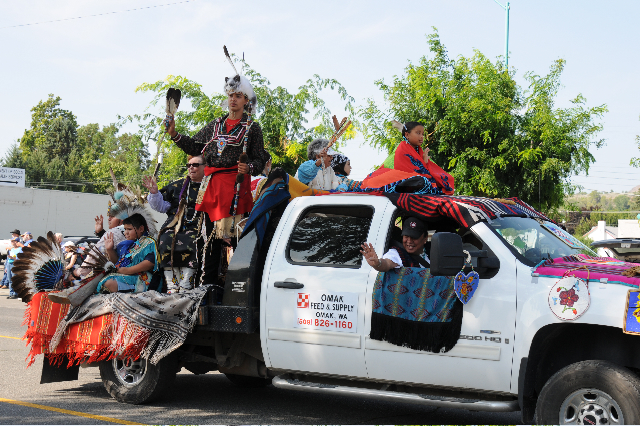
In Omak, I got a taste of Native pride during the Omak Stampede Parade, which mainly featured local businesses, rodeo princesses, groups like firefighters, Republican office holders or candidates, and less than half a dozen Indian floats. (I saw no Latino groups in the parade, despite their large presence picking fruit and in agriculture–they “officially” number about 15 percent of Omak’s residents.)

A Native float at the Omak Stampede parade.
Some of the many teepees at the Native encampment at the Stampede.

The Stampede features a tribal encampment with teepees and a performance area where tribal members perform traditional dances and song in gorgeous costumes.  It reminded me a lot of Alaska, particularly the many gatherings I saw there, including the largest conference called the Alaska Federation of Natives Annual Convention. Yup, I was definitely in Indian country.

My only real, true regret was that I missed the Suicide Race, which features some of the state’s finest Native horseman who charge down the steep hill and swim across the Okanogan River on their way to the finish inside the Omak Stampede stadium. You can watch it on YouTube, and note some times, yes, horses have died in this race.

A massacre in Colorado and public health’s chilling silence to gun violence

Like many people in the United States and around the world, I was horrified by the news on July 20, of yet another mass murder in the United States involving firearms. We still do not know as I write this post the motives of the alleged suspect, a 24-year-old medical student named James Holmes. Nor do we know yet how he acquired the multiple firearms—a semi-automatic rifle, a shotgun, and a pistol, according to initial reports—used to kill 12 people and leave 59 wounded. Press reports quote police officials saying he bought his firearms legally along with 6,000 rounds of ammunition. We do know that neither President Barack Obama or GOP presumptive contender Gov. Mitt Romney uttered the word “gun” in their public comments the day after the mass murders.

Alleged mass murderer James Holmes in a photo published by many media sources.

For his part, New York City Mayor Michael Bloomberg, a billionaire who does not have to worry about his political career even if he is voted out of office and who can afford to defy special interest groups because of his great personal wealth, was quick to criticize both presidential candidates for failing to put forward plans to address gun violence, which is a concern of many elected officials in any sized city. “Soothing words are nice,” said Bloomberg, “But maybe it’s time the two people who want to be president of the United States stand up and tell us what they’re going to do about it, because this is obviously a problem across the country.”

Boston Globe columnist Derrick Z. Jackson wrote on July 21: “Gun control has so completely disappeared from debate that John Rosenthal, founder of the Newton-based Stop Handgun Violence, told me this week before the Aurora shootings: ‘I’ve never seen more spineless cowardice and lack of national leadership. Can you imagine the outrage if instead, 83 Americans a day died from hamburgers?’ Instead the conservative Supreme Court struck down urban handgun bans. Last year saw record gun sales in America, based on FBI background checks, as the gun lobby whips up utterly false fears about Obama taking people’s guns away.”

Such mass killings like we saw in Aurora, Co., now occur with alarming frequency in the United State. Where I live, Seattle, we have experienced a wave of mass shootings during the last two months, the most lethal at a University District area restaurant called Café Racer and elsewhere in the city on May 30, that left six dead, including the alleged gunman.

From a purely statistical perspective, firearm violence is a national health issue, if not a crisis. The Centers for Disease Control and Prevention (CDC) reports that the number of firearm homicides in 2010 in the United States was a whopping 11,493, or 3.7 deaths per 100,000. And the role of firearms in suicides was nearly twice that rate. The CDC for 2010 attributes firearms in the suicides of 18,735 persons in the country, or a rate of 6.1 per 100,000. All told firearms are linked to 30,228 deaths annually at last count. This is a truly staggering figure, and one that should have the entire medical and public health community demanding that moral and political leaders in this country develop a broad array of interventions to reduce these numbers, the way we mobilize yearly to dress in pink and run against breast cancer or embrace other campaigns designed to save lives and promote health. By contrast, Japan counted 11 homicides related to firearms in 2008, or a rate of 0.0 per 100,000 in epidemiological terms.

So why is the medical and public health community silent? Well, the answer is simple. It is about politics and money. Specifically, it is about the lack of federal money. And of course those who should be out front on this issue, including heads of hospitals and medical associations as well as faculty and heads of health sciences universities, are not demonstrating the needed moral courage to speak truth to the supporters of the NRA, business interests, and political groups, who exploit American fears about government and who seek to maintain the status quo politically through fear-mongering. That job is mainly falling to journalists and citizens groups mostly, as well as victims of crimes and their families.

The Nieman Foundation at Harvard University reported in February 2012 that the gun industry’s main lobbying arm, the National Rifle Association (NRA), has “systematically suppressed data about gun violence and the impact it has on Americans’ lives.” The  CDC in the early 1990s was releasing studies that found that guns in the home presented a greater danger to the occupants than potential home invaders. In response the NRA helped to prevent the funding of research on firearms’ death and injury. As a result, reports the foundation, the CDC appropriations bill the last 15 years has contained this language: “None of the funds made available for injury prevention and control at the Centers for Disease Control and Prevention may be used to advocate or promote gun control.”  And this year, the NRA successfully added a similar amendment to the National Institutes of Health (NIH) appropriations language.

The most well-known advocacy group that promotes strict gun regulation, the Brady Campaign to Prevent Gun Violence, was extremely critical of the CDC in 2011 for, in its words, requiring researchers financed by the CDC to give the CDC a “head’s up” when they prepare to publish firearms-related research. The CDC, in turns, shares that information with the NRA as a courtesy. “If the CDC is allowing the NRA to review its studies, it’s a deeply troubling practice,” said Brady Center President Paul Helmke. “To have a government agency open itself and its science to the influence of any interest group, particularly one whose policies undermine the safety of our families and communities, is improper, offensive, and unjustifiable. We need science that we can trust.”

One has to look no further than the Department of Health and Human Services’ (DHSS) exhaustive annual report called Health, United States, 2011. It lists the word firearms just nine times, and buries firearms data deep into the report, making that information effectively unimportant in the overall health assessment for the country. Meanwhile the introduction to that report profiles motor vehicle deaths (about 40,000 deaths annually) and does not profile death by firearms (suicide or homicide, which number more than 30,000 annually). One has to wonder how connected the funding ban is to this type of editorial decision by the DHSS and the CDC, which publish this document.

Of course many proponents of very limited gun control disagree firearms-related violence is a “health” issue. One pro gun blog, published by a group called AmmoLand.com, calls those who would choose to address firearms safety “elite gun banners.” (The those being criticized is the CDC.)

Which item does the CDC and many public health research universities consider more of a public health threat, and which receives more research dollars and scholarly attention?

What we are seeing, at least at public health departments through funding mechanisms, is a full-court press on chronic disease linked to unhealthy food like, oh fatty french fries. When it comes to clogged arteries but not loaded semi-automatic weapons, the CDC doles out millions dollars ($103 million at last count) through Community Transformation Grants. It continually baffles me how trained scientists who work in health care flat out follow the money to pursue research grants to get more people to eat fruits and vegetables and stop smoking while keeping mostly silent as people in their communities are gunning themselves down and others.

I never understood this during my studies at the University of Washington School of Public Health, where there is not one course where firearms issues are addressed as a public health priority, at least according to my understanding of the courses offered. I did a quick search on the UW SPH web site on July 21 and found just seven references to firearms, six to guns, and 233 references to obesity. (UW researchers were involved in a joint study published in 2012 about gun storage cabinets in Alaska, but one would expect more given the numbers.) But this is no different than at any publicly funded health research university that relies on large federal grants to sustain its faculty and facilities. Clearly this impacts what future public health leaders are taught. During my two years in my program at the UW SPH, which used problem-based learning and cases that touched on everything from obesity to smoking to HIV/AIDs to homelessness to influenza, our classes never discussed firearms violence as a public health concern. (Note, that changed this year for the class behind me thanks to comments raised by my cohort to faculty for suggesting new topics).

In my frustration today, I even wrote to my member in the U.S. House of Representatives, Dr. Jim McDermott, by clicking the on the topical area of “gun control” to submit my email to his staff. I know from past experience that federal lawmakers never read 99% of such emails, and their replies usually do not address the contents of constituent communications, instead relying on general policy statements that amount to little substance. Still, I felt compelled to express my continued disappointment at the failure of leadership that he and others are demonstrating on this health and policy issue:

“As a public health professional and as your constituent, I am writing today to ask if you can inform your constituents what you and your allies, including in the health community and law enforcement community, are planning to do in terms of a meaningful policy response to address the proliferation of firearms and in terms of providing funding to health professionals to begin to address this issue as a legitimate threat to the health of U.S. citizens? Can you provide any details about how you are working locally with groups seeking to have upstream and federal actions to begin to chip away at the powerful special interest groups that have hijacked the public debate on firearms? Are you seeking to challenge blue dog Democrats or Republicans who continue to communicate talking points that equate the Second Amendment of the Constitution with the sale of personal weapons that in no way correspond to the wording or intent of the Constitution or the intent of the framers of the Constitution? I await your leadership. If there is to be no action, than one wonders why there continues to be cynicism of citizenry about the leaders we elect to Washington to do the people’s business, not the business of special interests that are allowing weapons manufacturers to profit from the misery of innocent citizens wiped out by a completely controllable problem, were there true courage and leadership to face down the attack ads. People can lead, but well, so can the leaders we elect. I await to hear your strong voice.” 

Portland: hip, healthy, homogeneous, and house of the homeless

I just visited Portland, Ore., twice now in the last nine days. Though I moved away in 1987, I have returned countless times. I still love it, as I have since I first visited the Rose City back in April 1983. I went to college in Portland from 1983 to 1987, and I have always felt comfortable studying, living, and working there. I fondly remember my outdoor summer job painting homes during the day and being able to commute nearly everywhere by my bike to my work locations.

I was enamored by the quirky stores like Corno’s on MLK Boulevard, which closed sadly in 1995 (RIP Corno’s we loved you!), and by the many urban gardens I saw in southeast Portland around the campus of Reed College. I also liked that I could bike throughout the city and feel relatively safe that bike commuting was accepted and more secure than in other cities because of the budding efforts by city planners to make that city bike friendly. Portland’s famous mayor from 1985-92, Bud Clark, a former Reed College dropout and tavern owner, made biking cool to a national audience by biking to his job in downtown nearly every day (way to go, Bud!). Mayor Bud made a big impression on me when we overlapped in Portland.

Portland is well-loved by its fans. Some call it one of the healthiest cities because of its many trails in the hills above the city, in Forest Park, an Olmstead Brothers designed gem from 1903 that today encompasses more than 5,100 acres and miles of multi-use trails and many critters.

Portland also defied a national trend by preventing a major highway construction project planned for Highway 26 from plowing through the downtown (the Mt. Hood Freeway). Instead, famed Gov. Tom McCall diverted highway funds ($23 million) in 1974 to build the now famous public transit system that laid the groundwork for the visionary light rail line known as MAX. Portland still has its freeways and gridlock, but it did go its one way. A highway was torn up in downtown and turned into a riverfront park. In essence, Portland has been making policy changes for many years that promoted an alternative vision to the sprawl development that has fueled this country’s destructive and costly obesity epidemic and proclivity to chronic diseases.

Portland is not perfect, however. By becoming trendy with progressives and attractive for lifestyle refugees, it is becoming more expensive and perhaps less diverse in some measurable ways.

First, on the plus side, many have praised the benefits to the “new urbanism” in Portland, for which the city is becoming increasingly famous. I’m not entirely convinced the high-end makeover of parts of Portland, such as the Pearl District, where the once famous Henry Weinhard’s brewery was converted to pricey condos and office/retail, is a good thing. Portland also has lots of farmers markets, parks, green spaces, and policy measures promoting healthy lifestyles and food choices. The Centers for Disease Control and Prevention touts this as “healthy community design.”

On top of design features, such as denser developments that are pedestrian friendly and built to promote interactivity, the city is now ranked No. 1 as the most bike-friendly, knocking rival and bike-loving powerhouse Minneapolis-St. Paul back down to the No. 2 slot, according to Bicycling Magazine. “After being named runner-up in our last round of best bike city rankings in 2010, Portland reclaims the top spot. The only large city to earn Platinum status from the League of American Bicyclists is a paragon of bike-friendliness, with 180 miles of bike lanes and 79 miles of off-street bike paths. Always quick to embrace cyclist-friendly innovations, Portland was the first city in the United States to implement bike boxes at intersections and elementary-school bike commuting trains. Among the city’s many bike shops is newcomer Go By Bike, which is located under the aerial tram and offers valet parking, rentals, and repairs.”

Of course there’s a downside. The Oregonian newspaper in 2011 analyzed 2010 census data and found the “whitest city” in the country– that would be, yes, Portland–became even less diverse in the last decade, while surrounding areas have grown more diverse. This is also a national trend in other major cities, where exurbs and suburbs are becoming more diverse ethnically.

The April 30, 2011, article in the Oregonian (In Portland’s heart, 2010 Census shows diversity dwindling), noted: “Of 354 census tracts in Multnomah, Washington and Clackamas counties, 40 became whiter from 2000 to 2010, according to The Oregonian’s analysis of the 2010 Census. … The city core didn’t become whiter simply because lots of white residents moved in, the data show. Nearly 10,000 people of color, mostly African Americans, also moved out.” Census data show that of the city’s 584,000 residents, 76% are white, compared to Oregon’s whopping 86% figure. Latinos are the next largest racial/ethnic group at 9.4%, followed by Asian Americans (7.1%), and African Americans (6/3%). And not everyone is living well, riding overpriced road bikes, and sipping microbrews. About one in six residents lives below the poverty line. The unemployment is slightly higher than the nation’s, though on average four in 10 residents has a college degree. One person who works in public health I talked to about job prospects in Portland told me, many PhDs were pouring beers and waiting tables while looking for professional work on the side; don’t come here without a job.

The most glaring example of the problems I saw during my two visits was the crush of humanity that was waiting at the entrance to the Multnomah County Library as it opened its door on a sunny July 3 morning. I counted about 60 persons, the majority of whom were clearly homeless or indigent. There are about 1,700 people living on Portland’s streets. Many persons I saw that morning were carrying all of their possessions in backpacks or large plastic bags. Many had not had a shower in some time. The library provided both a restroom to use and Internet access and simply a shelter. It basically resembled libraries in Seattle that serve as de facto homeless shelters during business hours.

I decided not to photograph the clear signs of economic distress I saw on the streets or at the library’s gates and focused on snapshots of the downtown features that make the city fun and livable – its downtown streetcar, the MAX light rail, beautiful open spaces, yummy food carts, a downtown farmer’s markets, bike infrastructure that made me salivate, and a vibe that keeps my teenager’s crush alive and throbbing.

Looking back at a North Carolina landfill, and who got dumped on

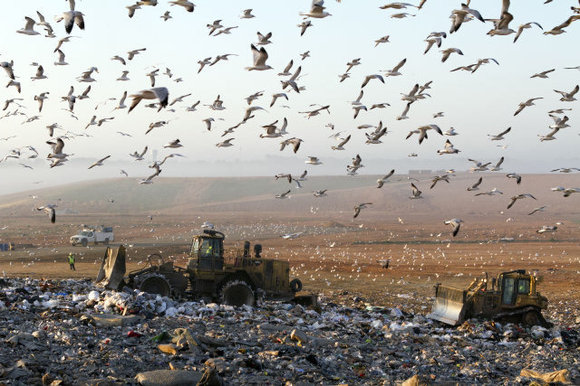
I have finally compiled my graduate thesis on environmental racism into a more easy to read PDF format. This document dates from July 1993, when I completed my MA in journalism at the University of North Carolina at Chapel Hill School of Journalism and Mass Communication. For my research project, I examined how a then-small, historically African American and poor community, Holly Springs, was chosen to become the site of Wake County’s new mega municipal landfill. Holly Springs, N.C., already had multiple open and closed landfills, and the rest of the county had not equitably assumed the same burden for waste generated in the most populous county in North Carolina, which is also home to the state capital, Raleigh.

The Raleigh News & Observer published this photo of the South Wake County landfill, in Holly Springs, in March 2012, found here: http://www.newsobserver.com/2012/03/15/1931937/wake-county-plans-future-development.html.

My efforts to publish an investigative series for a regional alternative weekly serving Chapel Hill and Durham, N.C., were nixed by a number of forces, including pressure from senior Wake County officials who communicated with the weekly I had approached and successfully led that paper to disassociate itself from me and this project before it was published. (That is my version of events.) However, I did publish the thesis online in 1998. The articles were found by residents of Holly Springs in 1998, who contacted me, and my research became part of a major legal dispute that went to the North Carolina Supreme Court and federal courts, where litigants eventually lost and then finally settled with the county for remediation work to lessen the impact. Many of the legal issues raised in the case were cited first in my thesis. After years of legal wrangling, the Wake County Commissioners finally voted to approve a major municipal landfill in 2006.

I am proud of this work. It is factually sound, rigorously investigated, fair to all parties, and written in the spirit of good enterprise journalism on behalf of persons who had the least power and resources to advocate for themselves against much more powerful and organized interests (in this case Wake County’s government).

Here is the abstract to my original 1993 thesis titled: Environmental Racism in Our Own Backyard: Solid Waste Disposal in Holly Springs, N.C.

For more than two decades, the historically black and poor township of Holly Springs in Wake County, N.C., has been targeted for landfills.  The pattern continues with Wake County’s proposed 471-acre landfill, scheduled to open in Holly Springs by 1998.  Each facility was sited adjacent to existing black communities, whose residents never participated in the siting process.  The first story of this thesis’ three-article series examines the inequitable pattern for distributing these dumps countywide and how their placement fits a national pattern.  The second article and Appendix A discuss the new “environmental justice” movement, whose grassroots and minority activists are protesting unwanted pollution and alleged environmental discrimination.  The movement’s members have coined the term “environmental racism” to describe the unfair apportionment of environmentally noxious facilities.  Article three discusses whether municipal solid waste landfills can cause ground water contamination.  Federally mandated landfill technology to be installed at the planned landfill may not provide pollution protection for ground water, used by Holly Springs for its municipal water source.

(Find a map of the then-planned South Wake Landfill here.)

A travelogue about Siberia paints a vivid picture of beauty and pain

It is often through really good travel writing that I am exposed to the world around me, more than from stories I gather from the news media. Perhaps it requires a personal perspective on places, people, and problems to make another land or culture come alive. That is what happened for me when I read Ian Frazier’s Travels in Siberia.

His travelogue, covering five separate trips to Siberia, and other parts of Russia, over a nearly 15-year period makes this region and its people and history suddenly meaningful, even though I have never stepped foot in Siberia. (I once flew less than 50 miles from its easternmost point, however.) As Frazier notes: “A tiny fraction of the world’s population lives in Siberia. About 39 million Russians and native peoples inhabit the northern third of Asia. … For most people, Siberia is not the place, but a figure of speech.”

Upon finishing Frazier’s book, I was left with great sadness and great curiosity about Siberia. During my six years working and living in Alaska, I had a chance to meet many Siberians who visited Alaska for official government programs. These included Chukotkans, who are linguistically and ethnically related to Inupiaqs of Alaska and the Inuit and Greenlanders. But because I did not speak Russian, I never was able to learn first hand their tales of their province, which lies just across the Bering Straight from Alaska.

I also once worked a year with a former doctor from Novosibirsk, in central Siberia. She had immigrated to the United States and worked in social services. She never talked much of her time there, except to describe persecution of Christians by the Soviets. She gave me an account of one Christian prisoner, who was interned in a Soviet prison in Kamchatka. I have forgotten that book’s name, as I could not read it at that time because it was too depressing a topic. I gave it to a local library, where I hope it was checked out.

Frazier manages to avoid this harshness and allows Siberia’s beauty come alive. And Siberia has that in an order of magnitude greater than most of us can imagine. The tragic side to Siberia’s story, of course, are the penal system of the Tsars, which exiled its enemies to the Russian empire’s eastern provinces, and the gulag system of Josef Stalin’s USSR, one of the greatest prison and killing systems in the history of humanity. The region covers more than 5 million square miles, much with arctic and subarctic climates that give way to brief summer months when mosquitos and gnats reign. It also has the world’s largest forest, the taiga.

During his cross-continental road trip from Leningrad to Vladivostok in the summer of 2001—one of the greatest road trips I have read about—Frazier and his two Russian guides and companions encounter Siberia’s amazing natural beauty, but also the scars of the Soviets’ and Russians’ treatment of their environment. From coal-choked cities to litter-strewn roadways to heavily polluted places in between, Frazier constantly encounters examples of poor or no governance or any form of regulation. He describes empty barrels (used to bring in fuel), which are strewn across the tundra in places as far as the eye can see.

The CIA, which some may not consider to be a neutral arbiter of Russian affairs, notes the following environmental health problems plaguing Russia: “air pollution from heavy industry, emissions of coal-fired electric plants, and transportation in major cities; industrial, municipal, and agricultural pollution of inland waterways and seacoasts; deforestation; soil erosion; soil contamination from improper application of agricultural chemicals; scattered areas of sometimes intense radioactive contamination; groundwater contamination from toxic waste; urban solid waste management; abandoned stocks of obsolete pesticides.” Frazier did not encounter all of these hazards, but certainly confirmed many.

Frazier’s later trip to the Russian Far East in 2005, to Yakutsk, and north along the dilapidated Topolinskaya Highway, finally allowed him to visit a former Soviet gulag, or penal colony. Gulags, or “lager” as they are known in Russia, are where Stalin’s regime sent political prisoners and undesirables by the hundreds of thousands to die in harsh prison conditions and be worked to death building railroads or roads, or mining gold in the most notorious of all slave mine systems, in Kolyma in central Siberia. Gulags played a pivotal role in the Soviet economy. Prisoners in gulags mined one-third of all the Soviet Union’s gold, and extracted nearly all of its coal and timber. The gulag population also numbered about one out of every 50 workers in the Soviet Union.  An estimated 6-9 million persons perished in what is known as the Great Terror, during the purges of the 1930, and the great famine of 1932-33, according to some estimates.  The most famous account of the gulag, of course, is the Gulag Archipelago, the 1973 chronicle of the penal system by the late Aleksandr Solzhenitsyn.

Frazier also details the deteriorating conditions in Russia that is leading to the nation’s depopulation in many cities and communities in Siberia. We catch glimpses of those problems in his sad descriptions of rampant alcoholism and a food safety issues. But Frazier barely touches on the public health catastrophe that is befalling Russia and its Siberian provinces.

According to United Nations (U.N.) figures, the average life expectancy for a Russian man is 59 years, or 166th place. Women can expect to live 72 years. Overall, Russia now ranks 163rd in overall life expectancy. The gap between expected longevity for men and for women-14 years-is the largest in the developed world.

The main killers are: HIV/AIDS, tuberculosis, alcoholism, cancer, cardiovascular and circulatory diseases, suicides, smoking, traffic accidents. The Russian government, according to critics, is doing little to stem the tide.

Tuberculosis deaths in Russia are nearly three times what the World Health Organization (WHO) classifies as an epidemic. What’s more, alcohol consumption per person is twice what the WHO considers dangerous to human health. In addition, more than 1 million people in Russia have been diagnosed with HIV or AIDS, according to WHO figures. Russia also has the 6th highest suicide rate in the world, peaking after the Soviet Union’s collapse.

There are many factors that have led to Russia’s much publicized population decline. According to the Rand Corporation, the collapse of the old Soviet social system in the 1990s was a major factor. In the Soviet era, nearly all health care was provided free by the state, with a system that emphasized the quantity of medical services, not quality of those services. When the centralized economy broke down, the public-health sector fell into a fiscal disrepair without a means of surviving in a market system. According to demographers, Russia’s population has dropped from 149 million a decade ago to just over 144 million today. And, that decline is accelerating.

Despite the gloom that is the public health calamity inside of Russia, and Siberia, I am now intrigued about visiting that vast but very unpopulated space on this planet, just as I was when I first flew over Greenland in 1997 and came back three years in a row to visit the world’s largest island. As Frazier himself says, “Siberia is …  a flyover country. I’m always interested in the thing that people don’t think about. Certain geographic places exist in your brain. You have a sense of Siberia. Everybody knows what they think Siberia is, just like in America everybody knows what they think the American West is.”

My new occupation, public health wizard, if the high court declares health reform unconstitutional?

So, less than 24 hours before the momentous decision of the conservative leaning U.S. Supreme Court on the constitutionality of the Patient Protection and Affordability Care Act (ACA), I am hearing almost no public discussion or reading any popular media addressing moral issues.

If the Supreme Court strikes down health care reform, should public health practitioners go to Hogwarts to learn magic, so they can solve public health problems with wands and spells and not actual resources, namely money?

Instead, we are hearing legal scholars discuss what time of the morning the justices come into the chamber, or whether the so-called individual mandate, which would compel every American to buy health insurance in the private market, is permissible under the Commerce Clause doctrine. We are getting detailed accounts of the ways the court might go on key issues, such as Medicaid’s expansion to have the federal government expand coverage to persons 133% above the federal poverty level and if the lawsuit by 26 states attorney Generals is valid before the law can be implemented. And so on and so forth, go very learned people trying to make sense of a complicated case.

What we are not hearing enough of are discussions about how many millions of Americans remain uninsured, and the costs associated with doing nothing to address that crisis. (The U.S. Census Bureau pegs the number at 50 million.) We are hearing next to nothing about the historic efforts that have prevented this nation from adopting a national health care system like other modern, capitalist democracies such as Canada, Taiwan, Japan, and France (see this comparison of how the United States system is different than and similar to other national systems, but still less efficient and more expensive). I suppose we are not getting this rehash because our nation already had that spasm of coverage during the debate before the passage of the ACA in Congress along strictly party lines in March 2010.

So in this vortex of news distortion without perspective, I would recommend that anyone who wants to get a grasp of the “bigger story” about the essential inequity and deficiencies in the U.S. health system read T.R. Reid’s clearly written tome called The Healing of America, the book I read before I began my studies in public health in 2010. In his 2009 analysis of health care systems in France, Germany, Japan, the UK, Canada, India, Switzerland, and Taiwan, Reid finds we are doing far worse in the United States, paying more money, and living less healthy lives, despite the false propaganda that we have the “best health care system in the world.” You can see a summary of the other national models here. I am not the first person to point out that learned persons, such as the 12 justices who will rule on June 28, 2012, should read this book.

Reid notes, in an article that draws from what he outlines in his book: “The world champion at controlling medical costs is Japan, even though its aging population is a profligate consumer of medical care. On average, the Japanese go to the doctor 15 times a year, three times the U.S. rate. They have twice as many MRI scans and X-rays. Quality is high; life expectancy and recovery rates for major diseases are better than in the United States. And yet Japan spends about $3,400 per person annually on health care; the United States spends more than $7,000.”

Reid points out the immorality that is our patchwork system of universal care (the Department of Veterans Affairs for military personnel), subsidized care for the poor and elderly (Medicare and Medicaid), and privatized care, if you have an employer in most cases. It is immoral because it still leaves out millions of Americans, which the very imperfect ACA, after intense lobbying to pre-empt a single payer system and scuttle any discussion of a national health plan, tried to address by using market mechanisms (the individual mandate). According to Reid, “Every developed country except the United States has designed a health care system that covers every resident. … Covering everybody in a unified system creates a powerful political dynamic for managing the cost of health care … Universal coverage also enhances health care results by improving the overall health of a nation.”

So again we are failing to discuss the main issue here, which is a moral one. Health care, argue many medical and religious leaders, is not purely a political issue, but a moral right. I will leave this post with a very clearly stated summary from the group called Physicians for a National Health Program, an 18,000-member organization dedicated to the creation of a national single-payer health program. The organization states: “The U.S. spends twice as much as other industrialized nations on health care, $8,160 per capita. Yet our system performs poorly in comparison and still leaves 50 million without health coverage and millions more inadequately covered. This is because private insurance bureaucracy and paperwork consume one-third (31 percent) of every health care dollar. Streamlining payment through a single nonprofit payer would save more than $400 billion per year, enough to provide comprehensive, high-quality coverage for all Americans.” I could not have said it better myself.

As for me, I was contemplating a bit of street theater downtown on June 28, but perhaps in my laziness I did not execute the costume and plan. Maybe later, when we learn about the implications of the Supreme Court’s decision, I will dress up as a public health wizard, like Harry Potter and his pals at Hogwarts. Then, I will recite magic phrases and wave my wand and cast spells to cure people and pay their medical bills, without of course actually doing something to fix what is ailing our political and health care systems that continue to leave our nation dragging behind other countries by all measures. That may actually be a job in demand, because if the ACA is struck down, a lot of public health interventions will no longer be funded, and our nation’s health will be worse because of it.

On becoming a public health zombie

Mark Twain, my favorite writer, in Life on the Mississippi, wrote of the transformation that occurred when he,  the majestic pilot of the paddleboat, no longer saw the magic and wonderment in the beautiful world outside the pilot’s cabin:

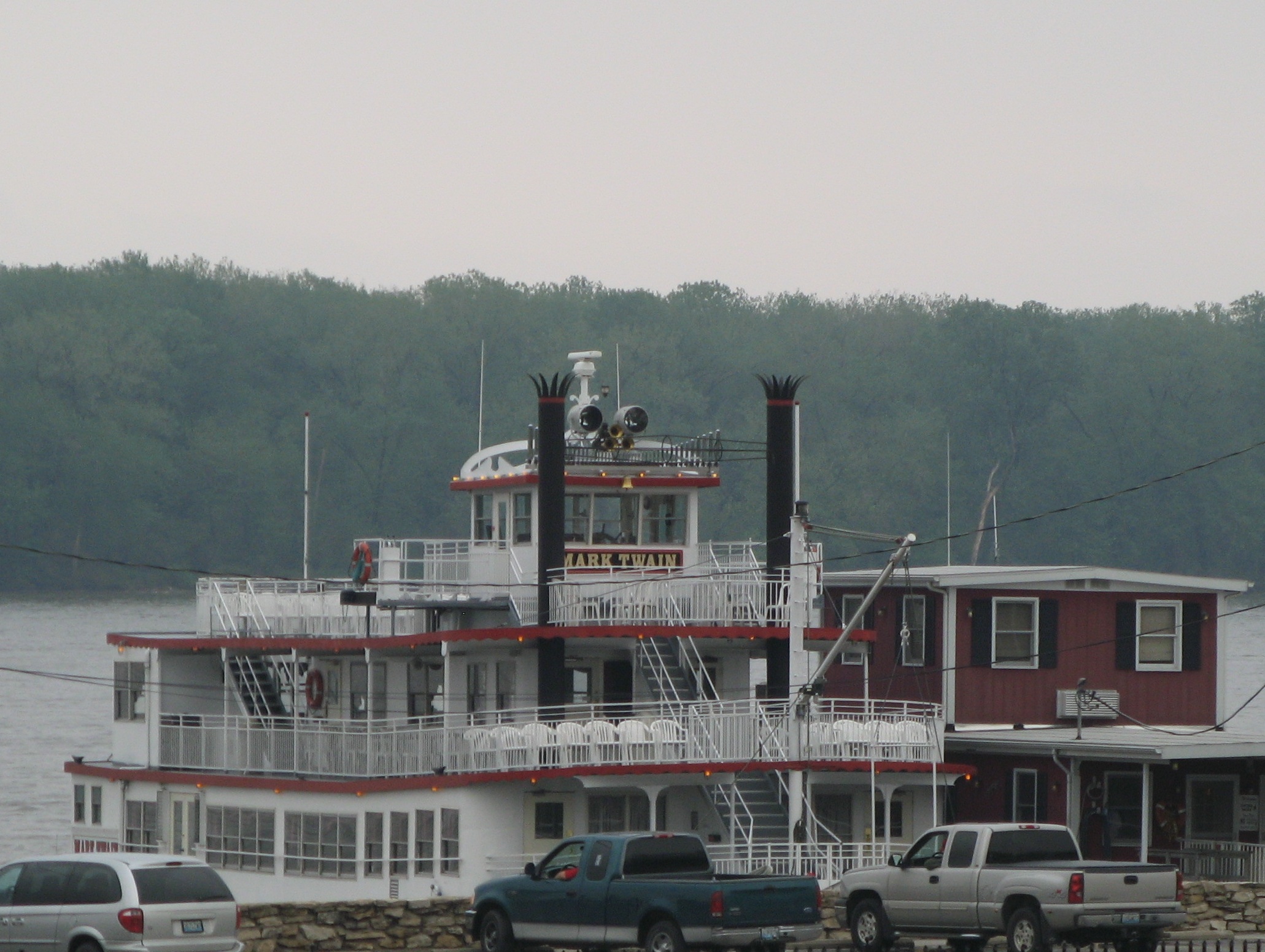
The Mark Twain riverboat in Twain’s hometown of Hannibal, Mo.

But as I have said, a day came when I began to cease from noting the glories and the charms which the moon and the sun and the twilight wrought upon the river’s face; another day came when I ceased altogether to note them … . No, the romance and the beauty were all gone from the river. All the value any feature of it had for me now was the amount of usefulness it could furnish toward compassing the safe piloting of a steamboat. Since those days, I have pitied doctors from my heart. What does the lovely flush in a beauty’s cheek mean to a doctor but a ‘break’ that ripples above some deadly disease. Are not all her visible charms sown thick with what are to him the signs and symbols of hidden decay? Does he ever see her beauty at all, or doesn’t he simply view her professionally, and comment upon her unwholesome condition all to himself? And doesn’t he sometimes wonder whether he has gained most or lost most by learning his trade?

And it is with these words, etched in my head, that I began to realize that I had become a zombie. To be precise, I had become a fully credentialed (MPH) public health zombie.

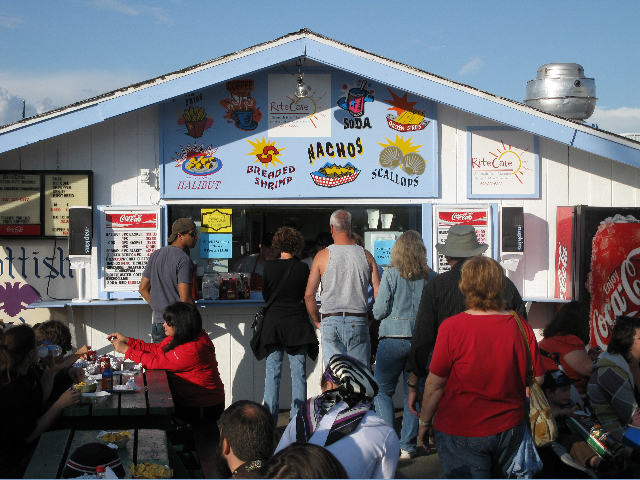
When I attend big festival type events, I no longer experience pure fun and enjoy the carnival atmosphere in a pure form. I look at how healthy or, rather, how unhealthy the food sold is. Is it loaded with transfat and sodium? Is it industrially raised meat with potential risks of carrying e-coli?

Fairgoers at the 2009 Alaska State Fair in Palmer, Ak., load up on deep fried everything.

Instead of people watching for pleasure, I will study the crowd through a public health lens. And are those attending a celebration, like Seattle’s annual Fremont Fair, smoking and drinking excessively? (And they were at the Fremont Fair in June this year – I guessed nearly one in five attendees smoked, and I counted at least four outdoor beer gardens, with people imbibing booze as early as noon on a summer day.)

Did people drive to this event, or did they use a healthy form of active transportation like biking, walking, or perhaps a bus?

Bikes aplenty were found at the Fremont Fair on June 16, 2012, in Seattle.

And what about that “electric” cigarette stand run by “Vapor Pro”– a definite concern of public health officials trying to battle the peddlers of nicotine to young and old people alike.

Electric smokes were being sold at the Fremont Fair on June 16, 2012 — should they be allowed?

I also recently visited a middle school in Snohomish County, and was looking at the school entirely as an environment where public health interventions were or were not working. Were kids walking and biking to school? No, they had to bus. The school was located off a busy highway, and there were no sidewalks anywhere near the school. I could go on and on and on. The visit actually was driving me nuts because of all the built environment issues I was seeing that was preventing the kids from being more active than they could be.

For its part, the CDC has, to my delight, decided to poke fun at its earnest seriousness protecting the public’s health by launching a “zombie preparedness” campaign to prepare for a “zombie apocalypse.” The was a surprisingly successful tongue-in-cheek awareness campaign on how to prepare for disasters. It received a lot of coverage. Was this a sudden dash of entrepreneurial social media savvy by the organization dedicated to protecting the health of the nation that tens of millions of Americans know little or next to nothing about?

As much as I hate seeing people eat incredibly unhealthy food, and smoke cigarettes in any form, and get drunk on beers in the midday sun, and drive their cars everywhere, I wish I could now just turn off my own “public health zombie.”  Now I often ponder if I have succumbed to Twain’s curse of the riverboat pilot, contemplating what I have gained against what I have lost by learning this trade.  The good news is, I have my next Halloween costume already planned: a zombie public health inspector.

Health interventions, the positive face of geopolitical engagement

On June 14, Tom Paulson’s insightful blog, Humanosphere, put the spotlight on U.S. military initiatives underway in Africa as part of a grander strategic focus the U.S. Government is placing on Africa, through the U.S. Africa Command called Africom. He raised concerns about the dual efforts of the U.S. Government. On one hand, it was expanding its covert operations, purportedly to root out so-called terrorism networks and promote and training activities in Africa by building bases stretching from Djibouti to Ouagadougou, Burkina Faso, while at the same time trying to stomp out malaria, which kills about 600,000 Africans a year. According to a U.S. Department of Defense (U.S. DOD) press release, “Africom incorporates malaria prevention into much of its theater engagement, distributing mosquito nets and teaching new diagnostic techniques during training events throughout Africa.”

I think few could argue with the humanitarian goals of this type of health intervention, at least with some basic metrics. But in reality, health-related assistance usually has a broader function. Combining “hard” and “soft” power  is nothing new to geopolitics or the U.S. Government and its diplomatic, development, and military branches. The two often go hand in hand. Closer to home for most Americans, but still far away in the U.S. Arctic in communities along coastal Alaska, the U.S. Coast Guard has spent four years expanding its training activities and capacities in the Arctic to prepare for offshore oil drilling by Shell Oil Co. Production is scheduled to begin in the summer of 2012 in the U.S. portions of the Beaufort Sea, just north of one of America’s largest oilfield, Prudhoe Bay. Oil would then be shipped down the aging and half-empty Trans-Alaska Pipeline System (TAPS).

The Prudhoe Bay oildfield is one of United States richest oil producing areas, but its production is declining leading to offshore development.

The Coast Guard preceded its Arctic ramp-up with a much heralded health and logistics outreach, called Operation Arctic Crossroads, starting in 2009, to Alaska’s western coastal communities, such as Barrow and Kivalina. These were welcomed by the mostly Native residents and received high marks from nearly all quarters in Alaska. The Coast Guard is perhaps one of the most celebrated institutions in Alaska because of its humanitarian work saving countless lives and vessels, year after year, and because of the stellar reputation it has earned, demonstrated by its outstanding safety and rescue record. (I am a huge fan of the Coast Guard, if you cannot tell, having reported on their helicopter rescues numerous times as a reporter in Sitka, Ak., in 1993.) But the Coast Guard also has noted these outreach events in Alaska have been ultimately tied to the much larger issue of energy security and defense. The U.S. DOD reported “the Arctic has economic, energy and environmental implications for national security. Coast Guard missions there are increasing because Shell Oil Co. has permits to drill in Alaska’s Chukchi and Beaufort seas beginning this summer.” The U.S. DOD further notes, “Shell will move 33 ships and 500 people to Alaska’s North Slope, and will helicopter some 250 people a week to drilling platforms.”

Deadhorse is the main landing area for the North Slope oil and gas production facilities in Alaska.
The coast of the Beaufort Sea holds significant oil reserves that Shell Oil Co. will begin tapping in the summer of 2012.

All told, Shell spent some $2.2 billion for offshore leases alone, not to mention millions in legal wrangling, government relations, PR, advocacy in Alaska and in DC, and much more since the mid-2000s. The New York Times estimates Shell spent $4 billion in its quest for one of the biggest oil prizes in North America outside of the Athabascan oil sands of Alberta and shale oil finds in North Dakota. (Shell also is drilling for natural gas in the Chukchi Sea this summer also.) The issues framing a stronger U.S. commitment in the Arctic are natural gas and oil resources and a so-called “race for resources,” as it has been described by some, which concerns rights to those resources on the Arctic Ocean seabed floor.

The U.S. Energy Information Agency claims that nearly a quarter of untapped oil and natural gas resources are in the Arctic basin, which explains the significant interest by the major multinational oil exploration companies in the shallow Arctic waters off Alaska’s North Slope. Companies like Shell and ConocoPhillips and others have been staking out their claims for years by buying controversial offshore drilling leases that have been sharply contested in protracted legal fights with environmental groups and Native Alaskan residents of the North Slope Borough (the Inupiat). The Inupiat residents,  who, while mostly supporting onshore development, are concerned about the threat an oil spill or blowout in pristine Arctic waters, similar to BP’s spill in the Gulf of Mexico in 2010. Some Inupiat resident say that would harm their subsistence hunting of migratory bowhead whales, which have been hunted and eaten by these historic Arctic residents for thousands of years.

A whaling ship rests in the Arctic summer sun in Barrow, on the coast of the Beaufort Sea.

What is clear is that interventions premised on health care will likely be part of a larger strategic framework of  nations as powerful as the United States. Those actions, no matter how well-intentioned to improve health care from Kivalina to Kenya, must be understood in a much larger context of any nation’s political and economic interests. This is particularly true regarding access to and the development of natural resources, wherever those resources may be.