So, You Want to Know More About the Motor City?

(Ed. Note: Dozens of links are provided below, after the introduction.)

Miichigan Central Station

Detroit’s unwanted celebrity status nationally and internationally continues to fascinate me. Detroit is now known as a failed American urban experiment. For the more cynical or the painful realists, it represents the dark end to America’s middle-class dream, and the embodiment of the decline of American power and even its civilization.

Detroit rose like a phoenix at the beginning of the 20th century and then experienced the near death of the American automobile industry at the start of the next one, culminating in the taxpayer-funded bailouts of General Motors and Chrysler during the Great Recession. Once the nation’s fourth largest city, the population has fallen from 1.8 million to less than 800,000 in 50 painful years.

Since the violent Detroit riots of 1967 that killed 43 and burned more than 1,000 buildings, the community has transformed into a nearly all-African-American city. Sadly, it now ranks as the country’s murder and arson capital. Multiple factors, well beyond Detroit’s control, spurred these changes. These include white flight and suburbanization, along with national racial politics and globalization.

From a public health perspective, there are not many major cities doing worse. Entire neighborhoods have been vacated. Burnt out shells of homes and businesses dot the urban landscape that now is turning to seed. Nearly half of the city’s children live in poverty. Once glorious buildings that were testament to the confidence in industrial capitalism, notably the ghostly Michigan Central Station, stand vacant as monuments to a past glory. They are our America’s modern-day Roman Colosseum, symbol of a dying or dead empire.

Detroit is also my home town, where some of my family have long roots as Michiganders. It is the place where my life story began, at the intersection of two stories of my adoptive and biological families, who all eventually fled or simply moved away.

To help others understand Detroit Motor City and why it matters, now more than ever, I have compiled some of my favorite links to resources, films, books, and online content that I have uncovered recently. Take a moment to learn more about this famous place that once was the world’s greatest industrial city.

Detroit, Enduring Icon of Decline and “Ruin Porn” CelebrityAndrew Moore Book Cover

  • Detroit Disassembled, photo book by photographer Andrew Moore (highly recommend)
  • The Ruins of Detroit, photo book by Yves Marchand and Romain Meffre (highly recommend)
  • James Griffioen, Detroit photographer of decay (recommend)
  • Five Factories and Ruins (web site)
  • Lost Detroit: Stories Behind the Motor City’s Majestic Ruins, by Dan Austin and Sean Doerr, provides historic and architectural background
  • American Ruins and The New American Ghetto, by Camilo José Vergara, depict dereliction and abandonment in cities like Detroit, Camden, N.J., and Chicago
  • Julia Reyes Taubman, socialite ruin photographer of Detroit and subject of some blowback for photographing decay while protected by a wall of money
  • Detroit 138 Square Miles, website that accompanies photographer Julia Reyes Taubman’s photo book
  • Beautiful Terrible Ruins, art historian Dora Apel examines ways Detroit has become the paradigmatic city of ruins, via images, disaster films and more and notes that the images fail to show actual drivers in the downward spiral, such as globalization, neoliberalism, and urban disinvestment
  • Diehard Detroit, a time lapse video of many of Detroit’s famed architectural ruins, abandoned factories and homes, monuments, buildings, and freeways, with absolutely no perspective on the meaning behind the mayheim, just titilating entertainment with great technique and a cool drone toy (it is stunning visually, and thus classic “ruin porn”)
  • Detroit’s Stunning Architectural Ruins, and Why Documenting Its Faded Glory Matters (an article by the Huffington Post, a liberal blog which exploits unpaid “contributors” more than Henry Ford ever did his factory workers)
  • Urban Ghost Media, photos of the much-photographed and now infamous Eastown Theater

Detroit and Media Coverage

Must-See Detroit Documentary Film: Burn

The great documentary about arson in Detroit and the men who fight it.
  • Burn, a documentary film by Tom Putman and Brenna Sanchez, tells a year-long story of the year in the life of Detroit firefighters, who battle uncontrolled arson against all odds (amazing filmmaking!!! … from the firefighters interviewed: “That is how you burn a city down. One at a time.”)
  • Interview with filmmakers Putnam and Sanchez on their documentary Burn (great read on scrappy filmmaking with a purpose)
  • The Making of Burn—so, you want to make a great film no one in power gives a crap about, but you have to do it anyway

Must-Read Books on Contemporary Detroit

Detroit, The Former Glory

Pro-Detroit Media Coverage and the “Re-Birth” Branding

Detroit, Industrial IconDiego Rivera Mural, at the DIA

Nice Photo Essays of Before and Now:

Detroit Stories and Research of Interest

Viktor Frankl and the simple secrets to living a meaningful life

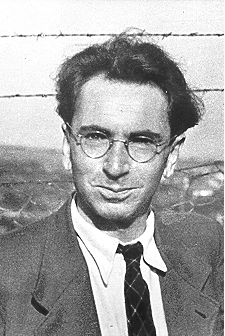
Viktor Frankl Photo
This photo of Viktor Frankl was taken shortly after his liberation from the Nazis in 1945.

Renowned psychiatrist, philosopher, and writer Viktor Frankl stands as a giant among 20th century thinkers. The Austrian-born Frankl (b. 1905, d. 1997) was a psychiatrist whose life was transformed by his experiences as a Jewish prisoner who survived the Holocaust and internment at the Auschwitz death camp and three other German concentration camps.

With the exception of a sister, all of his immediate and extended family and his beloved wife were murdered by the Nazis. From the aftermath of this horrific experience, he embarked on a life’s work that provided deceptively simple but remarkably clear ideas that literally provide a framework on how all people can live meaningful lives.

Frankl survived his brutal internment, which should have killed him, by seeing a purpose in his ugly reality and by taking control of his responses to that experience with positive actions and a mental attitude that ensured his survival and also his outlook on life and his fellow man and woman. His simple ideas offer no shortcuts, and they uncomfortably place each person in control of how they choose to respond to life’s challenges, even ones as unforgiving as genocide and mass murder.

Frankl proposes all of us are motivated to seek a higher purpose, even when our circumstances are as cruel as a death camp surrounded by barbed wire and vicious men armed with machine guns. Frankl writes: “Man’s search for meaning is the primary motivation in his life not a ‘secondary rationalization’ of instinctual drives. This meaning is unique and specific in that it must and can be fulfilled by him alone… .” More than pleasure, more than material things, meaning motivates us all. It is our purpose for being.

Man’s Search for Meaning, a book that changed modern thinking

Cover Man's Search for Meaning
Viktor Frank’s seminal 1946 Holocaust memoir, Man’s Search for Meaning, has been translated into more than 20 languages, has sold more than 10 million copies, and is considered one of the most influential books among American book readers.

Frankl published those principles in his highly acclaimed and influential 1946 memoir, Man’s Search from Meaning, which today has been translated in more than 20 languages and has sold more than 10 million copies. It is considered among the most influential books in the United States, according to a Library of Congress survey.

He originally developed the framework for his sparse set of powerful ideas when he was practicing psychiatry in Vienna before the Nazi occupation and saw how he could help patients overcome their suffering by making them aware of their life’s calling. His treatise, stashed in his coat, was literally lost when he was imprisoned.

Later in his life, when he had achieved global recognition because of the widespread popularity of his bestseller, he was asked by a university student: “…so this is your meaning in life… to help others find meaning in theirs.” His reply was as clear and direct as the theory behind his therapy, “That was it, exactly. Those are the very words I had written.”

As one writer influenced by Frankl, Genrich Krasko, points out, Frankl’s ideas are more prescient today, given millions have no meaning in their lives, particularly in affluent societies: “Viktor Frankl did not consider himself a prophet. But how else but prophetic would one call Frankl’s greatest accomplishment: over 50 years ago he identified the societal sickness that already then was haunting the world, and now has become pandemic? This ‘sickness’ is the loss of meaning in people’s lives.”

Logotherapy, Frankl’s foundational theory

Frankl called his system logotherapy, derived from the Greek word “logos,” or “meaning.” It has been called existential analysis, which may over-simplify its scope. The philosophy and medical practice boils down to providing treatment through the search for meaning in one’s life. Its utterly basic but ultimately powerful foundational ideas are easily summarized:

  • Life has meaning in all circumstances, even terrible ones.
  • Our primary motivation in living is finding our meaning in life.
  • We find our meaning in what we do, what we experience, and in our actions we choose to take when faced with a situation of unchangeable suffering.

Frankl notes, “Most important is the third avenue to meaning in life: even the helpless victim of a hopeless situation facing a fate he cannot change, may rise above himself, may grow beyond himself, and by so doing change himself. He may turn a personal tragedy into triumph.” This latter point is particularly poignant, as it calls out the role that adversity can have in shaping us and our destinies and improving our character and our life’s narrative.

In short, no matter what circumstances we find ourselves, so long as we have a purpose, we can find fulfillment. What’s more, we are fulfilled by right action and by “doing,” not through short-term pleasure or narcissistic pursuits.

Frankl argues that meaning can be found in meaningful, loving relationships, in addition to finding it through purposeful work or deeds. In fact, it was the strong love of his first wife that kept him alive amid the unspeakable horrors of Auschwitz. He felt her presence in his heart and it literally let him live when others around him perished.

Frankl’s core ideas at odds with more ‘accepted’ health and mental health paradigms

Frankl’s ideas collide with behaviorist models, which show that conditioning will determine one’s responses—the proverbial Pavlovian dog or Skinnerian lab rat. By contrast, through his own experiences and those he observed treating depressed and suicidal patients before and after the war in Vienna, Frankl claims that “everything can be taken from a man but one thing: the last of the human freedoms—to choose one’s attitude in any given set of circumstances.”

When faced with a situation, we all chose. But our power is defined by our actions. “Between stimulus and response, there is a space,” he claims. “In that space is our power to choose our response. In our response lies our growth and our freedom.”

The concept of personal choice conflicts with extensive research that clearly documents how one’s environment, race, socioeconomic status, and more—the so-called social determinants of health (SDOHs)—shape one’s life more than one’s individualistic decisions.

A model explaining the social determinants of health.
Viktor Frank photo 1947
This photo of Viktor Frankl was taken two years after his liberation from the Nazis, when he returned to psychiatric practice to help people through his principles called logotherapy.

For two years, while earning my MPH at the University of Washington School of Public Health from 2010 to 2012, I found myself frequently and painfully at odds with current research and literally thousands of studies that proved to me that SDOHs will impact our lives in the most profound ways.

Yet I found the field and its most ardent practitioners lacking an explanation that showed the real power people have in controlling their personal outcomes. This is something that the public health field and my faculty sharply criticized by showing the medical model, which tells persons to control their health, has largely failed to promote wider population health metrics.

While I do embrace a “policy and systems” approach, I even more strongly believe that every person has the ability to make life-changing choices, every minute of every day—from the food they put in their mouth, to devices they watch daily, to the people they associate with, to the jobs they take or do not take (however awful often), to the way they manage their personal emotions. They have choices, and often they are cruel and brutally unfair choices, which often favor the privileged.

Frankl was famous for meeting with some patients, asking them to reflect on finding meaning in their lives over their entire life span, and providing the mental treatment they needed to take control of their lives without future interventions or drugs, which predominates the American model of mental health treatment. Some of his patients only required one session, and they could resolve to deal with life’s circumstances without any further intervention.

This is a radically and in fact dangerous model that challenges how the United States is grappling with mental illness nationally, though many practitioners use Frankl in their work. One psychiatrist I tweeted with wrote me back saying, “I’m far from the only one [using Frankl]! There’s a large humanistic community in the counselling/psychotherapy world.”

Frankl’s ideas continue to be studied, refuted, debated, and argued by learned and well-intentioned academics, which I think would amuse Frankl. He was more interested in the practical work of day-to-day living and less with becoming the subject of a cult following.

As one commentator I saw in a documentary who knew Frankl noted, Frankl was not interested in fame, otherwise he would be more famous today.

Paul Wong is one of many academics who have analyzed the ideas of logotherapy and mapped them in published work.

Here is just one example showing how theorists explain logotheraphy; see the table by Paul Wong on life fulfillment and having an ideal life.

Why Frankl’s thinking profoundly inspired me and thousands of others

For more than three decades, I have been wrestling with the concept of personal responsibility and the influence of our environment and systems that impact our destinies. Such factors include one’s family, country, religion, income, the ecosystem, our diet, and political and economic forces, among others.

I also have been fascinated by examples of people choosing hard paths in dire circumstances as the metaphor that defines successful individuals’ life narratives. In Frankl’s death camp reality, this ultimately boiled down to choosing to be good, and helping fellow prisoners, or choosing to partake in evil, which many prisoners did as brutal prisoner guards called kapos.

No one gets a free pass in this model, and all people in all groups can be one or the other, Frankl says. “In the concentration camps, for example, in this living laboratory and on this testing ground, we watched and witnessed some of our comrades behave like swine while others behaved like saints,” writes Frankl. “Man has both potentialities within himself; which one is actualized depends on decisions but not on conditions.”

I had not been able to order these two lines of thinking into a coherent set of principles, as Frankl so perfectly did. When I stumbled on him quite by accident or maybe design this summer, while reading books by Robert Greene and even management guru Stephen Covey, I had that most rewarding and delicious feeling of “aha.” It was more like, “Wow, what the hell was that!”

It felt like a thunderclap. I almost reeled from the sensation. I then began to tell every single person I know about Frankl, and I learned many of my colleagues had already read him. I felt robbed not one teacher or academic, at three respected universities I attended, had covered or even mentioned Frankl, when his ideas are foundational to our understanding of the fields of psychology, public health, business, organizational behavior, religion, and the humanities in the 21st century.

Frankl deserves vastly more attention then he is given by health, mental health, and social activist thinkers. That is a shame too, because as a speaker, Frankl brimmed with enthusiasm and could convey complex ideas in the simplest ways to reach his audience. Watch his presentation at the University of Toronto–a brilliant performance.

Frankl’s ideas matter to each of us, in everyday life

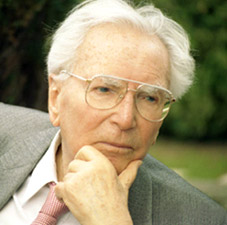
Photo courtesy of PBS, showing a pensive and thoughtful Viktor Frankl (http://www.pbs.org/wgbh/questionofgod/voices/frankl.html)
Photo courtesy of PBS, showing a pensive and thoughtful Viktor Frankl. Click on the photo for a link to the web site.

One my most satisfying feelings is discovering that one’s personal life experiences and ideas on issues as big as the meaning of life also resonate profoundly with millions of others—those who have read his work. Even more gratifying is discovering that the core principles to living life amid hard choices can be grounded in principles that can help everyone, even in the most dire of personal experiences.

My own travels in the developing world stand out for me. I met countless people facing vastly more painful, difficult, challenging lives than I have faced. Yet, the wonderful people I met had nothing but smiles and treated me with genuine sincerity. I had to ask myself, why is it that so many people are clearly content when their surroundings indicate they should be experiencing utter despair and even violent rage. Why is there kindness in their hearts and peace with their reality.

Photo of Coptic Youth, Egypt by Rudy Owens
These young men, all Copts, a persecuted minority, highlight for me the depth of goodness one finds in the world, even when many have no material foundation that suggests they should be happy.

I understood at all levels what I was experiencing. But Frankl’s framework ties this rich set of personal experiences to all of us, and to larger existential ideas of what we are meant to do with our time.

For Frankl, the answer is just doing what life needs us to do. As Frankl wrote nearly 70 years ago, “Life ultimately means taking responsibility to find the right answer to its problems and to fulfill the task which it constantly sets for each individual.”

With that point, I now must ask you, the reader, What are you doing with your life, and are you doing what you are being asked to do? You cannot escape this question, and if you avoid it, you will always have the pain and emptiness of not listening to your own calling. The choice of course is your own.

The enduring influence of Bernd and Hilla Becher

Photography is a highly personal artistic and communication medium. I have found that those who are successful in this arena achieve that status because their work is clearly recognizable. Success is never by accident, and the photographers I greatly admire remain consistently clear and compelling over time, and usually with great impact on others in the field.

Sebastião Salgado comes to mind for me in the field of visual storytelling with a clear vision. His impact can be seen widely in imitators and co-travellers. The same can be said with the husband-wife duo Bernd and Hilla Becher.

Lime kilns, by Hilda and Bernd Becher.
Lime kilns, by Hilla and Bernd Becher.

The German couple photographed industrial architecture in Europe and North America for nearly 40 productive years, until Bernd’s death in 2007. Their easily recognizable subjects include water towers, blast furnaces, gas tanks, timbered homes, and other industrial features.

The pair published books with their images, grouped together in what they called “typologies,” or sets of images of the same objects from different geographic locations, usually in sets of say nine or 21 images. Each image would be photographed identically, with direct frontal composition, no lens distortions, and with a neutral density skyline that did not distract the viewer from the subject.

These ordered collections had almost no captions and simply conveyed the form of the objects, letting the similarities of the objects communicate the meaning without any of the often absurd and blabbering arts-speak that is usually associated with art and photography commentary. (I imagine the Bechers would find such nonsensical writings absurd.)

Their books of photographs, such as Industrial Landscapes and Typologies of Industrial Buildings, compile their work into compelling sets of images. The influence of their aesthetic can be seen in numerous imitators and students, including this series I found recently on abandoned homes in Detroit.

Toward the end of his career, Bernd taught at the Kunstakademie in Dusseldorf, leading to a crop of photographers and a style of picture-taking that is is known as the “Dusseldorf School of Photography.” Bernd’s well-known and accomplished students include Thomas Ruff and Andres Gursky, one of the most celebrated photographers of the world who has sold the world’s most expensive photographic print.

Bernd and Hilda Becher, Blast Furnaces, at the St. Louis Art Museum.
Bernd and Hilla Becher, Blast Furnaces, at the St. Louis Art Museum.

I may have stumbled over the Bechers’ work without knowing it. However, I do recall feeling trapped in a hypnotic trance when I discovered a collection of their blast furnace images, or typology, in the new wing at the St. Louis Art Museum in December 2013.

I felt a deep kinship with their interest in industrical landscapes, perhaps because I grew up in St. Louis and was surrounded by similar forms in a city that was dying as an industrial center during my years there. I also felt a connection because I sensed something profoundly post-World War II about their work.

Their work is distinctly German to me, and their images are imbued with the personal experiences of two people who were in their adolescence during the Nazis’ brutal reign in Germany, when the world turned upside down, where the Holocaust and slave labor on a mass scale were engineered, and where killing and death were woven into the DNA of every German as a result of the country’s destruction that followed the country’s efforts to conquer Europe and beyond. (Bernd was born in 1931 and Hilla in 1934.)

Like it or not, they were a product of that experience, and I can feel it having also traveled widely in Germany on several trips and having studied this period of history intensely.

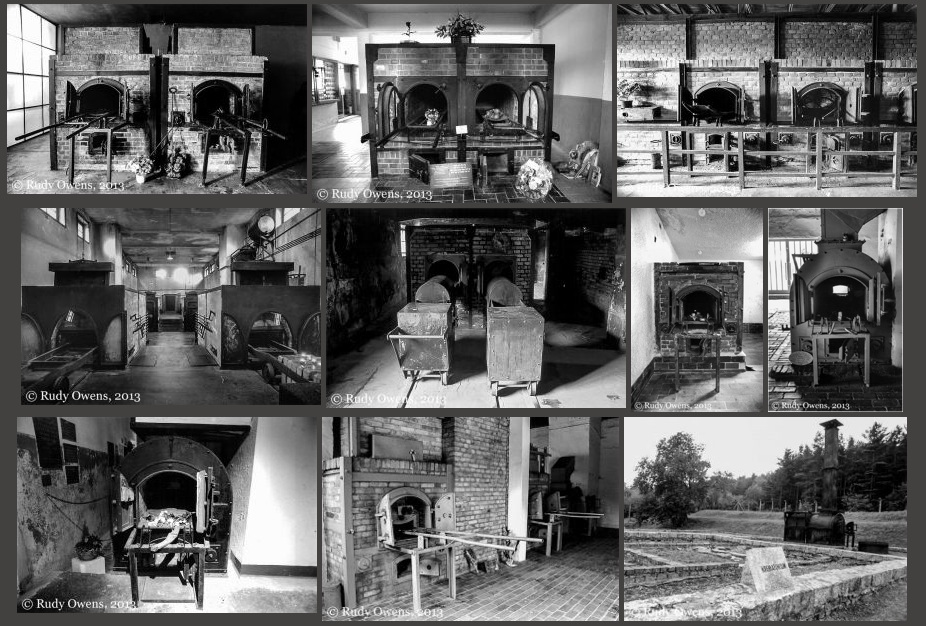
What is strikingly odd to me is I do not believe I was influenced by either of them. Yet the way I chose to explore my photographic project documenting concentration and death camps in five European countries closely mirrored the style of the Bechers. Even the way I chose to layout my photographs of crematoria, where murdered prisoners bodies were burned, bears an eerily familiar resemblance to the Bechers’ amazing work.

I don’t know what more to make of this except to say that I feel satisfied that my presentation style and methods are not singular. I also feel that the effect of combining similar images of strikingly mundane but complex objects can have greater weight in the format of a typology.

With that heavy photographic pontification complete, I present a screen snapshot of my crematoria series on my web site, followed by two screen snapshots of the Bechers’ typologies that I found online and also captured as a screen snapshot.

Rudy Owens' series on crematoria at Nazi concentration and death camps in Europe.
Rudy Owens’ series on crematoria at Nazi concentration and death camps in Europe.
Bernd and Hilla Becher, Gas Tanks.
Screen snapshot of the Bechers' many typologies and series, taken from Google's "image" tool.
Screen snapshot of the Bechers’ many typologies and series, taken from Google’s “image” tool.

Reflecting on the Armenian Genocide

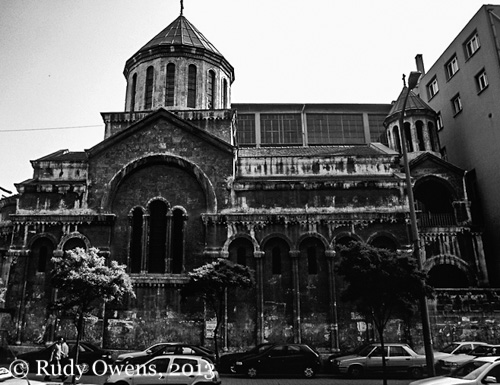
A long-abandonned Armenian church can be seen in the Karkoy neighborhood of Istanbul, Turkey, on one of the busiest streets of the largest city in the country.
A long-abandoned Armenian church can be seen in the Karakoy neighborhood of Istanbul, Turkey, on one of the busiest streets of the largest city in the country.

In September and October 2001, I traveled throughout Turkey for more than three weeks. It was one of my greatest trips ever. I loved the country and really enjoyed my experiences getting to know the Turkish people. I recommend the country to anyone. During that trip, I worked on a photo-documentary project, visiting historic locations of the Armenians. I also visited many other places too, from ancient monasteries, to Greek and Roman ruins, to the wonders of the Ottoman Empire, to Kurdish regions that were experiencing disturbances that have not fully settled to this day.

I did a lot of research before this trip, and received a lot of assistance from some Armenian colleagues I befriended as a result of my interest in photographing remnants of the Anatolian Armenians, who experienced the first clearly documented case of genocide of the 20th century. I do not wish to get into a larger discussion of that topic. I am republishing a story, with photographs, that I published first in 2002. It recounts my travels to historic locations linked to the genocide and Armenian history in present-day Turkey.

I finally got around to publishing this story again, after finding some materials I had forgotten about–the story told through numbers. Since I work in public health these days, I find myself steeped in data and perhaps a bit beholden to it. So with that frame of view, I present a “by the numbers” perspective on my travels in Turkey, this significant crime against humanity, and a point of view that I try to keep in focus when I get lost in the small stuff and forgot the important stuff.

My story, An Armenian Journey, is in PDF format, and because of its large file size at 25 mb, it may take a  while to download. Please be patient, as it well worth your time. A very useful map of the tragic events is published by the Armenian National Institute. A fine collection of historic prints and illustrations of now vanished Armenian communities in the Ottoman Empire in present-day Turkey can be found on the Houshamadyan web site. That site shows pictures of many of the places I visited, and you can compare historic pictures with the pictures I show in my story.

Reflecting on the Armenian Genocide, 1915-1922, by the numbers:

1  Number of Armenian Villages remaining in Turkey

1.5  Approximate number of persons, in millions, estimated to have been murdered during the genocide against Armenian citizens of the Ottoman Empire during and after World War I.

.6  Approximate number of Armenians, in millions, that the Turkish government today claims died during World War I during what the government called a military uprising.

35  Number of Armenian churches still active in Istanbul, according to a custodian at the Kilisesi Vakfik in the Galatasaray neighborhood of Istanbul.

100,000  Approximate number of ethnic Armenians residing in Istanbul today, according to members of the Holy Mother-of-God Armenian Patriarchal Church, in the Kumkapi neighborhood of Istanbul.

30 Approximate distance, in meters, from the Kumkapi police station to the Armenian Patriarchate (main church for Armenian Christians in Turkey).

5  Number of recognizable historic Armenian religious structures in Erzerum that are either labeled Selcuk or unknown origin.

2,549  Number of Armenian ecclesiastical buildings in the Ottoman Empire (churches, monasteries, parish structures), according to a survey by the Armenian Patriarchate of Constantinople in 1914, on the eve of the genocide (source, William Dalrymple, From the Holy Mountain).

464  Number of Armenian ecclesiastical buildings in the Republic of Turkey that had disappeared from the total of only 913 structures with known whereabouts in 1974, according to a survey done of the buildings that year (source, William Dalrymple, From the Holy Mountain).

252  Number of Armenian ecclesiastical buildings of the 913 buildings with known whereabouts that were in ruins, according to a survey done in 1974 (source, William Dalrymple, From the Holy Mountain).

197  Armenian ecclesiastical buildings of the 913 buildings with known whereabouts that were in sound shape, according to a survey done in 1974 (source, William Dalrymple, From the Holy Mountain).

0  Number of references to “Armenia” or “Armenians” at Ani, the historic cultural capital of the Bagratid Armenian kingdom in eastern Anatolia on the border of modern-day Armenia and inside Turkey.

1/2  Number of surviving Armenian structures in present-day Kozan, called Sis by the Armenians, and the capital of their kingdom in Cilicia in the 13th and 14th centuries and formerly seat of the Armenia Catholicasate.

0  Number of references to Armenia on signs next to these structures.

350  Approximate number of mosques (including the great Suleymaniye and Selimiye mosques), bridges, and buildings credited to the Armenian architect Sinan.

1  Number of Armenian religious buildings remaining in Harput, the center of the graphic, first-hand account of the genocide by American diplomat Leslie Davis called The Slaughterhouse Province.

4  Number of monument structures at Liberty Hill in Istanbul to honor Talaat Pasha and the Young Turks, the principal architects of the first genocide of the 20th century.

0  Number of signs outside the now locked and gated memorial indicating the contents inside the weed-covered area originally built in 1943 to honor the former Turkish leader, who was gunned down in Berlin in 1921 by an exiled Armenian, Soghomon Tehlirian (in 2001).

2  Number of Armenian spires visible at Isak Pasa Palace, near Mt. Ararat, a complex that contemporary sources say was built by a Kurdish chief in 1685. [Structure is called a Turbet in Let’s Go.]

2  Number of military points passed prior to entering the Ani complex.

3  Number of government and police offices required to complete an Ani application process (taking a quick one hour of time, in 2001).

25  Approximate cost, in U.S. dollars (as of October 2001), to visit the historic Ani ruins.

Number of road crossings open to commerce and road travelers between Turkey and present-day Armenia (in 2001).

6  Number of Armenian churches I visited in Istanbul that are now permanently closed.

0  Number of references to “Armenia” or “Armenian” at Akdamar Church, an Armenian church outside Van on an island in Lake Van.

53  Number of days more than 4,000 Armenian villagers in the Hatay Province south of Antakya, on Musa Dagh (“Mountain of Moses”), resisted Ottoman forces in 1915 before they were rescued by Allied warships.

18  Number of languages that Franz Werfel’s best-selling account of the famous siege and rescue–Forty Days of Musa Dagh–has been translated into since its first publication in 1933.

24  The day every April that Armenians the world over mark as their genocide anniversary day, commemorating the date in 1915 that 600 leading Armenians and another 5,000 Armenians in Istanbul were rounded up, and almost all killed.

Musings on slavery, abolitionist John Brown, and Hollywood’s clumsy embrace of human bondage

News stories continue to highlight the growth of human trafficking in the United StatesEurope, and especially Asia. One estimate puts the number of persons in captivity, either for forced bondage or sex trafficking and prostitution, at 12 million to 27 million. An increasing number of victims are young girls 18 and younger, who become infected with sexually transmitted diseases such as HIV/AIDs.

Slavery seems to bring out the worst of humanity, and perhaps is a manifestation of our inglorious inhumanity. Sadly it is, well, about as American as the U.S. Constitution that not only enshrined it, but gave Southern states extra voting power–the notorious 3/5ths clause–for its slaves in the census allotment of Congressional seats.

I still remember when I visited the Philippines in 2003. Male and female pimps repeatedly accosted me within seconds of exiting taxis in front of my hotels in Cebu City and Manila, where I was working on a photo-documentary project. I was sure their workers were sex slaves. When I told them to go away, they mocked me and even offered me young children. It was sobering to realize that I represented a market, a lucrative market, that eagerly comes to countries like the Philippines, Thailand, Cambodia, and Laos to exploit women, even young boys and girls. Though aware of the problem, and having seen evidence of its freewheeling nature in Asia, the unrelenting media coverage of sex slavery has become overwhelming.

Time Magazine reported on slavery in Embassy Row in the nation's capital three years ago, but it can happen anywhere in the United States.
Time Magazine reported on slavery in Embassy Row in the nation’s capital three years ago, but it can happen anywhere in the United States.

In April 2013, European Union Home Affairs Commissioner Cecilia Malmström lamented: “It is difficult to imagine that in our free and democratic EU countries tens of thousands of human beings can be deprived of their liberty and exploited, traded as commodities for profit.” The United Nations estimates human trafficking nets $32 billion annually—a major transnational business. The United States fares no better. There are slaves being trafficked and sold in my home city of Seattle right now. A local KIRO News story recently reported: “Child sex trafficking – as easy in Seattle as ordering a pizza.”

Visiting Osawatomie, and its place in U.S. history

So slavery was on my mind when I drove across the country in late May from St. Louis to Seattle. I wanted to take a road less traveled and see some out of the way places, including in Kansas. Most of my friends practically laughed at me when I described sight-seeing there. So, I pulled out my atlas and found Osawatomie on the map, about an hour southwest of Kansas City, along state Highway 169

Osawatomie is home to one of the most important battles of the violent pre-Civil War era known as Bleeding Kansas, which claimed 56 lives.

Specifically, it is where America’s most famous abolitionist and violent revolutionary, John Brown (1800-1859), fought pro-slavery forces to prevent the then Kansas Territory from becoming a slave state.  All told 30-45 free state defenders, known as Jayhawkers (the University of Kansas’ namesake) fought nearly 250 proslavery militia along the banks of the Marais de Cygnes River on Aug. 30, 1856. Brown’s son Frederick and others died. Many say the war actually began in this small Kansas town that pro-slavers burnt to the ground during the attack.

Entrance to John Brown Memorial Park in Ossawatomie, Kan.
Entrance to John Brown Memorial Park in Osawatomie, Kan.

In May of that year,  Missouri ruffians, numbering 800, had sacked Lawrence, Kan., and burned a hotel, killing one abolitionist. Their strategic goal was to keep an entire race of persons in human bondage and treated as nothing more than property, and expand the inhumane practice and trade into territories recently “ethnically cleansed” of its Indian population by the U.S. Army, based at Ft. Leavenworth.

On May 24 and 25, 1856, at the so-called Pottawatomie Massacre, Brown responded in kind, by murdering five pro-slavery settlers with a sword. The mass murder by Brown and his sons was inspired by Brown’s deep Christian faith that he had been called to undertake a divine mission to end slavery and contest its brutality and those of its violent supporters with force.

The repeated and well-publicized examples of slavery’s inhumanity in the United States enraged Brown to the point where he dedicated his life to crushing it and freeing the slaves. (Unlike most of his day, Brown also believed in the equality of races, including Indians, and of the sexes.)

Just two years earlier in 1854, a divided Congress passed the Kansas-Nebraska Act, ending the fragile 24-year-old Missouri Compromise allowing a balance of pro-slave and free states to join the Union. With the 1854 act, settlers themselves would determine if that “peculiar institution” of slavery, which held in bondage an estimated 4 million persons, or 13% of all residents in the young country, would be allowed. Pro-slavery voters won, but the constitution was disavowed, the bogus legislature tossed out, and Kansas entered a free state in 1861.

One historic political outcome from the four years of fighting in the territory was the rise of a young Illinois politician of the nascent Republican Party, who noted in his political speeches, “Look at the magnitude of this subject! … about one-sixth of the whole population of the United States are slaves!” Abraham Lincoln emerged from the turbulence of the era as the standard bearer of his party in the divisive 1860 election that set in motion the war to address what Lincoln accurately noted was the “the all absorbing topic of the day.”

As for Brown after Osawatomie, he travelled in and out of Kansas the next two years of violence before returning East to plan his failed Oct. 16, 1859, raid on the federal armory in Harper’s Ferry, Va.  The raid, with 21 men to trigger a Southern slave uprising, failed miserably.

A statue of the abolitionist and revolutionary John Brown stands guard at a park with his namesake in Osawatomie, Kan.

Brown was captured, tried in Charlestown, Va., and sentenced to hang to death on Dec. 2, 1859. During his trial he told the court, “Now, if it be deemed necessary that I should forfeit my life for the furtherance of the ends of justice, and mingle my blood further with the blood of my children, and with the blood of millions in this slave country whose rights are disregarded by wicked, cruel, and unjust enactments, I submit: so let it be done.”

Southern politicians were terrified by Brown’s decisive and violent insurrection against the U.S. government and their “cherished traditions.” Their paranoia of either a slave uprising or further such “meddling”  precipitated their rebellion against the union.

All of that history seemed overblown and forgotten in modern-day Osawatomie (pop. 4,447). The memorial to Brown and the battle is the John Brown Museum State Historical site. It includes a cabin of a local minister and his wife used as an Underground Railroad station. The cabin survived the battle. The park features a bronze statue of Brown and historic battle markers. It looked a little shabby and unappreciated, like any small-town park without money for upkeep, except it has happened to have two presidential visitors who delivered policy speeches, by Teddy Roosevelt in 1910 and Barack Obama in 2011.

Hollywood, Slavery, and the Battle for Kansas

For many of us, however, our perception of slavery is shaped by popular culture. One of two most recent Hollywood treatments of the subject was the scholarly costume epic Lincoln, by Stephen Spielberg. The film did not hide the brutality of slavery; in fact, the film opens with a vicious hand-to-hand battle pitting likely former slave Union soldiers locked in deadly embrace with their white Confederate adversaries. The film is basically a procedural drama how Lincoln’s administration passed the 13th Amendment to the Constitution, to end slavery “forever” in United States, while the nation’s most violent war rages outside of Washington.

The more controversial rendering of slavery is the 2012 Quentin Tarantino blood and gore pre-Civil War spectacle, Django Unchained.  This shoot-‘em up racks up a huge body count in a gratuitously violent revenge fantasy that follows the actions of a former slave, Django, played by Jamie Foxx. He kills perhaps nearly two dozen Southerners, blows up plantation mansions, and frees his true love. Unlike Lincoln, this film was heatedly debated. One review noted, “No single Hollywood film in the last decade has sparked the kind of controversy and wide-ranging response as Quentin Tarantino’s latest.”

The film triggered unrest not because of its brutal violence (nothing new for Hollywood splatter fests), but because of its rival view of history. “The most important thing about Django Unchained is that it’s a reaction against, or corrective of, movies like Birth of a Nation and Gone with the Wind. At every turn, it subverts or inverts the racist tropes that have defined Hollywood’s–and our culture’s–treatment of slavery, the Civil War, and Reconstruction,” according to Jamelle Bouie.

I have black friends who had a distinctly more positive personal reaction to the violent tale than did my white counterparts. While the film’s violence seems designed only thrill audiences, the violence of slavery and of efforts to expand it by pro-slavery bushwhackers in Kansas before and during the Civil War was every bit if not more cruel, if historical records are accurate. Reality actually trumps anything Tarantino could dream up.

The magazine Harper's printed an illustration of the 1863 raid by Southern bushwhackers of Lawrence, Kan, which killed 180 people.
The magazine Harper’s printed an illustration of the 1863 raid by Southern bushwhackers of Lawrence, Kan, which killed 180 people.

According to one account, a bushwhackers’ raid during the Civil War on Lawrence, Kan., is considered one of the worst cases of mass murder by the pro-Slavery forces.

On Aug. 21, 1863, 450 pro-Confederates Led by Bill Quantrill staged an early-warning raid and mostly showed no mercy, slaughtering about 180 men and boys as young as 14. Most of the victims were unarmed and still in their beds when the killing began. Another famous bushwhacker in the region, a psychopath named “Bloody” Bill Anderson, reportedly scalped victims before he was tracked and killed, and then beheaded as an example.

The official Hollywood rendering of “bleeding Kansas” and John Brown’s efforts to end slavery remains Michael Curtiz’s unsavory pro-slavery 1940 Western called the Sante Fe Trail (you can see the whole film here). The movie stars Errol Flynn as future Confederate General Jeb Stuart, then-actor Ronald Reagan as future Indian-killing General George Custer, and Olivia de Havilland as their mutual romantic interest. The film  renders a staggering historic whitewash of not only slavery and pre-Civil War America, but of John Brown’s actions in Kansas to contest the bushwhackers during the mid- to late 1850s.

Brown is portrayed by Raymond Massey as a bug-eyed, villainous psychopath bent on murder and revolution to end slavery, while Southern gentlemen like Flynn’s Stuart are true Americans who claim the South can work out slavery on their own terms.  There is no portrayal of slavery’s base cruelty, only abolitionist violence in Kansas and at Harper’s Ferry.

Raymond Massey portraying John Brown on his hanging day on Dec. 2, 1859--an event that sped the nation faster to Civil War.
Raymond Massey portraying John Brown on his hanging day on Dec. 2, 1859–an event that sped the nation faster to Civil War.

In an even more bizarre twist, future Confederate President Jefferson Davis is rendered as moral voice of wisdom, telling the graduating cadets: “”You men have but one duty alone, America.” This was the same Davis who owned slaves and dedicated himself to ensuring slavery’s survival as head of the pro-slave states doing everything they could to break away from that country.

The pro-slavery 1940 film Sante Fel Trail featured escaped slaves as subservient, pro-slavery fools who desired to return to plantation life rather than chase freedom with John Brown.
The pro-slavery 1940 film Sante Fe Trail featured escaped slaves as subservient, pro-slavery fools who desired to return to plantation life rather than chase freedom with John Brown.

The only “black folk” seen in this disingenuous Dixie-cratic rendering of reality are powerless, witless slaves who cannot think for themselves. After a firefight that sent Brown fleeing, a husband and wife slave couple from Texas caught up in Brown’s violence reveal themselves to Stuart as misguided lovers of the white slaveholding class: “Well, old John Brown said he gonna give us freedom but, shuckin’, if this here Kansas is freedom then I ain’t got no use for it, no sir,” drawled the wife. Her husband added, “Me neither. I just want to get back home to Texas and set till kingdom come.” I suppose that means he’d get a good whipping if he fessed up for trying to win his freedom.

As one film commentator noted: “In the years before 1960 most portrayals of slavery in cinema were like it was in Gone with the Wind and Jezebel. The slaves were happy and contented and too simple to live on their own. The Civil War was unnecessary and brought on by a handful of fanatics in the North.” The film’s final scenes show Brown before he is hung in 1859, followed by a happy kiss of the newlyweds, Flynn and de Havilland, all two years before the entire country entered its greatest conflagration that claimed more than half a million lives, finally “ending” slavery as a legal institution in the United States.

Former Klansman becomes part of Hollywood whitewash of Southern bushwhacking

The other noteworthy and historically inaccurate portrayal of Kansas-related bushwhacking violence is Clint Eastwood’s disturbing 1976 revisionist film The Outlaw Josey Wales. While supposedly based on a true Southern fighter, the film rewrites the script of historic events. Instead of violent Confederate bushwhackers who murdered indiscriminately, as they did in Lawrence, Southerners are portrayed as victims of murderous Jayhawkers and Union soldiers, who kill innocent women and slaughter surrendering prisoners, and hound Wales to Texas. The film was based on a novel, Gone to Texas, by Asa Carter, also author of a popular kid’s book called the Education of Little Tree.

At the time the film was made in 1976, it was unknown that Carter had reinvented himself. Instead of being a Cherokee Indian as he claimed, Carter was in fact a former Alabama Klansman, avowed racist, and speechwriter for Alabama’s segregationist Governor George Wallace. The books served as a clever reinvention for a man preaching against “government intrusion,” as Carter did for Wallace with racist hate language. Even his supposed Cherokee words were fiction. As for Josey Wales, the film helped to reinforce Southern stereotypes of Northern aggression and Southern innocence (despite its holding 4 million in captivity), while boosting Eastwood’s maverick filmmaking career.

In 2013, in an era when slavery seems to be as thriving an enterprise globally as it was in the antebellum South, perhaps it is time reexamine on the big screen the complex events in Kansas and Virginia and that fanatical revolutionary who committed his life to ending the institution forever. I just do not want the filmmaker to be Eastwood, Tarantino, or even Spielberg, nor a vampire camp production. Time to let someone else tell a tale that still needs to be told. Love or hate him, Brown was right about slavery’s stain on the nation. Brown’s enemies “could kill him,” wrote freed slave and fellow abolitionist Frederick Douglass, “but they could not answer him.”

Secret military tests in St. Louis and other communities violated the Nuremberg Code, according to researcher

As a former St. Louis area resident, I first thought my friend was pulling a prank when he shared a story on Sept. 29, which was picked up by the Daily Mail tabloid in the United Kingdom and alleged my old home city was intentionally contaminated by U.S. military researchers during the Cold war. I nearly deleted the email suspecting it was spam.

Professor Lisa Martino-Taylor

It turns out it was not a prank story in the Onion. During the last week of September 2012, St. Louis’ major broadcast news stations (KMOX and KSDK) broke a news story on recently completed research of government documents that showed U.S. military researchers conducted human subjects testing, in violation of the Nuremberg Code, on poor and minority residents in St. Louis during the 1950s and 1960s. The bombshell that was dropped by St. Louis Community College-Meramec sociology professor Lisa Martino-Taylor, in her PhD thesis, was that  U.S. Army’s researchers sprayed an aerosol on human subjects that allegedly was laced with a fluorescent additive, a possible radiological compound, produced by U.S. Radium Corp. The company had been linked to the deaths of workers at a watch factory decades before.

The issue of the U.S. government testing on unwilling and non-consenting persons for military and medical research during the Cold War has long been established, both in St. Louis, and also in the Inner Mountain West and in Washington State. At the Hanford Nuclear Reservation, in southeastern Washington, radioactive iodine (I-131) was intentionally emitted in 1949 ( the Green Run test) to measure the impacts of exposure on human health as part of the U.S. Air Force’s efforts to better understand and track Soviet weapons testing. For its part, St. Louis was one of 33 U.S. and Canadian cities and rural areas intentionally exposed to the spray that was dispersed from airplanes, rooftops, and vehicles. A subsequent National Research Council committee, in 1997, claimed these tests did not expose residents to chemical levels considered harmful. However, promised follow-up studies may not have been conducted. Residents in St. Louis were quoted in press reports claiming planes dropped a white powder that fell on people below, which residents did not view as potentially harmful.

Photograph published in Martino-Taylor’s thesis on the U.S. Army’s aerosol spraying activities in St. Louis and other areas.

According to Martino-Taylor, thousands upon thousands of St. Louis residents likely inhaled the zinc cadmium sulfide spray. In St. Louis, where tests were conducted in 1953-54 and 1963-64 by the U.S. Army Chemical Corps, Martino-Taylor said, ”The powder was milled to a very, very fine particulate level.  This stuff travelled for up to 40 miles.  So really all of the city of St. Louis was ultimately inundated by the stuff.”  The Daily Mail reported one of the compounds sprayed unknowingly on St. Louis residents was FP2266 (radium 226), which according to the U.S. Army was made by U.S. Radium Corp. The compound was the same one that was linked to the death and of former U.S. Radium Corp. workers.

According to press coverage, the U.S. Army has admitted that it added a fluorescent substance to the “harmless” compound, but the issue of whether the additive was radioactive remains classified.

The story was immediately picked up by a number of blogs, which repeated the allegations and news coverage. Almost immediately, Missouri’s two U.S. senators, Claire McCaskill (D) and Roy Blunt (R), wrote to Army Secretary John McHugh demanding answers and to ask if follow-up studies promised in 1997 by the National Research Council were ever completed.  The full text of McCaskill’s letter and press release can be found here.

Pruitt-Igoe housing complex before it was dynamited and cleared.

According to an Oct. 3, 2012, AP story, aides to Sens. McCaskill and Blunt said they have received no response. At the time of the story, the U.S. Army declined to be interviewed by the AP. The AP’s story notes that St. Louis was chosen for reserach because it resembled some Russian cities. However, one of the primary areas that was chosen for testing was the Pruitt-Igoe public housing complex, which was razed in the 1970s as a failed national public housing experiment–and one of St. Louis’ legacies as a decaying city. At the time of the spraying by federal researchers, the complex had 10,000 mostly African-American and low-income residents, 70 percent of whom were 12 and younger.

Martino-Taylor’s thesis (The Manhattan-Rochester Coalition, research on the health effects of radioactive materials, and tests on vulnerable populations without consent in St. Louis, 1945—1970) is worth examining first-hand, as it describes how she was tipped to the improbable and almost unbelievable tales of two women, both sharing stories of having been unwilling human subjects to military spraying and suffering health consequences from that research. Surprisingly, she knew nothing about these then allegations. Thus began her effort to request information under the U.S. Freedom of Information Act from the federal government, often in severely redacted form. A point that much of the media continues to miss is that her research focuses on the researchers as well as their victims. Her thesis statement states her work looks at how a “large number of participants inside an organization will willingly participate in organizational acts that are harmful to others, and how large numbers of outsiders, who may or may not be victims of organizational activities, are unable to determine illegal or harmful activity by an organization.”

The leaders of the studies, which she calls the Manhattan-Rochester Coalition, were the researchers who conducted the human-subjects research on nuclear weapons as part of the country’s efforts to prepare for, and win, a possible nuclear confrontation with the U.S.S.R. During the tests in St. Louis and other areas, according to Martino-Taylor, the U.S. Army violated the 1947 Nuremberg Code, the standard set after trials of Nazi doctors and war criminals, which established that “voluntary consent of the human subject is absolutely essential” for any human-subjects testing. There was no such standard in these tests in St. Louis, Minneapolis, and elsewhere, Martino-Taylor maintains.

Medical experimentation room at the Terezin concentration camp in the Czech Republic.

During the 1940s, the Nazi regime’s corrupt and criminal medical and scientific community committed horrific crimes at dozens of concentration and extermination camps in Nazi-occupied Europe, including live vivisections, gassings, cold water immersion tests, high-pressure testing, lethal injections, and intentional murder for “scientific purposes.” I in fact visited many of the rooms and buildings where these crimes against humanity occurred during my tour of the camps in the summer of 2000, so it was especially painful for me to know that my own government, in my former home city, may have been breaking established international guidelines that were codified following the defeat of the Nazis and their murderous state. (See my photo documentary here.) According to Martino-Taylor, the initial congressional investigation of the spraying program included testimony from experts that claimed the experiment team “chose to ignore Nuremberg.”

In the United States, following the Tuskegee Institute’s syphilis experiments on African-American men, reforms were passed in 1979 through the Belmont Report, which theoretically was supposed to protect human subjects from harm in research. However, even as the media report on this sensational story of testing on humans in two countries (Canada and the United States) in the 1950s and 1960s, researchers at elite universities and laboratories continue to violate the principles first set out at Nuremberg. Slate.com this year reported that “marginalized groups have frequently been coerced into studies that violate their right to consent. A recent review of the bio-ethics of human research in the U.S. offers little prospect for change.”

The Slate.com story, from Jan. 22, 2012, was gloomy in its overall assessment of the failure of safeguards to prevent unethical research on humans, particularly when large corporate interests are involved. The story said the Presidential Bioethics Commission issued a report on protecting human research subjects that trumpeted the United States’s so-called “robust” protections—rules that have repeatedly permitted and legitimized breaches of informed consent. “The failure to elicit consent is not confined to the U.S. One in every three U.S. corporate medical studies is now carried out abroad, usually in places where trials can be conducted more cheaply than in the U.S. Subjects are often unaware that the treatments are experimental.”

I am pretty sure the dust from this recent controversy will settle quickly, and even in St. Louis, the community will focus more on their beloved Cardinals’ bid for another World Series title. It is likely no one involved in these unethical if not possibly illegal studies will ever be held accountable for their actions against the civilians they may have harmed.

A trip to Indian country and the Omak Stampede

So what is “Indian country”?

Drummers gather to perform at the Indian encampment at Omak’s Stampede, in August 2012.

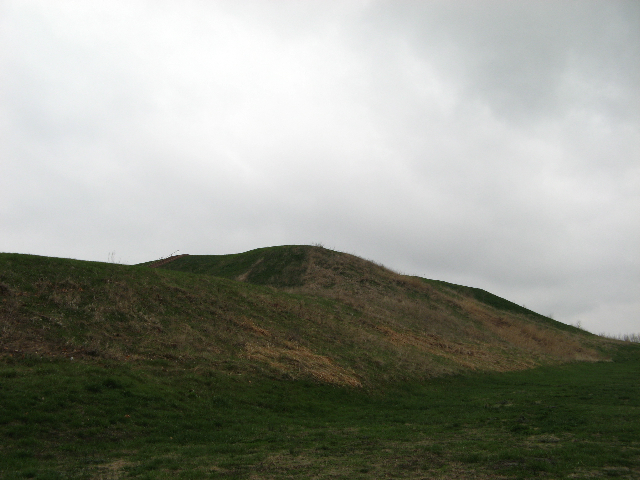
A now-deceased doctor friend of mine who dedicated his life to serving the Native community in the Indian Health Service used the expression a lot describing where he worked in New Mexico and Alaska. It is a legal term, codified in treaty rights, federal regulations, and court decisions. Indian country can be a physical place, associated with customs and cultures of the continent’s first peoples. It is also a state of mind. You literally know you are in Indian country when you go there. There are place names and of course the people. I grew up in St. Louis, Mo., which sits on the mighty Mississippi River (Ojibwe for “great river”), and I felt connected to Indian country there because of the great muddy and the phenomenal Cahokia Mounds just east of the city in Illinois. I knew I was living on historic Indian land even as a kid.

The largest Native mound in the United States is located at the historic Cahokia Mounds, just east of St. Louis.

I have lived the last 16 years of my life in what I definitely consider to be Indian Country, Alaska and Washington State. Alaska felt much more like Indian country to me. Anchorage, my home for six years, is very much a Native city in terms of population (about 16 percent). I rarely feel that connection in modern, congested, urban Seattle.  But I recently took a four-day trip to the hot, upper plateau of central Washington, from the Methow Valley to Omak, and indeed felt I had landed four-square in Indian country again.

According to a section of federal legislation pertaining to Native Americans, “Indian country” refers to three specific criteria:

-All land within the limits of any Indian reservation under the jurisdiction of the United States government, notwithstanding the issuance of any patent, and including rights-of-way running through the reservation;

-All dependent Indian communities within the borders of the United States whether within the original or subsequently acquired territory thereof, and whether within or without the limits of a State; and

-All Indian allotments, the Indian titles to which have not been extinguished, including rights-of-way running through the same.

Indian country also implies U.S. federal recognition of tribal bands as sovereign on their lands and capable of enjoying rights that are government to government. As one source notes, recognized tribes “possess absolute sovereignty [that] are completely independent of any other political power,” but also which is shared with other jurisdictions (local, state, and federal).

In Washington state, federal definitions of “Indian country” apply to state law, in addition to provisions acknowledging tribes non-taxable status in some commerce, such as the sale of tobacco products to tribal members on their reservation. In Seattle, there is still a band, the sparsely populated Duwamish, who have lost their sovereign status  and failed to win legal recognition in the city’s limits, on some of the choicest real-estate on the West Coast. Another nearby tribe, the Snoqualmie, regained their status in 1999 and promptly built a casino and became an economic and political player.

The decades-long fight over treaty-protected fishing and subsistence rights by the tribes culminated in the historic 1974 ruling in the landmark U.S. v. Washington case (the Boldt Decision) that unequivocally affirmed 19 federally-recognized tribes’ fishing rights to salmon and steelhead runs in western Washington. That decision gave the tribes rights to half of the salmon, steelhead, and shellfish harvests in the Puget Sound. It was a major game changer, and its impacts are still felt today–particularly legal squabbles if the decision should still be applied to land-use decisions impacting salmon habitat.

Yet, even as I gaze out on the beautiful Puget Sound, I am hard-pressed to think that I am on historic Indian lands, that I live in Indian country, where there are 29 federally-recognized tribes, in all corners of the state (see tribes and locations here).  But this is very much Indian country in a historic and cultural sense.

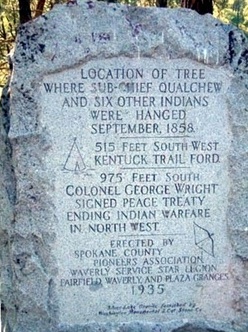
In fact, more than half of the state was outright taken by military force, illegal land seizures, and treaties (which also provided fishing and resource rights to tribal members) from the 1850s to the 1890s. Many stories of the exploitation of Native tribes come to mind, notably the hanging of Yakima warrrior Qualchan (also called Qualchew) by the reportedly violent Col. George Wright, in his campaign that defeated five tribes in Washington in the eastern half of what is now is the state. 

On Sept. 25, 1858, Qualchan had surrendered with a white flag and was hung within 15 minutes. That was followed with the hanging of six Palouse warriors the next day. Such incidents typified the period of conquest in my home state. Exploitation of tribal rights followed the signing of treaties. The Colville Tribes, for instance, had their lands stolen without their consent, setting off decades of legal battles that continued to the 1930s and ended in historic settlements returning hundreds of thousands of stolen acres of land.  Salmon and steelhead runs in the state were decimated by commercial fishing interests that harmed tribal groups in the upper and lower Columbia River basin. The runs were further extinguished by the dams built on the Columbia River. Only with the Boldt Decision in 1974 did the tide turn, but with numbers that no where near compared to the great runs of 100 years earlier.

Again, all of this is very academic and abstract to me and most Western Washington residents. Only when I traveled to the “World Famous Omak Stampede” rodeo and suicide race, with Native riders who charge down a 200 foot hill on horseback every second weekend of August, did I again realize I was truly in Indian country. Omak, in north central Washington, lies partially in the 1.4 million-acre Colville Reservation, in sparsely populated Okanogan and Ferry counties. The Confederated Tribes of the Colville Reservation number less than 10,000. I found the area to be amazingly beautiful. It’s hot in the summer, and bitterly cold in the winter. During my visit to Omak for the Stampede, the mercury hit 100 F.

Outside of agriculture (on non-tribal lands), there is little industry in this part of the state, but there is gold mining, forestry, and a limited personal use salmon fishery for tribal members.  Forestry is the mainstay for generating tribal revenues. Gaming is also a big moneymaker at the tribes’ three casinos. If you can believe it, the casinos are attracting acts like blues legend Buddy Guy and rock has-beens like Foreigner and Joe Walsh in the next few weeks. I think it’s a bit sad that even stalwart Canadians are driving south from British Columbia to spend their loonies at the tribal gaming tables, but come they do.

Despite the flow of revenues, health issues remain a problem, as they do throughout Indian country. A June 9, 2012, story republished in the New York Daily News about Tribal Councilman Andy Joseph, Jr., profiles his efforts to address Native health funding issues. The story notes his tribal members and others nationally “are dying of cancer, diabetes, suicide and alcoholism. They are dying of many diseases at higher rates than the rest of the population. And instead of those rates getting better, they’re getting worse.” Joseph is the tribes’ representative to the Northwest Portland Area Health Board, which serves 41 tribes in Washington, Oregon, and Idaho, and is that group’s delegate to the National Indian Health Board, which speaks for all 566 federally-recognized tribes in the country. The story notes that, nationally, tribal members die an average of five years earlier than the rest of the U.S. population and are six times more likely to die of tuberculosis or alcoholism, three times more likely to die of diabetes, and also twice as likely to be killed in an accident. What’s more, they are also twice as likely to die from homicide or suicide. Pretty grim data indeed.

According to Joseph, the major health issues associated with diet and nutrition have occurred as a result of conquest and cultural assimilation: “‘Joseph holds up a jar of canned salmon sitting on his desk. ‘Our people crave this,’ he said. ‘It was taken away from us when they put Grand Coulee Dam in.’ He reaches for a string of dried camas root. ‘It’s what our bodies were raised with for thousands of years. Now, we have Safeway and Albertsons and Walmart.'”

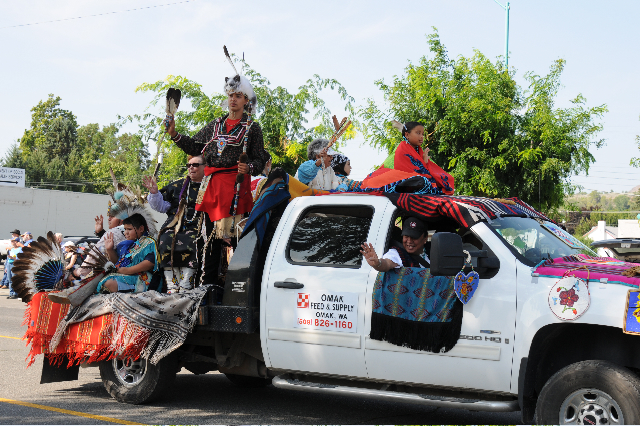
In Omak, I got a taste of Native pride during the Omak Stampede Parade, which mainly featured local businesses, rodeo princesses, groups like firefighters, Republican office holders or candidates, and less than half a dozen Indian floats. (I saw no Latino groups in the parade, despite their large presence picking fruit and in agriculture–they “officially” number about 15 percent of Omak’s residents.)

A Native float at the Omak Stampede parade.
Some of the many teepees at the Native encampment at the Stampede.

The Stampede features a tribal encampment with teepees and a performance area where tribal members perform traditional dances and song in gorgeous costumes.  It reminded me a lot of Alaska, particularly the many gatherings I saw there, including the largest conference called the Alaska Federation of Natives Annual Convention. Yup, I was definitely in Indian country.

My only real, true regret was that I missed the Suicide Race, which features some of the state’s finest Native horseman who charge down the steep hill and swim across the Okanogan River on their way to the finish inside the Omak Stampede stadium. You can watch it on YouTube, and note some times, yes, horses have died in this race.

Being SMART about feel-good social media sensations

Like many people, I have very mixed feelings about the media phenomenon that is the super viral video known as Kony 2012. It has a sexy opening line: “Nothing is more powerful than an idea”–something that is a two-edged sword.  This can be terribly awful if applied by those promoting “evil agendas” (explained below). The video is produced by a group called Invisible Children, itself a major recipient of corporate giving (JP Chase Morgan Bank is a huge supporter of this group, according to the company’s web site). This itself gives one pause.

The moment I saw it, I was screaming out loud: “manipulative,” “scam,” “cliche,” “heroic white saviors,” “powerless Africans with only one name,” “exploitative.” I actually have followed this story for more than a decade, and I have been to northern Uganda in 1997, where the Lord’s Resistance Army wrought havoc on innocent Ugandans. This is a long, complex story involving several African nations, ethnic groups, geopolitics, and more. This video, while bringing a horrible human rights offender to the attention of the public, disregarded many historic realities that I found deeply troubling as a former journalist. For instance, the main villain, Joseph Kony, is no longer in Uganda committing crimes; he reportedly was last seen in the Democratic Republic of Congo.

So what are we to do when we see how emotionally manipulative media products can gain one instant notoriety and fame, itself a goal of many scraping to make it in media production, photography, and storytelling.  (Recall “performance artist,” but definitely not a journalist, Mike Daisy and the factually inaccurate story he pushed about Apple’s suppliers in China that compromised his career and brought disgrace to the radio show This American Life.)

I can never disassociate the message from the person. Remember Leni Riefenstahl and her hypnotically seductive Triumph of the Will, a  scary masterpiece of fascist propaganda released in 1935 (when concentration camps were not quite operationalized) that helped the cause of one of the greatest murdering madmen of human history, Adolf Hitler? Riefenstahl latter downplayed her Nazi sympathies and attempted to justify her work as merely the output of an artist doing a job, without moral consideration for the outcome. And she was a brilliant photographer and filmmaker, who even after being associated with a genocidal regime, revitalized her career with images of Sudan (The Last of the Nuba) that many would think of today as “progressive” in its orientation. (See the stunning photo below.)

Leni Riefenstahl’s photos of the Nuba, seen here, are brilliant images in their own right, but should they be viewed as distinct from her ties to a genocidal regime from her more youthful days?

I just stumbled on a promotional page for a group called International League of Conservation Photographers. I immediately smelled the conflict between huge egos involved in their media/photographic work and their worthwhile “cause.” The video creates an image of heroic warriors, backed by their own orchestral score. Or, are they just talented photographers trying to make a living too as photographers. What do you all think?

I am always going to suspect self-promotion if I do not see a clearly defined goal that accompanies the promotion. This organization states what many would believe to be a worthy goal: “The ILCP seeks to empower conservation photographers by creating an organizational structure that allows them to focus on the creative aspects of their work while at the same time finding venues that allow their images to make a significant contribution to the understanding and caring of the environment.” But is this truly a clear roadmap?

In public health, they teach us that the best interventions have SMART objectives because they provide the clearest guidelines for developing measurable, achievable actions. SMART stands for:
-Specific
-Measurable
-Attainable
-Relevant
-Time Bound

Whether SMART objectives actually lead to change, or themselves become watered down by their clever wording, is another topic. But in general, I believe this is a relevant way for looking at groups who promote social change. Is what they are offering SMART, or is something more akin to Triumph of the Will, dressed in clever social media marketing. That really is the job of the viewer, but also those who can also use social media to call attention to Triumph of the Will’s and Kony 2012’s viral step-children.

A look back at an uncomfortable photo: Birkenau

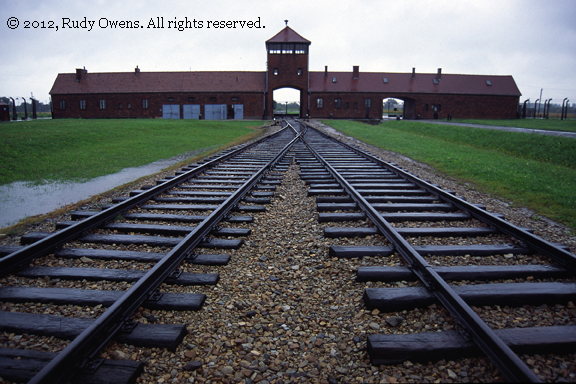
In March, I licensed a photo to the University of Texas at Dallas that I took in July 2000 of Birkenau, the largest Nazi death camp that is known to most people as Auschwitz. The image will be used by the university’s Holocaust studies center, which is a good thing. I don’t enjoy looking at these photos, but I do think this is one of the better ones I took from my documentary project I did throughout Europe of Nazi camps and places linked to that regime’s terrible crimes.

I remember the day I took this photo well too. It was pouring rain, in late July. I awoke at 5 a.m. to catch the train from Krakow to Auschwitz. I was the first one at the gate that morning. I met a death camp survivor right by that entranceway. He was at one of the subcamps, Gurtz. He was an elderly Israeli man, but fit and vital. We exchanged some words. He was tough and he hated being there, but he was there all the same. I then toured the whole camp. During the tour, I met a survivor and his colleagues and heard personal stories. I took a lot of pictures that day and learned a great deal about things that still disturb me. I remember the survivor shaking my hand as I left saying he was glad I had come. As I look back, I am glad I came, but some days I am not.