Africa revisited through the Dark Star Safari

From the comfortable security of my modern cocoon in Seattle, Wash., I am vicariously reliving some long-ago travels I made in Africa during the summer of 1997, which already was 15 years ago. I have the often cynical but always observant and honest Paul Theroux to thank for being lifted out of my quotidian boredom and back to my brief five-week journey in central and East Africa.

Sunrise on the Serengeti, a magnificent sight indeed.

In June 1997, I travelled to Rwanda, just three years after the genocide. I arrived there, hoping to try my hand at freelance journalism and perhaps cover some of the genocide trials that were underway in the aftermath of the horrific crimes against humanity. I lacked two of the most critical elements to pull this off: connections and cash. Maybe I lacked cajones too. I also was floored by malaria once I arrived in Kigali, Rwanda, and I pulled out in two weeks, having lost a lot of weight and having determined I would not have the resources to succeed in my original plan. As to whether I would have succeeded as a freelancer if I stayed longer is hard to say, as Rwanda then was in the throes of an incredibly violent civil war that had claimed thousands of lives. That conflict, which involved the stopping of microbuses—like ones I was riding—and the slaughtering of all passengers, was pitting the Tutsi-led forces of the new post-genocide government of Rwanda against the extremist Hutu militias who had taken hold in then eastern Zaire. This was just before Zaire’s own meltdown into violent civil war, tribal violence, and foreign interventions that remains unresolved to this day.
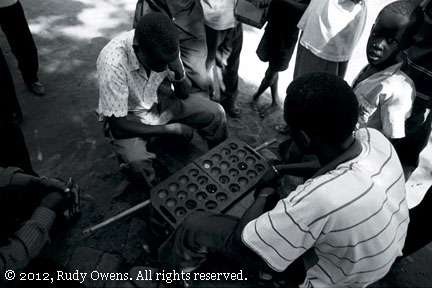
Passing the time in Moroti, Uganda, on my way to the north of the country in 1997.

Theroux’s book, called Dark Star Safari, is typical and classic Theroux. It recounts a year-long trip he made from Cairo to Capetown in the early 2000s, mostly by land transportation, using local means such as the back of trucks, buses, microbuses, and sometimes rides in Land Rovers and overland safari trucks with the many white Westerners he sees. Theroux is unforgiving in his criticism of both Africans and of outsiders, who are mostly Westerners but occasionally Indians, Japanese, and Chinese. Theroux often savagely skewers this mostly Western crowd as if they were the marabou scavengers, the quite ugly and ubiquitous large storks seen throughout eastern Africa, which lurk about and wait for carrion to devour.

I like Theroux because he attempts to put what he sees into context, with the perspective of a man who spent two years of young adulthood as a Peace Corps volunteer in Malawi in the 1960s and later several years as a lecturer in Kampala, Uganda, before the despot Idi Amin took over and destroyed that nation. To his credit, Theroux’s comments on the failures of aid projects, for instance, are based on his first-hand encounters. He credits foreign aid organizations and Western governments for creating a culture of aid dependency in many African nations. But his biggest target is corruption by African leaders and its military and civilian rulers. Writes Theroux of the large cities he visited and detested on his trip: “Scamming is the survival mode in a city where tribal niceties do not apply and there are no sanctions except those of the police, a class of people who in Africa generally are little more than licensed thieves.“

Traveling by bus in Uganda, rarely a dull moment.

I have exchanged a few emails about this book with a friend of mine who also did a Peace Corps stint in Africa and who thought Theroux was honest about what he observed. I told my friend that Theroux’s description of traveling through a inhospitable, mostly lawless area from Mega, Ethiopia, to Isiolo, Kenya, where two white Westerners refused to give him a ride in their Land Rover, brought back my own memories. Like Theroux, I saw plenty of those same Land Rovers in Kenya, Rwanda, and Uganda and also never got a lift. (Did I deserve one—no, but they could have been offered; I did refuse a ride once too because I wanted to walk, but the driver was African and a decent guy.) I too wondered who are these privileged outsiders anyway? I remember distinctly two haughty U.N. officials—an African and European—sniping like French lords at low-paid Rwandan hotel staff while wearing stylish dark shades and expensive suits, angry dust got on their suitcases, as they disembarked at Milles Colines Hotel, made famous during the genocide where Tutsis hid while surrounded by killers. The cost for a room in 1997 was about $150 a night as I recall, or about half of what a Rwandan then earned in a year. I could not afford the place and luckily found accommodation with a great aid worker I met who I thought was doing good work.
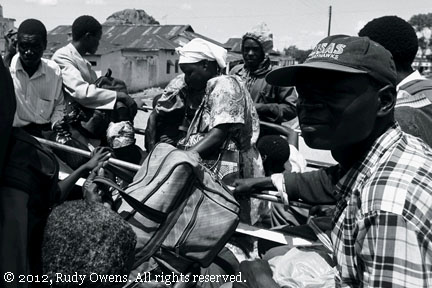
Like Theroux, I travelled by truck to some remote parts in the bush. This trip took about 12 hours and was among my most memorable.

I also remember Italian missionaries in Northern Uganda, near Karamojo, in the deep bush who ran a furniture shop and spoke the local language and seemed completely at ease and in their element — like some of the Italian missionaries Theroux met in Ethiopia and Kenya. And, like Theroux, I remember these “overlanders,” the white tourists on coverted safari trucks crossing Africa, when I stopped at Lake Naivasha, Kenya. In my case, the passengers expressed excitement about seeing mountain gorillas in Rwanda without having a clue about the raging conflict there or another violent uprising that was occurring in southwest Uganda. And one has to wonder about two female aid workers he disparaged for their peddling of a Plumpy’nut type nutritional food product to poor children in person cause they reportedly didn’t trust the mothers to deliver the aid themselves? Is that true? I believe it is. Just this spring I heard an announcement by U.S. AID that the United States is pushing corporate food aid with corporate food giant Pepsico, in Ethiopia. What’s good for Pepsico is also good for U.S. AID and Ethiopians, if I am to believe the facts in this press release.

Anyway, not everyone agrees with Theroux, and here’s one attack, by John Ryle from 2002 in the Guardian, of the book and of the writer himself. Personally, I think Theroux is smart and clearly sees the public health, economic, political, and outsider-driven problems that challenge the countries he visited. I also do not think one sells books being nice or being 100 percent true. Theroux is a strong brand, and you know what you get when you read his brand. And it remains exceptionally enjoyable.

I shot this photo near Mt. Karamojong, a mountain that is home to a rebellious group who were known to rob locals with AK 47s when they were not fighting with other cattle raising tribes in Kenya. Or maybe they are just a tribe trying to survive in a land with few resources and many threats.

A trip to Indian country and the Omak Stampede

So what is “Indian country”?

Drummers gather to perform at the Indian encampment at Omak’s Stampede, in August 2012.

A now-deceased doctor friend of mine who dedicated his life to serving the Native community in the Indian Health Service used the expression a lot describing where he worked in New Mexico and Alaska. It is a legal term, codified in treaty rights, federal regulations, and court decisions. Indian country can be a physical place, associated with customs and cultures of the continent’s first peoples. It is also a state of mind. You literally know you are in Indian country when you go there. There are place names and of course the people. I grew up in St. Louis, Mo., which sits on the mighty Mississippi River (Ojibwe for “great river”), and I felt connected to Indian country there because of the great muddy and the phenomenal Cahokia Mounds just east of the city in Illinois. I knew I was living on historic Indian land even as a kid.

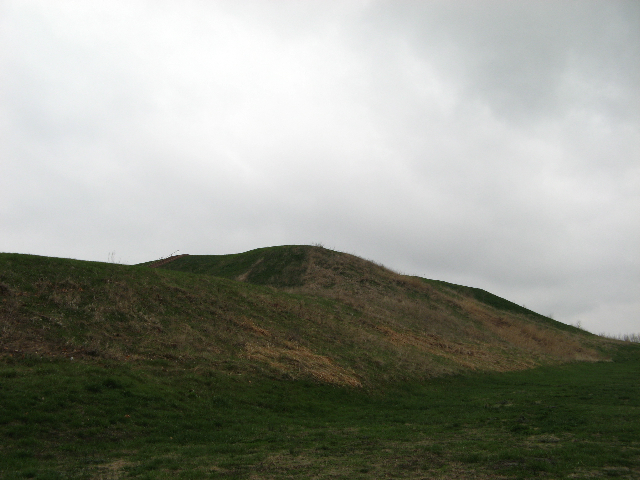
The largest Native mound in the United States is located at the historic Cahokia Mounds, just east of St. Louis.

I have lived the last 16 years of my life in what I definitely consider to be Indian Country, Alaska and Washington State. Alaska felt much more like Indian country to me. Anchorage, my home for six years, is very much a Native city in terms of population (about 16 percent). I rarely feel that connection in modern, congested, urban Seattle.  But I recently took a four-day trip to the hot, upper plateau of central Washington, from the Methow Valley to Omak, and indeed felt I had landed four-square in Indian country again.
According to a section of federal legislation pertaining to Native Americans, “Indian country” refers to three specific criteria:

-All land within the limits of any Indian reservation under the jurisdiction of the United States government, notwithstanding the issuance of any patent, and including rights-of-way running through the reservation;

-All dependent Indian communities within the borders of the United States whether within the original or subsequently acquired territory thereof, and whether within or without the limits of a State; and

-All Indian allotments, the Indian titles to which have not been extinguished, including rights-of-way running through the same.

Indian country also implies U.S. federal recognition of tribal bands as sovereign on their lands and capable of enjoying rights that are government to government. As one source notes, recognized tribes “possess absolute sovereignty [that] are completely independent of any other political power,” but also which is shared with other jurisdictions (local, state, and federal).

In Washington state, federal definitions of “Indian country” apply to state law, in addition to provisions acknowledging tribes non-taxable status in some commerce, such as the sale of tobacco products to tribal members on their reservation. In Seattle, there is still a band, the sparsely populated Duwamish, who have lost their sovereign status  and failed to win legal recognition in the city’s limits, on some of the choicest real-estate on the West Coast. Another nearby tribe, the Snoqualmie, regained their status in 1999 and promptly built a casino and became an economic and political player.

The decades-long fight over treaty-protected fishing and subsistence rights by the tribes culminated in the historic 1974 ruling in the landmark U.S. v. Washington case (the Boldt Decision) that unequivocally affirmed 19 federally-recognized tribes’ fishing rights to salmon and steelhead runs in western Washington. That decision gave the tribes rights to half of the salmon, steelhead, and shellfish harvests in the Puget Sound. It was a major game changer, and its impacts are still felt today–particularly legal squabbles if the decision should still be applied to land-use decisions impacting salmon habitat.

Yet, even as I gaze out on the beautiful Puget Sound, I am hard-pressed to think that I am on historic Indian lands, that I live in Indian country, where there are 29 federally-recognized tribes, in all corners of the state (see tribes and locations here).  But this is very much Indian country in a historic and cultural sense.

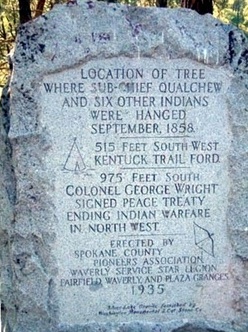
In fact, more than half of the state was outright taken by military force, illegal land seizures, and treaties (which also provided fishing and resource rights to tribal members) from the 1850s to the 1890s. Many stories of the exploitation of Native tribes come to mind, notably the hanging of Yakima warrrior Qualchan (also called Qualchew) by the reportedly violent Col. George Wright, in his campaign that defeated five tribes in Washington in the eastern half of what is now is the state. 

On Sept. 25, 1858, Qualchan had surrendered with a white flag and was hung within 15 minutes. That was followed with the hanging of six Palouse warriors the next day. Such incidents typified the period of conquest in my home state. Exploitation of tribal rights followed the signing of treaties. The Colville Tribes, for instance, had their lands stolen without their consent, setting off decades of legal battles that continued to the 1930s and ended in historic settlements returning hundreds of thousands of stolen acres of land.  Salmon and steelhead runs in the state were decimated by commercial fishing interests that harmed tribal groups in the upper and lower Columbia River basin. The runs were further extinguished by the dams built on the Columbia River. Only with the Boldt Decision in 1974 did the tide turn, but with numbers that no where near compared to the great runs of 100 years earlier.

Again, all of this is very academic and abstract to me and most Western Washington residents. Only when I traveled to the “World Famous Omak Stampede” rodeo and suicide race, with Native riders who charge down a 200 foot hill on horseback every second weekend of August, did I again realize I was truly in Indian country. Omak, in north central Washington, lies partially in the 1.4 million-acre Colville Reservation, in sparsely populated Okanogan and Ferry counties. The Confederated Tribes of the Colville Reservation number less than 10,000. I found the area to be amazingly beautiful. It’s hot in the summer, and bitterly cold in the winter. During my visit to Omak for the Stampede, the mercury hit 100 F.

Outside of agriculture (on non-tribal lands), there is little industry in this part of the state, but there is gold mining, forestry, and a limited personal use salmon fishery for tribal members.  Forestry is the mainstay for generating tribal revenues. Gaming is also a big moneymaker at the tribes’ three casinos. If you can believe it, the casinos are attracting acts like blues legend Buddy Guy and rock has-beens like Foreigner and Joe Walsh in the next few weeks. I think it’s a bit sad that even stalwart Canadians are driving south from British Columbia to spend their loonies at the tribal gaming tables, but come they do.

Despite the flow of revenues, health issues remain a problem, as they do throughout Indian country. A June 9, 2012, story republished in the New York Daily News about Tribal Councilman Andy Joseph, Jr., profiles his efforts to address Native health funding issues. The story notes his tribal members and others nationally “are dying of cancer, diabetes, suicide and alcoholism. They are dying of many diseases at higher rates than the rest of the population. And instead of those rates getting better, they’re getting worse.” Joseph is the tribes’ representative to the Northwest Portland Area Health Board, which serves 41 tribes in Washington, Oregon, and Idaho, and is that group’s delegate to the National Indian Health Board, which speaks for all 566 federally-recognized tribes in the country. The story notes that, nationally, tribal members die an average of five years earlier than the rest of the U.S. population and are six times more likely to die of tuberculosis or alcoholism, three times more likely to die of diabetes, and also twice as likely to be killed in an accident. What’s more, they are also twice as likely to die from homicide or suicide. Pretty grim data indeed.

According to Joseph, the major health issues associated with diet and nutrition have occurred as a result of conquest and cultural assimilation: “‘Joseph holds up a jar of canned salmon sitting on his desk. ‘Our people crave this,’ he said. ‘It was taken away from us when they put Grand Coulee Dam in.’ He reaches for a string of dried camas root. ‘It’s what our bodies were raised with for thousands of years. Now, we have Safeway and Albertsons and Walmart.'”

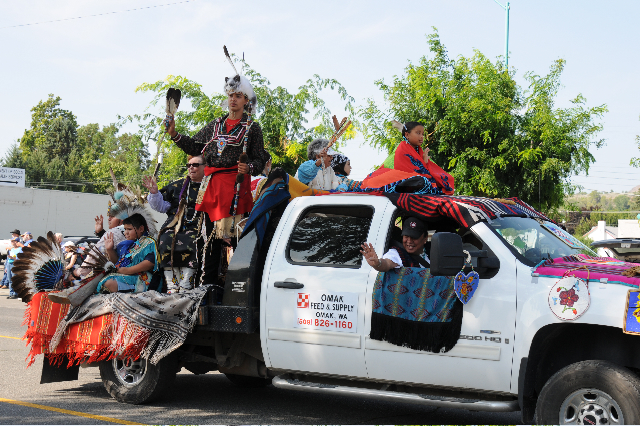
In Omak, I got a taste of Native pride during the Omak Stampede Parade, which mainly featured local businesses, rodeo princesses, groups like firefighters, Republican office holders or candidates, and less than half a dozen Indian floats. (I saw no Latino groups in the parade, despite their large presence picking fruit and in agriculture–they “officially” number about 15 percent of Omak’s residents.)

A Native float at the Omak Stampede parade.
Some of the many teepees at the Native encampment at the Stampede.

The Stampede features a tribal encampment with teepees and a performance area where tribal members perform traditional dances and song in gorgeous costumes.  It reminded me a lot of Alaska, particularly the many gatherings I saw there, including the largest conference called the Alaska Federation of Natives Annual Convention. Yup, I was definitely in Indian country.

My only real, true regret was that I missed the Suicide Race, which features some of the state’s finest Native horseman who charge down the steep hill and swim across the Okanogan River on their way to the finish inside the Omak Stampede stadium. You can watch it on YouTube, and note some times, yes, horses have died in this race.

A travelogue about Siberia paints a vivid picture of beauty and pain

It is often through really good travel writing that I am exposed to the world around me, more than from stories I gather from the news media. Perhaps it requires a personal perspective on places, people, and problems to make another land or culture come alive. That is what happened for me when I read Ian Frazier’s Travels in Siberia.

His travelogue, covering five separate trips to Siberia, and other parts of Russia, over a nearly 15-year period makes this region and its people and history suddenly meaningful, even though I have never stepped foot in Siberia. (I once flew less than 50 miles from its easternmost point, however.) As Frazier notes: “A tiny fraction of the world’s population lives in Siberia. About 39 million Russians and native peoples inhabit the northern third of Asia. … For most people, Siberia is not the place, but a figure of speech.”

Upon finishing Frazier’s book, I was left with great sadness and great curiosity about Siberia. During my six years working and living in Alaska, I had a chance to meet many Siberians who visited Alaska for official government programs. These included Chukotkans, who are linguistically and ethnically related to Inupiaqs of Alaska and the Inuit and Greenlanders. But because I did not speak Russian, I never was able to learn first hand their tales of their province, which lies just across the Bering Straight from Alaska.

I also once worked a year with a former doctor from Novosibirsk, in central Siberia. She had immigrated to the United States and worked in social services. She never talked much of her time there, except to describe persecution of Christians by the Soviets. She gave me an account of one Christian prisoner, who was interned in a Soviet prison in Kamchatka. I have forgotten that book’s name, as I could not read it at that time because it was too depressing a topic. I gave it to a local library, where I hope it was checked out.

Frazier manages to avoid this harshness and allows Siberia’s beauty come alive. And Siberia has that in an order of magnitude greater than most of us can imagine. The tragic side to Siberia’s story, of course, are the penal system of the Tsars, which exiled its enemies to the Russian empire’s eastern provinces, and the gulag system of Josef Stalin’s USSR, one of the greatest prison and killing systems in the history of humanity. The region covers more than 5 million square miles, much with arctic and subarctic climates that give way to brief summer months when mosquitos and gnats reign. It also has the world’s largest forest, the taiga.

During his cross-continental road trip from Leningrad to Vladivostok in the summer of 2001—one of the greatest road trips I have read about—Frazier and his two Russian guides and companions encounter Siberia’s amazing natural beauty, but also the scars of the Soviets’ and Russians’ treatment of their environment. From coal-choked cities to litter-strewn roadways to heavily polluted places in between, Frazier constantly encounters examples of poor or no governance or any form of regulation. He describes empty barrels (used to bring in fuel), which are strewn across the tundra in places as far as the eye can see.

The CIA, which some may not consider to be a neutral arbiter of Russian affairs, notes the following environmental health problems plaguing Russia: “air pollution from heavy industry, emissions of coal-fired electric plants, and transportation in major cities; industrial, municipal, and agricultural pollution of inland waterways and seacoasts; deforestation; soil erosion; soil contamination from improper application of agricultural chemicals; scattered areas of sometimes intense radioactive contamination; groundwater contamination from toxic waste; urban solid waste management; abandoned stocks of obsolete pesticides.” Frazier did not encounter all of these hazards, but certainly confirmed many.

Frazier’s later trip to the Russian Far East in 2005, to Yakutsk, and north along the dilapidated Topolinskaya Highway, finally allowed him to visit a former Soviet gulag, or penal colony. Gulags, or “lager” as they are known in Russia, are where Stalin’s regime sent political prisoners and undesirables by the hundreds of thousands to die in harsh prison conditions and be worked to death building railroads or roads, or mining gold in the most notorious of all slave mine systems, in Kolyma in central Siberia. Gulags played a pivotal role in the Soviet economy. Prisoners in gulags mined one-third of all the Soviet Union’s gold, and extracted nearly all of its coal and timber. The gulag population also numbered about one out of every 50 workers in the Soviet Union.  An estimated 6-9 million persons perished in what is known as the Great Terror, during the purges of the 1930, and the great famine of 1932-33, according to some estimates.  The most famous account of the gulag, of course, is the Gulag Archipelago, the 1973 chronicle of the penal system by the late Aleksandr Solzhenitsyn.

Frazier also details the deteriorating conditions in Russia that is leading to the nation’s depopulation in many cities and communities in Siberia. We catch glimpses of those problems in his sad descriptions of rampant alcoholism and a food safety issues. But Frazier barely touches on the public health catastrophe that is befalling Russia and its Siberian provinces.

According to United Nations (U.N.) figures, the average life expectancy for a Russian man is 59 years, or 166th place. Women can expect to live 72 years. Overall, Russia now ranks 163rd in overall life expectancy. The gap between expected longevity for men and for women-14 years-is the largest in the developed world.

The main killers are: HIV/AIDS, tuberculosis, alcoholism, cancer, cardiovascular and circulatory diseases, suicides, smoking, traffic accidents. The Russian government, according to critics, is doing little to stem the tide.

Tuberculosis deaths in Russia are nearly three times what the World Health Organization (WHO) classifies as an epidemic. What’s more, alcohol consumption per person is twice what the WHO considers dangerous to human health. In addition, more than 1 million people in Russia have been diagnosed with HIV or AIDS, according to WHO figures. Russia also has the 6th highest suicide rate in the world, peaking after the Soviet Union’s collapse.

There are many factors that have led to Russia’s much publicized population decline. According to the Rand Corporation, the collapse of the old Soviet social system in the 1990s was a major factor. In the Soviet era, nearly all health care was provided free by the state, with a system that emphasized the quantity of medical services, not quality of those services. When the centralized economy broke down, the public-health sector fell into a fiscal disrepair without a means of surviving in a market system. According to demographers, Russia’s population has dropped from 149 million a decade ago to just over 144 million today. And, that decline is accelerating.

Despite the gloom that is the public health calamity inside of Russia, and Siberia, I am now intrigued about visiting that vast but very unpopulated space on this planet, just as I was when I first flew over Greenland in 1997 and came back three years in a row to visit the world’s largest island. As Frazier himself says, “Siberia is …  a flyover country. I’m always interested in the thing that people don’t think about. Certain geographic places exist in your brain. You have a sense of Siberia. Everybody knows what they think Siberia is, just like in America everybody knows what they think the American West is.”

Every day can be bike to (fill in the blank) day

Here in the United States, promoters of biking and various groups attempt to rally public awareness around the health, environmental, cost, and multiple other benefits of biking by having “bike to work month” and “bike to work day.” This is important, because these activities can turn the attention of a chaotic media landscape for a brief moment on the incredible versatility and value of biking.

The down side is, once the day, week, or month passes, the next worthwhile cause takes the spotlight, and the public’s attention quickly turns away from biking, and without sustained interest, meaningful policy work and political momentum fizzles. Luckily, I live in a Seattle that at least has a critical mass of cyclists and some more “advanced” infrastructure to help keep cyclists somewhat safe from the perils of sharing roads with vehicles. To Seattle’s credit, it is getting ready to update its bicycle master plan. (For anyone who is from Seattle and who has not taken the survey, please do so.) And nationally, many advocates are working hard to sustain a national movement one community at a time.

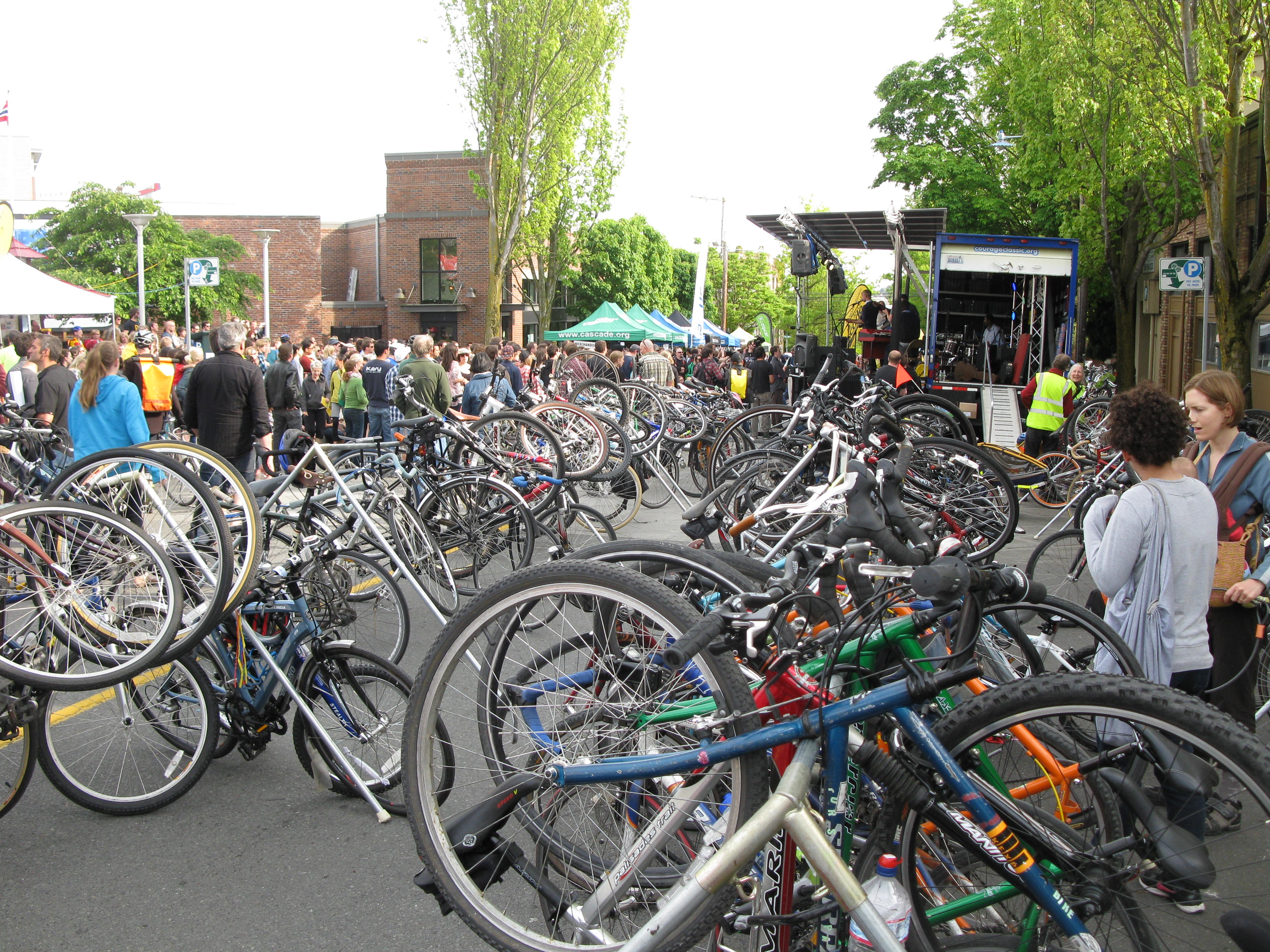
As a highlight of “bike to work day” on May 18 in Seattle, a portion of the Ballard neighborhood was closed to vehicle traffic. Bikers were able to lock their bikes to makeshift bike locks. This is a scene we seldom see in this country because too few businesses and governments support and pay for basic infrastructure to make cycling more doable — such as having secure areas to lock bikes and accommodate them. (This is not the case in every community, and cycling advocates throughout the country are working to ensure new developments accommodate bikes with the right bike racks.)

Celebrating Bike to Work Day in Seattle’s Ballard neighborhood, May 18, 2012.

I remembered my travels to Germany. Even back in the 1980s, I found hundreds of bikes locked outside, in large bike parking areas, that were used during every month of the year, including winter months. I long for the day when bike racks are common in front of every building, and every rack is occupied by a locked bike.

A sea of bikes in in Heidelberg, Germany, December 1985 — winter did not scare these cyclists, and they had a place to park their bikes.

Denmark, a place I could call home

I love Denmark, reportedly the world’s “happiest country.” I could live there. I could die there. In fact, for years I had truly hoped to marry a Danish woman and become part of the extended Danish family.

Well, not all of these happened. I clearly have not died, and I have not married a Danish woman, though I have known many amazing Danish women who impress me by their linguistic abilities, intelligence, dry sense of humor, warmth, and worldliness. They have good schools in Denmark, and Danes have some other quality I cannot fully explain that always has charmed me. They also are very humble despite, overall, being extremely capable (take for example the promotion of wind energy). They also like cozy, or “hygge,” which can mean enjoying each other’s company over an after-dinner coffee and sitting in a living room without any hurry to dash off anywhere. I felt it there, particularly with my friends in Copenhagen and Aarhus.

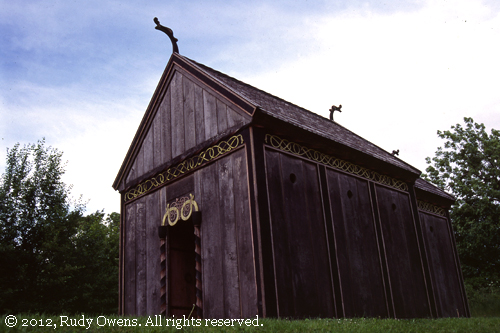
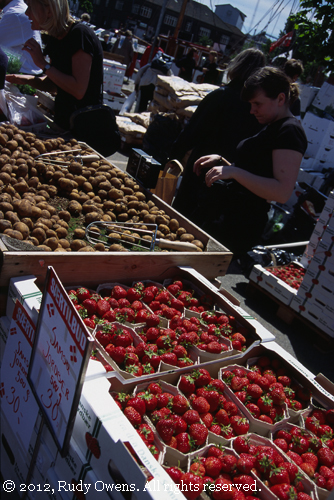
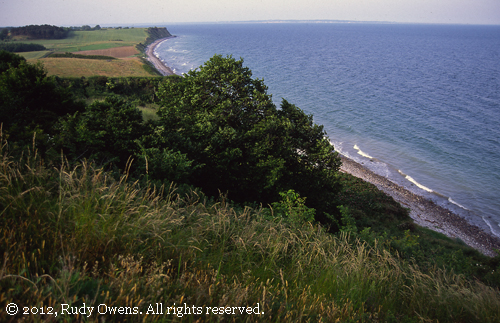
I was very fortunate to have spent about a month in the summer of 2000 living in Aarhus, the second largest city of Denmark, on the Jutland. It is a lovely city, with a world-class university, a great transportation system, great white sand beaches north of the city, and generally very friendly residents. (I just discovered they have published a plan to turn Aarhus into a world-class biking city, with a strong local investment in public spending and planning.) My host, a wonderful Danish pediatrician I had met in Greenland in 1999, took me to some very out of the way places and gave me a place to call home base while I worked on photography projects that summer in Greenland and on the European continent. After 12 long years, I am finally publishing some of those photos here. Hej hej.

What Denmark can teach Snohomish County and other Puget Sound areas

For my current class on management in my public health program at the University of Washington, we are examining the Snohomish County Health District’s strategic plan. Snohomish, just north of Seattle, has nearly 720,000 people. The two top killers in the county are chronic diseases (cancer and heart disease).  The county’s health profile largely mirrors the rest of the nation’s—residents are suffering from obesity and being overweight, they rely heavily on personal vehicle use to travel, and their built environment has been created mostly to facilitate personal vehicle use. (There were 449 vehicular deaths in the county from 2002-08; deaths from unintentional injuries rank as 4th leading killer in the county.)

In short, the county is premised on sprawl development, which encouraged real-estate speculation, all collapsing with a bang when the housing bubble burst in 2008. Such sprawl, subsidized by taxpayer funded infrastructure (i.e., roads to serve the automobile) and extremely cheaply priced energy (gasoline), of course is one of the major factors leading to this nation’s ever-worsening health indicators, such as a rise in type 2 diabetes and bulging waist lines.

By comparison, Denmark, where I visited for more than a month in 2000, has a robust public health system and a healthier population than the United States’, and it spends about half per capita on health care than the extremely inefficient U.S. system. The country has strict land use and planning regulations, and nationally and locally they have a heavily subsidized public transportation system that enables residents to commute to work and their homes by bike, bus, and light rail.

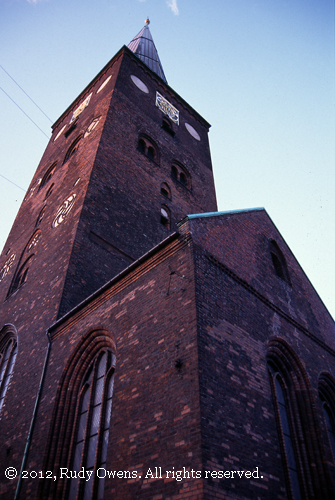
I lived in Riis Skov, just north of Aarhus, the country’s second largest city. Aarhus, even back in 2000, had an incredibly well-designed multi-modal transportation system that encouraged “active transportation” (biking, walking). Today, one can find free bikes in the city.  The downtown area, site of the historic cathedral and main square, by the port, was pedestrian only. Bike paths in all directions from the city were designated in blue painted paths on the streets and with bike charettes or with clear white lines. People rode their low-tech, three-speed bikes everywhere, even in the rain (many did not use bike helmets, interestingly).

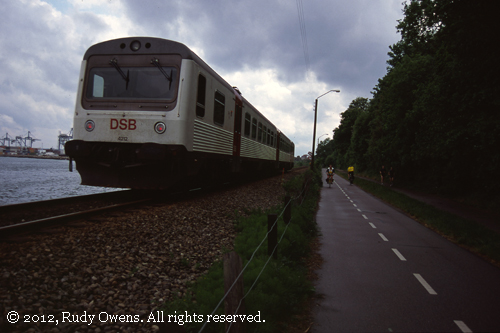
Multimodal planning in Aarhus, Denmark--making it safe for bikes in the city center

Here in Seattle, where I live, we have nowhere near as safe or robust a multi-modal transportation system. There are no blue-painted bike lanes. We have bike lanes painted onto dangerous busy streets, and we lack the sophistication in planning that Aarhus had achieved years before Seattle could build a light rail. We have a lot to learn from our Danish friends. Go Aarhus, go Denmark!

Rails and trails--how residents commute to and from Aarhus, Denmark

Photographing leprosy in the Philippines

In 2003, I visited two leprosy clinics in the Philippines, run by the Philippine Leprosy Mission. One is located near the capital, Manilla, the other operates outside of the second largest city, Cebu City.

Leprosy is not considered a major global health priority, relative to much more serious infectious diseases, such as tuberculosis and HIV/AIDS, or mosquito-borne malaria. Still the World Health Organization (WHO) estimates that more than 200,000 persons, mostly in Africa and Asia, are infected. It’s a bacterial disease, and has been reported well before the time of Christ. The disease mainly affects the skin, the peripheral nerves, mucosa of the upper respiratory tract, and also the eyes. Leprosy is curable and treatment provided in the early stages averts lifelong disability. If it is not caught, it can cause progressive and permanent damage to the skin, nerves, limbs, and eyes. That is the leprosy in the popular imagination. It is the disease that causes deep fear because it is misunderstood.

My photographs were shared with the American Leprosy Mission, which supports these two missions. These were the final product of my trip. The project grew out of a relationship I developed with a Seattle-area physician, working to raise funds to help permanently eliminate the disease, in conjunction with the American Leprosy Mission and supporters in the Philippines.

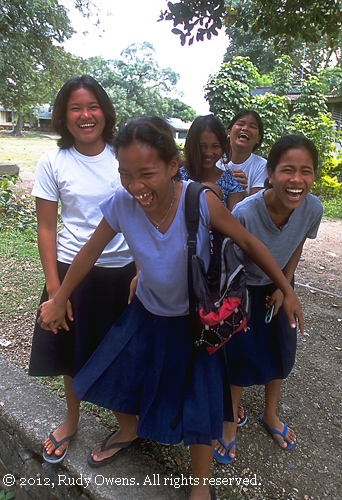
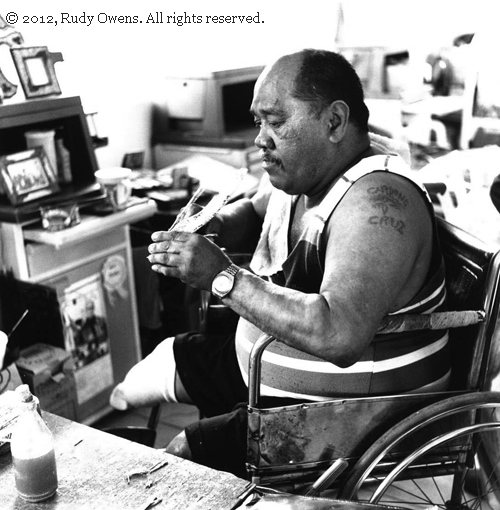
The two photographs shown here were taken at the Eversly Childs Sanitarium, near Cebu City, on the island of Cebu. The facility is home to patients suffering from leprosy, and their children, like the young girls laughing below. Patients served by the Philippines Leprosy Mission are engaged in a variety of activities, including trades that help them earn a living, including this man. This was not my greatest work, and wish I had spent more time getting to meet the residents. This was parachute documentary work, and it shows. However, I think the photos presented residents as themselves, living their lives to their fullest. While outside support is critical to this mission, the place is ably run by Filipino professionals. I remember these smiling young ladies the most. Wonderful people.

Australia, what I saw, and so much more to see

I watched the 2008 old-fashion movie epic Australia last night, a film surprisingly about historic racism Down Under. The film evoked part of my imagination that Australia always filled ever since I read Bruce Chatwin’s travelogue called Songlines. That book profiled the aboriginal concept of Dreamtime. To the subsistence based first Australians, the landscape has special meaning, revealed in songs, transmitted over generations, creating a powerful bond between the people and their land. While living six years in Alaska, I encountered a similar perspective learning about Native Alaskans’ subsistence culture, in which they conceived of their harsh land through cycles of hunting and fishing, a cyclical view and distinctly non-linear.

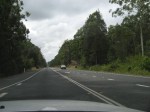
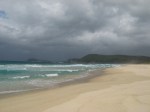
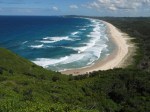
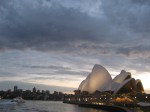
I only saw a sliver of Australia, from Sydney to Brisbane. It would the equivalent of driving from Los Angeles to San Francisco. There is so much more to see. One day I hope to see more.

Memories of Kalaallit Nunaat (Greenland)

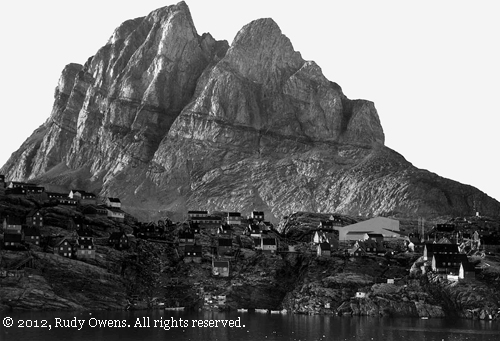
Come next month, it will be 14 years since I first traveled to Greenland, perhaps my favorite destination I have ever been lucky to enjoy. (A summary of my first two visits can be found on my web site here.) I actually visited Greenland on three occasions, last during the late spring/early summer of 2000. That was an incredible trip. I visited with my Greenlandic friends in several communities, including one of the world’s most remote and northernmost cities, Uummannaq (see the rocky island photo below).

This small sample of my images also include young residents of Sisimiut, the second largest Greenlandic city, and on Ericsfjord, in the small community of Qassiarsuk, across the fjord from the small hub city of Narsasuaq, where visitors can land and explore the country’s rich Inuit and Norse cultural traditions. There’s nothing quite like the light, cleanliness, and wide-openness of Greenland, nor the friendliness of its residents.

Arriving at night by ferry at Uummannaq, west coast of Greenland
Young men at fishing camp, near Sisimiut, Greenland
Ericsfjord from Qassiarsuk, Greenland

A few reasons why I loved Italy, its culture, and its history

I travelled to Italy for 10 days in October and November 2006. I loved every minute of my time there, from simple pleasures like drinking cappuccino every morning (and I am not a coffee drinker), to soaking up the country’s warm, lush light in the morning and at sunsets. It does make one think that Rome once ruled from Iraq to the Atlas Mountains of North Africa to northern England to the Black Forest of Germany and to the upper Nile of Egypt. And then, it collapsed. I hope to go back to Italy again.